
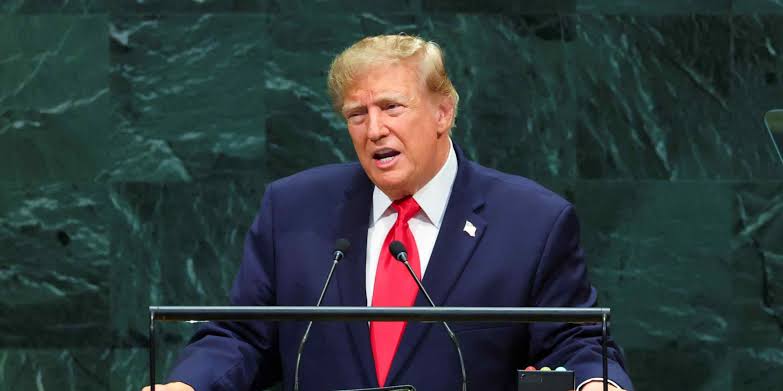
President Trump stood at the United Nations on Monday and told the room he is weighing whether to wipe out a country. He also said he expects a peace deal with that same country, right after the November midterms.
The line
He put the choice to world leaders as two doors.
I have a big decision to make: Will a deal be made with Iran that lets them rebuild and create a far greater country than it ever was before … or do I annihilate the Islamic Republic, and do it quickly?
President Donald Trump, UN General Assembly, September 22
The war is in its seventh month. Trump defended it as the only way to stop Iran’s nuclear program, and asked other countries to squeeze Iran economically until it comes to the table.
The midterm timeline
The prediction is as notable as the threat. Trump said he expects a deal after the November 3 midterm elections.
He also said Jared Kushner and envoy Steve Witkoff met Iranian officials on the sidelines in New York. His readout was thin.
They had a very good meeting, and we’ll see how it turns out.
President Donald Trump
So the administration is talking. It is talking while the president is on a stage describing the alternative as annihilation, and while naming an election as the moment the talking pays off.
What it costs at home
This is not an abstraction for anyone who buys gas.
Brent crude topped $108 a barrel in mid-September after Saudi Arabia shut a key pipeline. Chuck Grassley has been pushing Trump to halt diesel exports to bring domestic prices down, and diesel is what moves groceries and freight.
Trump said a week ago that Iran had reached out and the war might be ending. Oil markets did not believe it then. A speech about annihilation is not the thing that convinces them now.
How allies actually see it
Trump has said repeatedly that America is respected again. There is polling on that, and it does not agree.
Pew surveyed more than 40,000 adults across 36 countries between February and May of this year. The findings:
- A median of 23% say they have confidence in Trump to do the right thing in world affairs.
- About 57% view the United States unfavorably, against 37% favorable.
- Roughly half say the United States is not a reliable partner.
- In Canada, 83% called the US reliable in 2022. Today it is 35%.
- Sweden, the Netherlands and Germany each dropped more than 40 points on the same question.
Those are not enemy states. Those are the countries whose ports, bases and intelligence services the United States relies on when it goes to war.
Pew also found something that should worry any president. Views of the country and views of its leader are now moving together more tightly than they used to. Foreign publics are no longer separating America from whoever is running it.
The BeezLoop Take
Two sentences in the same speech do not fit together. A negotiator with real leverage does not need to announce annihilation from a podium, and a president genuinely about to close a deal does not tell the other side he is considering erasing their government. One of those statements is doing work the other undercuts.
The election timing deserves a straight look. Trump named November 3 as the turn. A deal that arrives right after a midterm, after seven months of war and gas prices people feel every week, is a deal whose schedule was set by something other than Iran. If the terms were available in September, Americans paid for the delay at the pump. If they were not, then the prediction was never based on anything.
On the respect question, there is now a number instead of an argument. Twenty-three percent confidence across 36 countries. Canada going from 83 to 35 on whether America can be counted on. Allies deciding the United States is unreliable is not a public relations problem. It is the thing that determines whether anyone flies with you, sells to you, or shares what their spies know.
The war itself has gone on long enough that its original justification deserves the same scrutiny. Seven months in, the administration is still describing the nuclear program as the reason. It has not laid out publicly what the strikes have actually set back, or what an end looks like short of the two doors the president offered.
The question
If a deal is coming in November, what changes on November 4 that was not true in September? And when an ally says out loud that America cannot be counted on, is that their problem to fix or ours?
Sources: Axios · NBC News · CBS News · Pew Research Center · Detroit News