
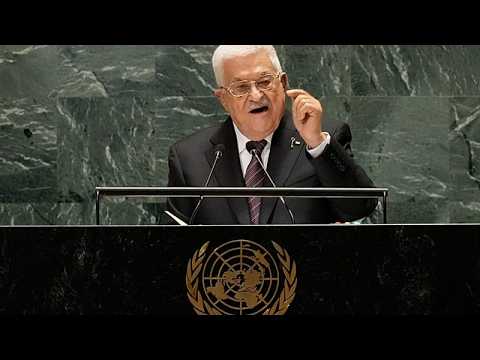
Mahmoud Abbas addressed the United Nations on Thursday from a screen. For the second year in a row, the United States did not give the Palestinian delegation visas to get to New York.

The visa denial
The UN headquarters is in Manhattan, which means the US controls physical access to the General Assembly. Abbas said so plainly.
For the second consecutive year, the Palestinian delegation was denied the entry visas required to reach New York and participate in the meetings of the United Nations General Assembly in person.
Mahmoud Abbas, in his recorded address
So he spoke by prerecorded video, to a hall he was not allowed to enter.
What he said
He called the present moment one of the most dangerous periods in Palestinian history, pointing to the war in Gaza and long-running military occupation in the West Bank.
He accused Israel of genocide in Gaza. He said Palestinians will not be displaced and will not disappear. He said he remains committed to a two-state outcome and that peace runs through a Palestinian state.
And he made a specific ask: full membership in the United Nations, not the observer status the Palestinians currently hold.
The timing is not accidental. Several European governments formally recognized a Palestinian state over the past week.
The reception
He got a long round of applause.
The contrast with the next day was stark. When Benjamin Netanyahu took the podium in person, roughly 77 delegations walked out and he told the ones who stayed that anyone else who wanted to leave should go.
One man addressed the body on a screen because he could not get in, and the room applauded. The other was in the room, and the room emptied.
What full membership would and would not do
Worth being clear, because the phrase gets used loosely.
Palestine currently has non-member observer state status, granted in 2012. That allows participation but not a vote in the General Assembly.
Full membership requires a recommendation from the Security Council, where the United States holds a veto. That is the whole obstacle. No amount of General Assembly sentiment changes it.
So the request is largely symbolic as a matter of process, and entirely real as a matter of pressure. Abbas is asking the countries that just recognized Palestine bilaterally to make Washington the only thing standing in the way.
The BeezLoop Take
Denying visas to a delegation invited to the United Nations is the part of this that should bother Americans regardless of what they think about Gaza. The US agreed, as a condition of hosting the UN, to let delegations reach it. Doing this once could be argued as a one-off. Doing it two years running is a policy, and it means the host country is deciding who gets heard in a building that is supposed to be outside its control.
That is a bad precedent that cuts in every direction. A future administration with different enemies inherits the same tool. Anybody cheering this because they dislike Abbas should ask which delegation gets blocked next and by whom.
Abbas is also not a sympathetic figure to a lot of Palestinians, and pretending otherwise would be dishonest. He is in his twentieth year of a four-year term. There has been no Palestinian presidential election since 2005. When he asks for full UN membership on behalf of a people, it is fair to note that those people have not had a chance to say whether he speaks for them.
The applause is worth reading carefully too. A standing ovation for a leader nobody elected recently, delivered by a hall that then walked out on a leader who faces voters, is not a clean verdict on democracy. It is a verdict on Gaza, and the delegates in that room were expressing something about the war, not endorsing Abbas as a governing figure.
The two-state line is the one that has gotten quietest. Abbas repeated it. European governments recognizing Palestine are formally endorsing it. Netanyahu called that recognition a mark of shame. Nobody in that hall this week described a concrete path from where things are now to two states, and the recognitions do not create one by themselves.
The question
Should the country hosting the United Nations be able to decide which delegations physically reach it? And what does recognition of a Palestinian state accomplish if the leader accepting it has not faced an election in twenty years?
Also this week: Trump threatened to annihilate Iran from the same podium, and the US and China extended their trade truce.
Sources: UPI · Boston Globe · Jewish Telegraphic Agency · PBS NewsHour