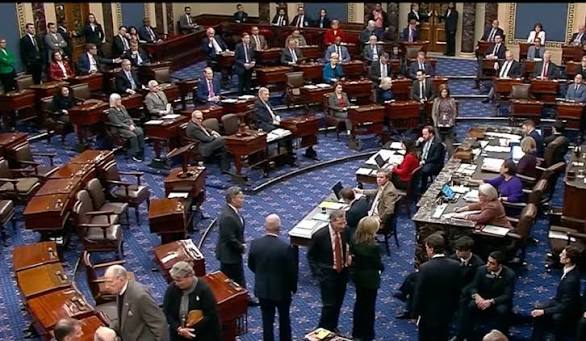
The Senate voted Thursday on whether to make Donald Trump pull American forces out of the Iran war without congressional approval. It failed, 49 to 50.
Two days on, the vote itself is settled and the thing it exposed is not. Forty-nine senators put their names to the position that a seven-month war needs congressional sign-off, and the chamber has no plan to do anything about it before November.
Who crossed
Four Republicans voted for the resolution:

- Susan Collins, Maine
- Lisa Murkowski, Alaska
- Rand Paul, Kentucky
- Thom Tillis, North Carolina
One Democrat voted against it: John Fetterman of Pennsylvania.
One senator did not vote. Angela Alsobrooks of Maryland was absent for a family matter. She had supported similar resolutions before.
What the resolution would have done, and would not have
This is the part that gets skipped, and it matters.
The measure was a concurrent resolution. That kind does not go to the president for a signature and does not carry the force of law. An affirmative vote would have directed Trump to remove US forces from hostilities with Iran absent explicit congressional authorization, but as a statement rather than a binding command.
So the vote was symbolic. That does not make it meaningless. It makes it a record of where fifty senators stand, seven months into a war Congress never declared.
It was also described as the final war powers vote before the midterms.
The war it is about
The Iran war is in its seventh month. Trump told the UN this week he might annihilate Iran, while predicting a deal right after the November 3 elections.
The costs are not abstract for anyone who buys fuel. Diesel hit a record $6.529 a gallon in the EIA reading for the week of September 21, up $2.78 in a year. It was $3.76 when the war began in late February.
That is the backdrop Marjorie Taylor Greene has been filming at gas pumps, and part of why household budgets are stretched.
The BeezLoop Take
The vote count is the story and almost nobody will report it that way. Forty-nine senators went on record saying a president needs congressional authorization to keep fighting a war in its seventh month. That is not a fringe position, it is one vote short of half the chamber, and it included four Republicans.
The constitutional question here has no partisan home and should not be treated as though it does. Congress holds the power to declare war. It has not used it since 1942, and every administration of both parties has spent eighty years finding ways around that. Democrats who are outraged now were mostly quiet during Libya, and Republicans who are quiet now were loud during Benghazi. The principle only counts if it survives your own party holding the pen.
That said, this particular vehicle was designed to fail safely and everyone involved knew it. A concurrent resolution does not bind anybody. Members got to record a position without creating a consequence, which is the most common thing that happens in that building. If the Senate genuinely wanted to end the war it would attach the restriction to an appropriation, because money is the only lever that has ever worked.
Fetterman deserves to be named plainly rather than treated as a curiosity. He was the only Democrat to vote with the administration on continuing a war his party overwhelmingly opposes, and voters in Pennsylvania are entitled to a fuller explanation than the vote itself provides. The four Republicans deserve the same attention in the other direction. Collins, Murkowski, Paul and Tillis broke with their president on a war during an election year, which costs something.
And the timing is what it is. This was the last war powers vote before the midterms, which means the next real reckoning over the Iran war happens at the ballot box while diesel is $6.50 a gallon. Congress declined to decide. Voters get it instead.
The question
If 49 senators say a seven-month war needs congressional authorization, what exactly does Congress think its war power is for? And when the only vote available is one that cannot bind anybody, is that oversight or performance?
Sources: NPR · CNBC · Washington Post vote tracker · Democracy Now