

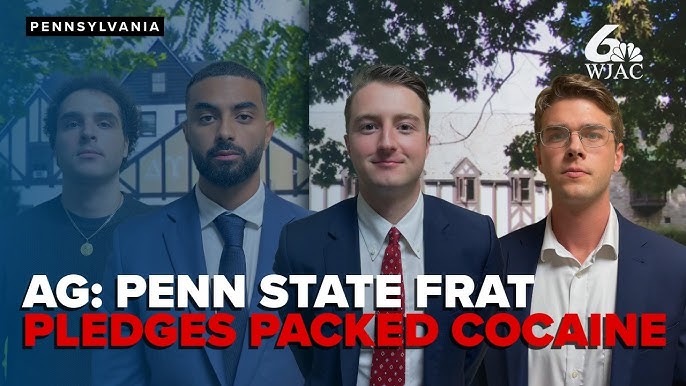
Pennsylvania Attorney General Dave Sunday announced felony charges Monday against 14 people, including 13 current or former Penn State students, following a grand jury investigation into a cocaine trafficking operation centered on two off-campus fraternities. Prosecutors say the ring ran from 2023 to 2024, moving large quantities of cocaine from Philadelphia and New York into State College, where it was cut, packaged, and sold, mostly to Penn State students.
According to the grand jury presentment, the two alleged ringleaders were Agostino Abbatiello, 24, of Westbury, New York, and Thomas Robinson, 23, of Pittsburgh, senior members of the fraternities Sigma Chi and Delta Upsilon respectively. Investigators say the two made regular supply runs to Philadelphia and New York, and that packaging work happened inside the fraternity houses themselves, carried out by fraternity brothers and, allegedly, by pledges as part of their initiation.
Pledging as Alleged Labor
The detail drawing the most attention is what prosecutors say packaging cocaine became for some pledges: not a side task, but part of how they were initiated into the fraternity. Two other defendants, Mohammed Hurabi and Lars Zeepvat, face felony corrupt organization and conspiracy charges as alleged primary dealers in the operation; both were released on $500,000 unsecured bail.

A 14th defendant isn’t a student at all. Paul Robinson, 59, Thomas Robinson’s father, is charged with tampering with evidence, hindering apprehension, and obstructing the investigation, accused of trying to conceal a safe containing drugs and cash as the case closed in. He was released on $1 million unsecured bail, with a preliminary hearing scheduled for September 2.
All of this is still allegations at this stage. Every defendant is entitled to a presumption of innocence, and the case will be tested in court, not in a grand jury presentment.
A University Response That Raises Its Own Questions
Penn State has placed Delta Upsilon on interim suspension and noted that Sigma Chi already operated without university recognition, meaning it fell outside the school’s direct oversight. That’s a real distinction administratively, but it doesn’t fully answer the more basic question: how did a multi-kilo trafficking operation, with regular interstate supply runs and dozens of alleged distributors, run inside student housing next to campus for roughly two years without drawing scrutiny?
Universities have gotten good at building visible, well-funded infrastructure around campus safety messaging. Cases like this are a reminder that visibility and effectiveness aren’t the same thing, and that the parts of student life happening furthest from official oversight are often exactly where the biggest risks end up concentrated.
🔥 Inside the Penn State Cocaine Ring Charges:
What do you think? Does this case show a real gap in how universities monitor off-campus Greek life, or is this simply criminal activity no oversight system could have realistically caught? Let us know your thoughts in the comments on BeezLoop.com!
Related coverage: CBS Pittsburgh.
Related from BeezLoop: Eight Shot at a Florida Memorial Gathering, Looksmaxxing's Biggest Streamer Is Charged With Rape and A Grand Jury Called It a Drowning.






[…] Related: two Ole Miss students were found dead with kratom at both scenes, and fourteen were charged in a cocaine ring tied to Penn State fraternities. […]