
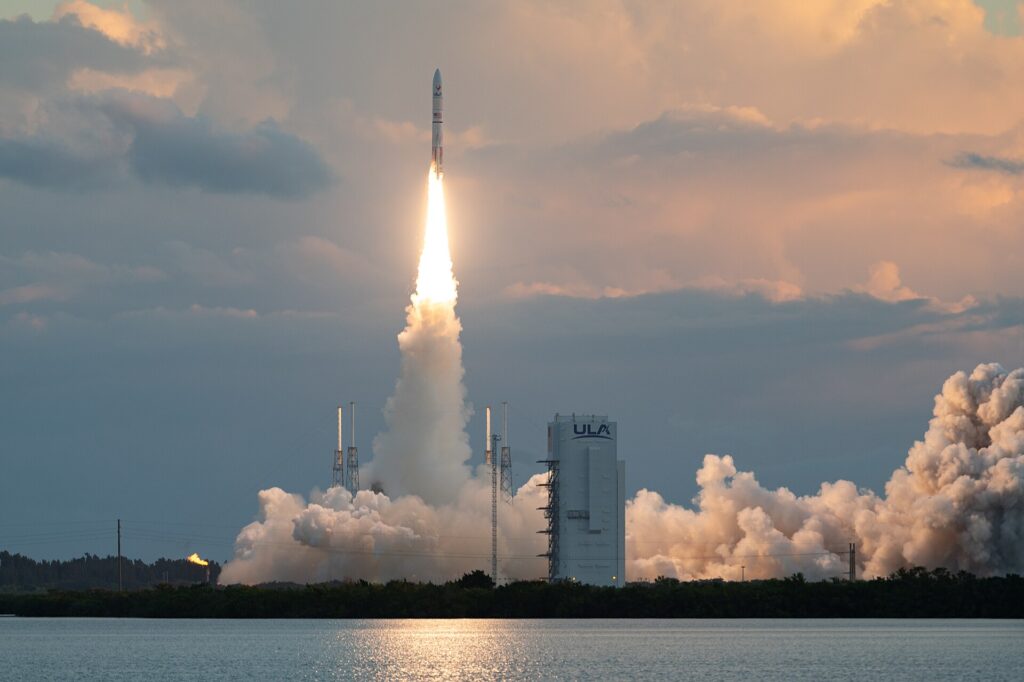
A United Launch Alliance Vulcan rocket failed Sunday about 10 minutes after lifting off from Cape Canaveral, and all 40 Amazon Leo internet satellites aboard were lost. It’s the first mission ULA has lost since the company was formed in 2006. “Today, we did not meet that standard,” ULA said, The Next Web reported.
It was the first of 38 Vulcan launches Amazon bought to build Leo, its answer to SpaceX’s Starlink, and it was Vulcan’s return to flight after months on the ground.

What went wrong with the Vulcan launch?
The rocket lifted off at 12:40 p.m. Eastern from Space Launch Complex 41. About 10 minutes in, something failed. Ars Technica’s sources said the main stage’s two BE-4 engines, made by Jeff Bezos’s Blue Origin, kept firing at least 30 seconds past their planned shutdown and the rocket began to spin. Reuters reported it was unclear whether the engines were to blame. ULA said it doesn’t have “any specific data yet,” and Blue Origin is helping investigate.

Amazon took it in stride in public. “There is risk with any launch, and that’s especially true for inaugural missions like LV-01,” the company said, calling ULA a “trusted partner.”
What does this mean for Amazon’s Starlink rival?
It’s a setback Amazon can’t easily afford. Leo had about 400 satellites in orbit before Sunday and needs more than 3,200 for its first-generation network. Amazon already missed a July deadline to have half its network up, and the FCC gave it more time while stripping some of its spectrum priority. The full network is due by July 2029. Amazon’s next launch, 36 satellites on a European Ariane 6, is set for no earlier than Nov. 23.
Meanwhile SpaceX keeps launching Starlink on its own rockets and has stopped taking new Falcon 9 bookings from outsiders. For anyone hoping a second satellite internet option would bring prices down, especially in rural areas, Sunday pushed that further out.
Why does a rocket failure matter beyond Amazon?
Vulcan is one of only two rockets the Pentagon relies on for most national security launches, alongside SpaceX’s. The Defense Department hadn’t yet cleared Vulcan to resume those missions and was waiting on Sunday’s result. Another grounding leaves the U.S. military leaning even harder on one company. NASA’s administrator posted that the nation needs ULA and offered help.
It also hits Florida’s Space Coast, where ULA and Blue Origin both build and launch rockets and where the pace of launches drives the local economy.
The BeezLoop Take
Launch failures happen, and Amazon is right that new missions carry risk. But this one exposes a bigger problem: America’s access to space now depends heavily on SpaceX, and every setback for a competitor tightens that grip.
That’s not a knock on SpaceX, which has earned its lead. It’s a warning about having no backup. The Pentagon and Amazon both need Vulcan flying reliably, and the investigation needs to be fast and public.
The open question: is this a one-time engine problem ULA can fix in weeks, or a deeper issue that grounds Vulcan into next year?
Sources: The Next Web · CBS19 (video)