
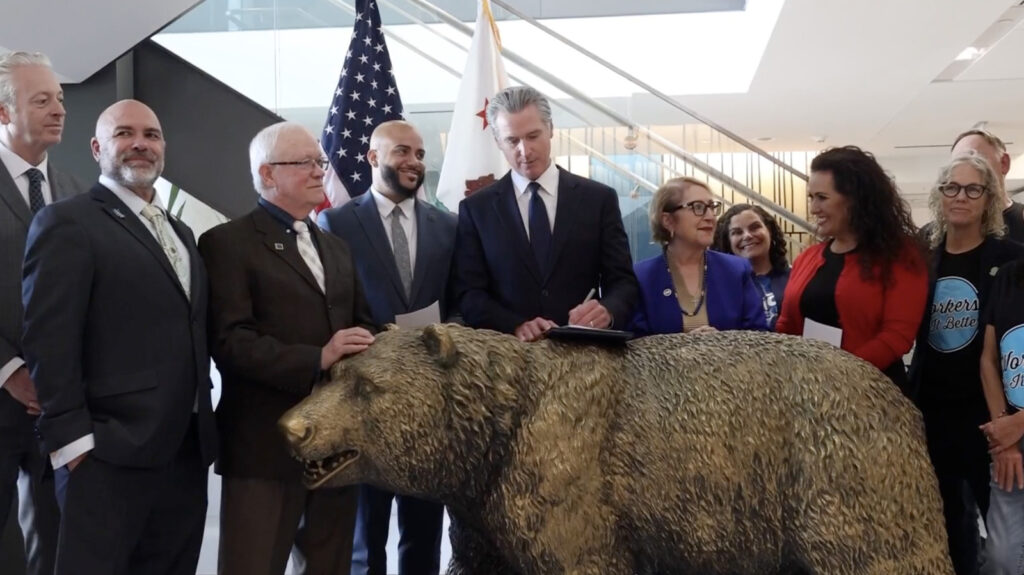
California employers won’t be allowed to let an AI system alone fire or discipline a worker. Gov. Gavin Newsom signed the No Robo Bosses Act (SB 947) on Wednesday, a year after he vetoed an earlier version. The law requires a human to check any firing or discipline decision that mainly relies on AI, and to tell the worker in writing. It takes effect July 1, 2027.
Its backers say it’s the first law of its kind in the country. It’s also exactly the kind of state AI rule the Trump administration has said it wants to stop.
What does California’s No Robo Bosses Act require?
The law covers “automated decision systems,” defined broadly as tools built on machine learning, statistics, data analytics or AI that produce outputs used in employment decisions. Spam filters and calculators don’t count. If an employer leans mainly on one of those systems to discipline or fire someone, it has to:

- Have a human independently check the decision using other information, like performance reviews, work samples, personnel files or witness accounts.
- Tell the worker in writing that an automated system was a main factor and that a person reviewed it.
- Explain the data. Workers can request information about what personal data the system used.
- Name a human contact the worker can go to.
Employers also can’t use these systems to guess at protected traits like race or disability, or to retaliate against workers for using their legal rights. The state labor commissioner, the attorney general and local prosecutors can enforce it. Union contracts with their own algorithm protections can qualify for a waiver.
No worker should ever be fired or disciplined by a robo boss. … AI must remain a tool controlled by humans, not the other way around.
Sen. Jerry McNerney, D-Pleasanton
Why did Newsom sign it this time after vetoing it in 2025?
Newsom vetoed McNerney’s first version, SB 7, last year, saying its notification rules were too broad. When McNerney brought the bill back in February, he cut the requirement to warn workers in advance that AI would be used, and he dropped coverage of gig workers. That’s what got it signed.
Labor backed it hard. The California Federation of Labor Unions, AFL-CIO sponsored the bill. Business groups, including the California Chamber of Commerce, kept opposing it to the end, arguing that phrases like “primarily relies” aren’t defined clearly enough for employers to know when the law applies.
Today, California’s workers and our unions have changed the national narrative on how Americans can fight back and win against AI taking over our jobs and workplaces.
Lorena Gonzalez, president, California Federation of Labor Unions
Can the Trump administration block California’s AI law?
It’ll probably try. In December 2025, President Trump signed an executive order directing the Justice Department to set up an AI Litigation Task Force to challenge state AI laws the administration considers burdensome, and tying some federal funding to whether states enforce them. Employment rules covering hiring, monitoring and firing are squarely in its sights, according to the law firm Fisher Phillips.
But an executive order doesn’t wipe out state law on its own. Only Congress or a court can do that. Until one does, California employers have to follow SB 947. We wrote about the administration’s approach yesterday: Trump does have an AI policy. It is stopping states from having one.
For comparison, Illinois already requires employers to disclose AI use in some employment decisions, but it doesn’t ban AI-only firings. California’s law goes further.
The BeezLoop Take
This law asks for very little, and that’s the strongest argument for it. It doesn’t ban AI at work. It doesn’t stop a company from using software to flag problems. It says that before a machine’s output costs someone a job, a person has to look at the evidence and put their name on the decision. Most workers would assume that’s already how firing works.
The business complaint about vague wording has some merit. “Primarily relies” will get argued over in court, and employers deserve clear rules. But that’s a reason to write guidance, not to let software fire people with no review.
The cuts that got it signed matter too. Dropping gig workers leaves out the people most likely to be managed by an app already. Rideshare and delivery drivers can be cut off by an app with little human involvement, and this law doesn’t reach them. Labor won a real fight here, but it gave up the group that needed protection most.
The open question is whether the law survives long enough to take effect. Between now and July 2027, it has to get past a Justice Department task force created specifically to stop laws like it.
Also on BeezLoop: Starbucks is closing 250 stores and calling them ‘underperformers’.
Sources: Office of Sen. Jerry McNerney · National Law Review · Quartz · Fisher Phillips