
At 12:01 this morning, roughly a billion dollars of Canadian goods stopped being allowed into the United States. Not taxed. Banned. The law being used to do it is 96 years old and no president had ever used it before this year.
What is banned
Sixty-eight product lines, worth about US$1 billion a year, effective 12:01 a.m. Eastern today.
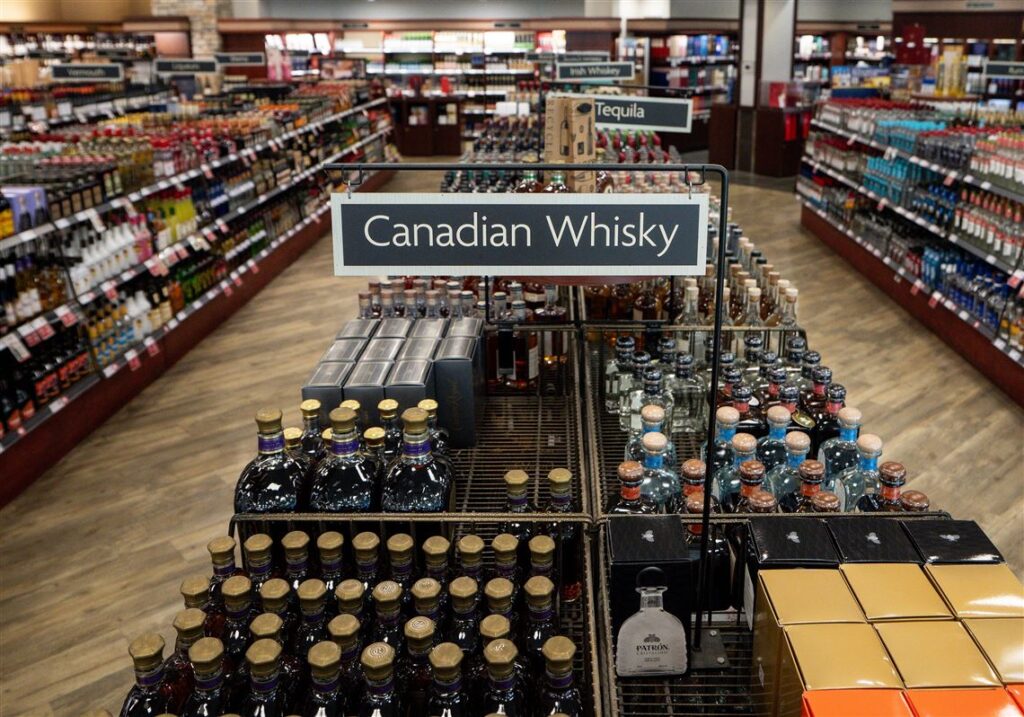
- Most Canadian alcoholic beverages, including beer, wine and spirits.
- Specified dairy-related products, including whey.
- Molasses.
- Motorcycles and mopeds over 800 cc.
The difference between this and a tariff is the entire point. A tariff makes a product more expensive and leaves the buyer a choice. A ban removes the option. The goods cannot enter at any price.

The law nobody had used
The authority is Section 338 of the Tariff Act of 1930.
It lets a president impose extra duties on a country that discriminates against US commerce, and, if the discrimination continues after a first proclamation, exclude that country’s products from the United States entirely.
It has been on the books since 1930. According to the Congressional Research Service, this administration is the first to expressly invoke it to impose tariffs. The escalation to an outright ban is a further first.
The sequence:
- August 22: 50% tariffs on roughly 5% of Canadian imports, citing treatment of US dairy, alcohol and auto industries.
- Canada retaliates.
- September 8: Trump signs five proclamations under Section 338, imposing bans and revising the tariff lists.
- September 15: the tariff modifications take effect.
- September 29: the bans take effect.
How much this actually costs
Worth being honest about scale in both directions.
A billion dollars is a rounding error against roughly $400 billion a year in Canadian goods crossing into the US. Most analysts put the macroeconomic effect at close to nothing, and you are unlikely to notice it at the grocery store.
It is not a rounding error if you are a distillery in Ontario, a whey processor in Quebec, or one of the Canadian manufacturers that builds large-displacement motorcycles. For those firms the American market did not get harder. It closed.
At least one Canadian whisky producer has already reported finding a workaround.
The BeezLoop Take
The dollar figure is the least interesting thing here and the precedent is the most. A statute sat unused for 96 years because every administration of both parties concluded it was too blunt to touch, and the tool that replaced it, tariffs, at least leaves a market functioning. This White House picked the instrument everyone else left in the drawer, and it worked, in the narrow sense that the goods are now stopped.
What makes it a precedent rather than a one-off is how little resistance it met. Section 338 requires a presidential finding that another country discriminates against US commerce, and the president makes that finding himself. There is no vote, no agency proceeding anyone outside the executive branch controls, and no obvious ceiling on what counts as discrimination. If beer and whey clear that bar, it is difficult to name a product that could not.
And the target is the part that should make people uncomfortable regardless of what they think about trade policy. This is Canada. Not a rival, not a sanctions case, the country Americans share the longest undefended border on earth with and roughly $400 billion a year in trade. The first use of an emergency-grade exclusion power in nearly a century went to an ally over dairy rules and liquor board shelf space, which tells you the threshold was never really about the severity of the offense.
The honest counterargument deserves space: Canada does protect its dairy sector aggressively through supply management, provincial liquor boards genuinely do disadvantage American producers, and US administrations have complained about both for decades without getting anywhere. Trump is not inventing a grievance. The question is whether a grievance that survived thirty years of negotiation justifies the first use of a power Congress wrote for genuine economic warfare.
Our read is that the ban will be remembered less for the billion dollars than for establishing that the drawer opens. Whoever is president next has the same statute, the same unilateral finding, and now a precedent showing it can be used on a friend.
The question
If a 96-year-old emergency trade power can be used against Canada over whey and beer, what is left that it cannot be used for? And does anyone other than the president get a say before the next one?
Related: Trump blamed China for fentanyl and then gave Xi an arrival ceremony.
Sources: Congressional Research Service, R49349 · BNN Bloomberg · PwC trade alert · Dorsey & Whitney client alert · White House fact sheet