

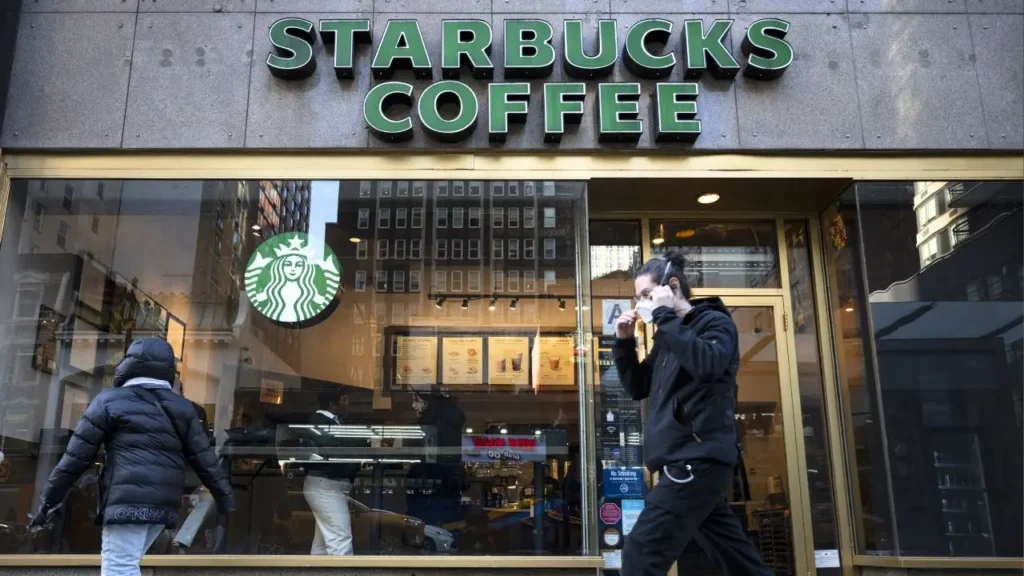
Starbucks is closing about 250 North American stores this week. The company says they were underperforming. The question worth asking is whether that is a Starbucks problem or a customer problem.

The numbers
- About 250 North American coffeehouses closing this week.
- That is about 1.4% of a North American footprint of 18,371 stores as of the end of June.
- Roughly $300 million in restructuring charges, split $200 million cash and $100 million non-cash.
- Most closures done by the end of 2026.
The company’s explanation is that the locations did not deliver the experience it wants for customers and partners, or were not financially viable.
Twenty of the 250 are unionized stores, which is 8% of the closures. Starbucks says it will move employees to other stores where it can, and provide severance where it cannot.

This is the second round
It is not a one-off, and the pattern is what makes it readable.
- September 2025: Starbucks said it would shrink its North America store count by 1% and laid off 900 nonretail employees.
- May 2026: another 300 corporate workers cut.
- September 2026: this round.
All of it sits under a turnaround plan called Back to Starbucks, run by chairman and CEO Brian Niccol, who arrived in September 2024.
The case that it is really about Starbucks
There is a strong version of the company’s argument and it deserves a fair hearing.
Starbucks overbuilt. For years it opened stores aggressively, including locations within a few blocks of each other, on the theory that convenience wins. That works until the stores start eating each other’s business.
The mobile order boom also broke the physical design. Cafés built for people to sit in became pickup counters with crowds of drivers waiting, which is worse for everyone and is exactly the experience problem Niccol keeps naming.
Closing 1% of a footprint is a small pruning, not a retreat. Companies do this routinely and healthy ones do it more decisively.
The case that it is about the customer
And there is a real version of this too.
A daily Starbucks habit is one of the first things to go when a household tightens up, and households are tight. Consumer sentiment is near a record low. The 10-year Treasury hit 5.12% this week, pushing borrowing costs up. Health insurers want 15% more next year. Diesel is at a record $6.529, which feeds into the price of everything on the shelf.
Discretionary five-dollar purchases are the most sensitive line in a household budget because they are the easiest to cut without anyone noticing.
The BeezLoop Take
Both things are true and the framing that forces a choice between them is wrong. Starbucks genuinely overbuilt, mobile ordering genuinely broke the store format, and a 1% trim is genuinely routine. Anyone reading 250 closures as the economy collapsing is overreading a rounding error on 18,000 stores.
But the company gets to choose its words and underperforming is doing convenient work. A store underperforms when not enough people walk in and spend. Sometimes that is because the store is badly placed. Sometimes it is because the people who used to walk in are counting money differently than they did two years ago. The press release does not distinguish, and it does not have to.
Watch the corporate layoffs rather than the stores. Nine hundred nonretail jobs last September, 300 more in May, and now another round of closures. A company confident that demand is fine does not keep cutting the people who plan for the future. That is a balance sheet being managed downward on purpose, and it has been going on for a year.
What we would not do is hang this on any president. Starbucks overbuilt under one administration and is closing stores under another, and the mobile-order design problem is nobody’s policy failure. The honest version is that a company made its own strategic errors and is now correcting them into an economy that gives it no cushion for the correction.
The people who actually pay for this are the baristas. Starbucks says it will transfer them where it can and pay severance where it cannot, and that is more than many employers offer, so give it to them. But a transfer is only worth something if there is another store within driving distance, and in the markets being thinned out there may not be. The detail worth holding is that 20 of the 250 are unionized, 8% of the closures, in a company that has spent years fighting its own unionization drive. Starbucks says viability drove the list. It has not published the math, and until it does, the people whose stores organized are entitled to wonder.
The question
Is closing 1% of your stores good management or an early warning? And when a company says a location underperformed, how would anyone outside the building tell the difference between a bad store and a broke customer?
Sources: CNBC · CNN Business · Restaurant Dive · Retail TouchPoints