
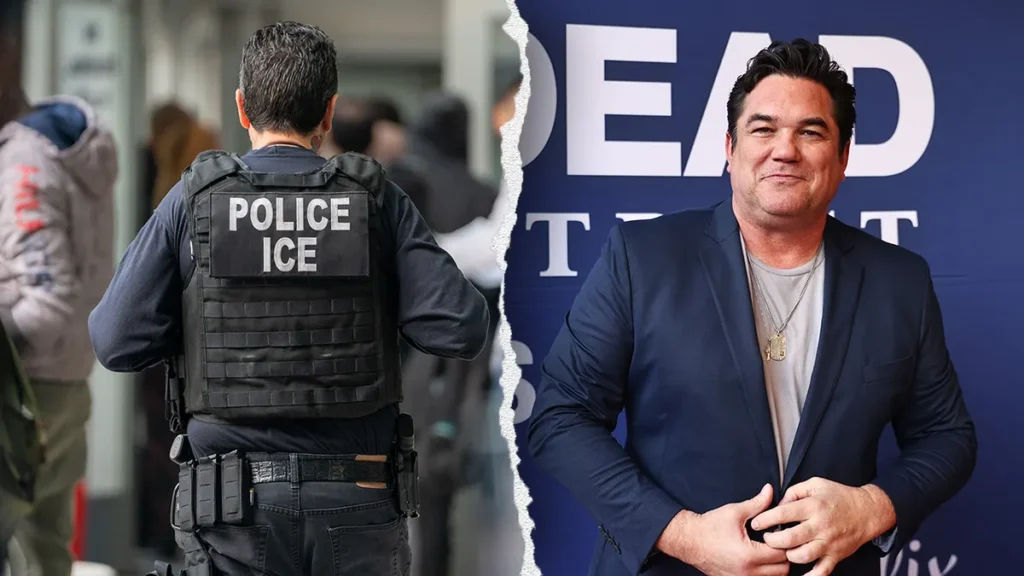
Dean Cain played Superman on television in the nineties. In August 2025 he announced he was joining ICE. At CPAC this year he defended it. He is 60, he has a podcast called The Homeland, and he has a production company. None of that is an accident, and the pattern is worth understanding rather than just mocking.
The concrete case
- Cain announced on Fox News on August 6, 2025 that he was signing up with ICE, after posting an ICE recruitment video.
- At CPAC 2026 he doubled down, framing it against people who he said shrieked to defund the police.
- He founded Proud American Studios.
- He hosts a podcast called The Homeland.
The economics nobody says out loud
Here is the part that explains the pattern better than psychology does.
A working actor in his fifties or sixties who is no longer getting leads faces a specific problem: the audience that knew him is aging, the industry that employed him has consolidated, and the roles are gone. The options are character work, conventions, or something else.

The something else is a genuinely functional career. Conservative media has an appetite for recognizable faces that dramatically exceeds its supply of them. A former network lead brings name recognition that no political commentator can buy, and in exchange gets bookings, a speaking circuit, a podcast audience with high advertiser value, and, crucially, an identity as a brave truth-teller rather than an actor whose phone stopped ringing.
That is not a conspiracy. It is a labor market with an opening in it.
The BeezLoop Take
The mockery aimed at these figures is mostly about status and it mostly misses, which is why it never lands and never stops. Calling someone a washed-up third-rate actor concedes the premise they are working from, that Hollywood discarded them for their politics, and hands them the grievance the whole enterprise runs on.
The accurate version is less satisfying and more useful. There is a real market inefficiency here: conservative media needs famous faces and Hollywood produces people who used to be famous and are now available. Both sides get something. The audience gets a celebrity who validates them, the celebrity gets relevance and income, and the only thing being sold is the impression that a culture war drove a talented person out rather than an industry that stops calling almost everyone at fifty.
Cain is the case where this stops being a media-economics observation, though, and that distinction matters. Hosting a podcast is a career move. Actually joining an armed federal enforcement agency in your sixties is not a bit, and treating it as one is a mistake. Either it is real, in which case a 60-year-old actor is doing immigration enforcement and that deserves scrutiny on its own terms, or it is largely promotional, in which case ICE participated in a publicity arrangement and that deserves scrutiny too. Nobody is asking which.
The part worth criticizing from the left, honestly, is the reflex that produced this supply in the first place. An industry that treats a mild political heterodoxy as a hiring problem creates the exact grievance pipeline it complains about. Hollywood did not make Dean Cain join ICE. But the confident assumption that there is no cost to freezing people out has been wrong for about a decade now, and the receipts are a whole cable ecosystem staffed by people who used to work in it.
The question
Is a sixty-year-old actor joining a federal enforcement agency a career move, a genuine commitment, or a recruitment campaign, and why has nobody made ICE answer that? And how much of this pipeline exists because the other industry stopped calling?
Related: Nicki Minaj is telling young people to vote Republican.
Sources: The Hollywood Reporter · The Hill · Fox News · U.S. Immigration and Customs Enforcement