

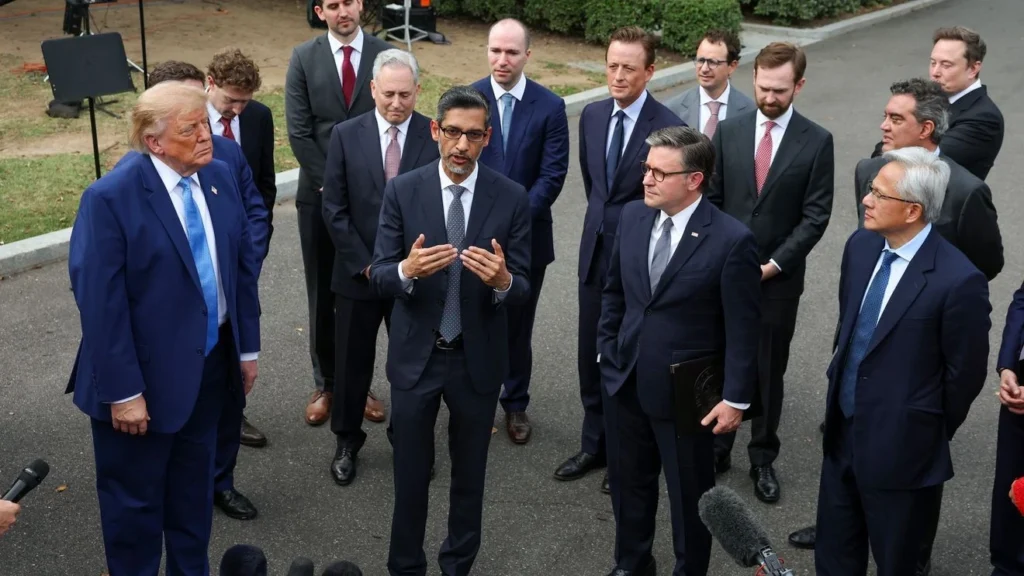
The premise of the question is slightly off. Trump does have an AI policy, and it is aggressive. It just runs in the opposite direction from what people mean by regulation: the federal government is actively working to stop the states from regulating AI.
Disclosure: this article is about AI policy and was drafted with AI assistance from Anthropic’s Claude. Anthropic is an AI company with a direct commercial interest in how this is regulated.
What the policy actually is
On December 11, 2025, Trump signed an executive order titled Ensuring a National Policy Framework for Artificial Intelligence. The stated goal is one rulebook instead of fifty, and a minimally burdensome approach.

- It creates an AI Litigation Task Force inside the Justice Department, operating from January 10, 2026, to sue states over their AI laws, on grounds that they burden interstate commerce or are preempted by federal rules.
- It directed the FTC to issue a policy statement by March 11, 2026 classifying state-mandated bias mitigation as a per se deceptive trade practice.
- It threatens states that pass what it calls onerous AI laws with loss of certain federal funding.
- It carves out state laws on child safety, compute and data center infrastructure, and state government procurement.
A state AI moratorium had been floated for the 2026 defense bill and was left out. The executive order pursued the same end by other means.
Why
Three reasons, and only one of them is ideological.
- The China argument. Any constraint is framed as a handicap in a race, which is the most effective argument in Washington because it cannot be disproven on a hearing schedule.
- Industry proximity. The largest AI companies have spent heavily on access, and a single federal standard they help write beats fifty state legislatures they have to fight individually.
- The market. AI capital expenditure is holding up a meaningful share of the equity market. An administration presiding over a shaky economy has an obvious interest in not being the reason that stops.
The BeezLoop Take
The strongest argument for preemption is real and gets dismissed too fast. Fifty conflicting state AI regimes would be a genuine mess, compliance would favor exactly the largest companies everyone claims to worry about, and a coherent federal standard would be better than a patchwork. That case is serious.
The problem is that this order does not create the federal standard. It removes the state ones. There is no accompanying federal framework with teeth, no agency given real authority, no substantive rules that would exist afterward. Preemption without replacement is not one rulebook instead of fifty. It is zero rulebooks, and calling it a national framework is a naming decision rather than a policy one.
The bias mitigation provision is the part that should get more attention than it has. Directing the FTC to treat state-mandated bias testing as a deceptive trade practice does not just block those rules, it inverts them: a company that complies with a state law requiring it to check whether its hiring model discriminates could be exposed for saying so. That is an unusual thing to do and it was done quietly.
And this connects to something we covered. Google, OpenAI and Anthropic set up their own AI safety agency with no government authority. Read the two together and the shape is clear: the federal government is clearing the states out of the way while the industry stands up a voluntary body to fill the space. That is self-regulation with a federal escort, and it is worth naming plainly even by an outlet using one of those companies’ products to help write the sentence.
The child safety carve-out is the tell. If preemption were about coherence, it would apply to everything. Carving out the one category with universal political support means somebody knew exactly which fights were survivable.
If the point is one national rulebook, where is the rulebook?
If the point is one national rulebook, where is the rulebook?
Why was the FTC told to treat state-mandated bias testing as deceptive rather than simply preempted?
Why was the FTC told to treat state-mandated bias testing as deceptive rather than simply preempted?
Sources: Akin Gump analysis · Paul Hastings client alert · Ropes & Gray · StateScoop