
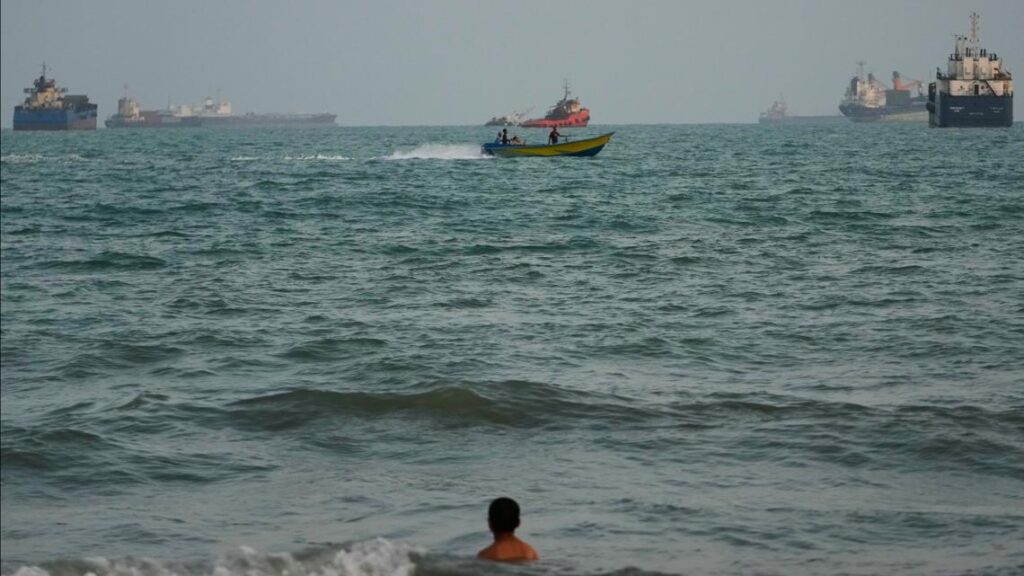
The U.S. military struck three Iranian oil tankers on Saturday, hours after saying Navy warships in the Gulf came under missile fire from Iranian forces. U.S. Central Command said no American personnel were hurt in the alleged attack, and that the retaliatory strikes permanently disabled two loaded crude carriers and destroyed a third that was traveling empty.
According to CENTCOM, the tanker M/T Downy was hit near Kharg Island, Iran’s main oil export terminal, while the M/T Stark 1 was struck near Jask on the Gulf of Oman coast. A third vessel, identified as the M/T Kylo, was described as completely destroyed after being caught without cargo in the Gulf of Oman.
Washington’s Message
CENTCOM commander Admiral Brad Cooper framed the strikes as a direct trade for the alleged attack on U.S. ships, saying the tankers were part of a shadow fleet that bankrolls Iran’s Revolutionary Guard and the militias it backs around the region.

The tanker-for-tanker approach isn’t new rhetoric. U.S. officials have been floating the idea of going after Iran’s oil shipping for weeks as a way to raise the cost of further attacks without escalating toward strikes on Iranian soil itself, which risks drawing in a wider regional response.
Iran’s Response
Iranian state media accused the U.S. of targeting civilian shipping and warned of what one official called “more severe” retaliation unless the naval posture around its coastline changes. Iran has denied that its forces fired on U.S. warships, a claim that could not be independently verified as of Saturday afternoon.
Saturday’s exchange came after roughly a month of comparative quiet in the on-and-off conflict that began in late February, when U.S. and Israeli strikes hit Iranian nuclear and military sites. Fighting has flared and cooled repeatedly since then, with each side blaming the other for renewed attacks.
Why It Matters Beyond the Gulf
Kharg Island alone handles the vast majority of Iran’s crude exports, so even a temporary disruption there ripples into global oil markets already jumpy over Gulf shipping risk. Energy traders have cited the on-again standoff in the strait as one reason crude prices have stayed elevated this year, a cost that shows up at the pump long before it shows up in a headline about a tanker nobody outside the shipping industry had heard of a week ago.
Sources · Washington Post · NPR · Al Jazeera
Related from BeezLoop: Hormuz Shipping Traffic Still Near Standstill Despite Navy's Mine-Clearing, Navy Clears All Mines From Strait of Hormuz, Trump Warns Iran and Sailors Attempt to Jump From USS Abraham Lincoln After Record 260-Day Deployment.