


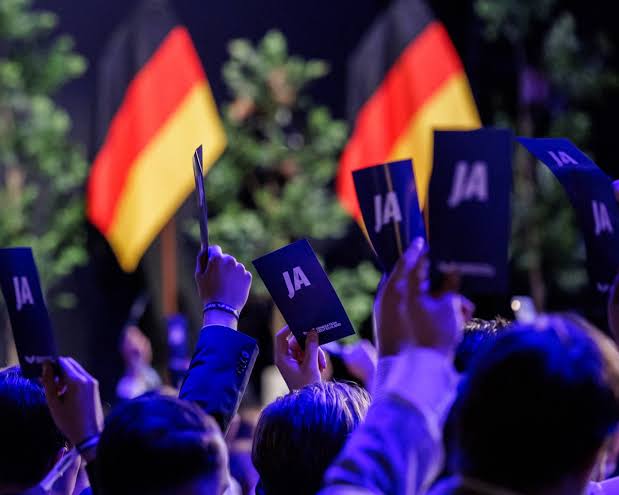
Germany is two days away from a state election that could hand a far-right party control of a German state government for the first time since the end of World War II. Polling ahead of Sunday’s vote in Saxony-Anhalt shows the Alternative for Germany, known as the AfD, leading by a massive margin, at roughly 42 percent support, more than double the level of support for the ruling Christian Democratic Union.
The AfD’s branch in Saxony-Anhalt has been formally classified as “definitively right-wing extremist” by Germany’s domestic intelligence agency, a designation that in most other democracies would be politically disqualifying. In eastern Germany it hasn’t stopped the party’s rise. The CDU is polling at just above 20 percent, with the Left Party at 12 percent, the Social Democrats at 7 percent, and the Greens at 5 percent.
A 35-year-old TikTok star leading the ticket
The AfD’s lead candidate, Ulrich Siegmund, is a 35-year-old former marketing professional who has built a significant following on TikTok, reportedly reaching close to half as many followers on the platform as there are eligible voters in the entire state. Siegmund has served in the Saxony-Anhalt state parliament since 2016 and has co-led the AfD’s legislative faction there since 2022, positioning himself as the face of a campaign built heavily around short-form video aimed at younger voters.

Saxony-Anhalt, a state of roughly 2 million people in what was formerly East Germany, has watched the AfD’s support climb steadily since the party’s founding, riding discontent over immigration, energy costs, and economic stagnation in the former East. A win Sunday wouldn’t guarantee Siegmund the governorship outright, since Germany’s other mainstream parties have so far refused to form coalitions with the AfD nationally, but a strong enough result could make that firewall much harder to hold at the state level.
Watched closely across Europe
The vote is being closely tracked well beyond Germany’s borders as a test of how durable the political cordon around far-right parties remains across Europe, following gains by similar movements in France, Italy and elsewhere. A first-place finish for the AfD, even without an outright governing majority, would mark a significant symbolic milestone in a country that has spent eight decades building institutional safeguards specifically designed to keep far-right parties out of power.
NPR · Al Jazeera · The Washington Post
Related from BeezLoop: 15-Year-Old Cartel Hitman Killed Alongside His Uncle, a Cartel Boss, in Michoacan Gun Battle, Germany Blames Russia for Drone Attack on Leipzig Airport, Closes Consulate and The Trash Can Mandate: Why Nigel Farage's Clacton By-Election Is the Ultimate Political Sarcasm.