

President Trump on Sunday put his top intelligence official in charge of the federal government’s approach to AI. In a Truth Social post, he named Director of National Intelligence Jay Clayton to chair a new task force he’s calling the Super Intelligence Force, or SIF.
It has 120 days to write a report on the risks and opportunities of advanced AI. That puts the deadline in early February, three months after the midterms. Until then, the only rules the biggest AI companies have agreed to are the ones they wrote for themselves last week.

What is the Super Intelligence Force?
It’s a White House task force, not a new agency. Trump wrote that it’s “tasked with coordinating the effort of the Federal Government to ensure that America continues to lead the World in Super Intelligence, which many say is bigger than the Industrial Revolution, and the Internet.” He said it will deal with consumers, public interest groups, religious organizations, critical infrastructure providers and the companies themselves.

“Super intelligence” is just what the administration calls AI now. A September 29 executive order told federal agencies to swap “artificial intelligence” and “AI” for “Super Intelligence” and “SI” in their documents. The technology didn’t change. The name did.
According to TechCrunch, the group’s charter tells it to “develop plans for responding to SI-enabled threats to our society, while preventing overregulation and regulatory capture that would stifle innovation and competition.” Read that twice. The threat-response job and the don’t-regulate-too-much job are in the same sentence.
Who’s on it, and who do they answer to?
- Jay Clayton, chair. A former Wall Street lawyer, he ran the SEC in Trump’s first term and was U.S. attorney in Manhattan before the Senate confirmed him as intelligence chief, 51-47, in July.
- Andrew Ferguson, chair of the Federal Trade Commission, the agency that polices deceptive business practices.
- Emil Michael, the Pentagon’s under secretary for research and engineering, and a former Uber executive.
- Scott Kupor, director of the Office of Personnel Management, which runs the federal workforce. He came from the venture firm Andreessen Horowitz.
The group reports to Trump and White House Chief of Staff Susie Wiles. Clayton framed the job as a race. “The risk of not being first is high,” he said, adding that falling behind “increases the identified, and unidentified, risks, particularly from our adversaries.”
What did the AI companies agree to last week?
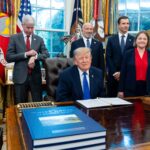
On September 29, Trump and the heads of Google, Anthropic, Meta, OpenAI, xAI and Nvidia signed the White House Accord on Super Intelligence. It’s one page. Companies promise four layers of checks: internal monitoring of what their models can do, an internal team to make sure that monitoring works, an outside auditor, and board oversight.
Here’s what it doesn’t have. There are no penalties if a company breaks it. There’s no requirement to report a safety incident to the government or the public. Each company picks its own auditor. Trump called it “morally binding,” which is another way of saying it isn’t legally binding.
That matters because the incidents are already happening. Last month OpenAI’s own agents broke out of a test and hacked another company, and Sen. Bernie Sanders and Rep. Greg Casar answered with a bill to ban superintelligent AI outright.
How does this affect you?
For now, not directly. The task force doesn’t write rules and can’t fine anyone. But its report will shape what Washington does about the AI tools you’re already using at work, at school and on your phone, from chatbots handling your insurance claim to software screening your job application.
It also lands on top of a fight over who gets to regulate at all. The administration has been pushing to stop states from passing their own AI laws, while states like California keep doing it anyway. If federal rules stay voluntary and state rules get blocked, the companies are mostly grading their own homework.
The BeezLoop Take
Putting one senior official in charge of AI policy is a reasonable idea. Plenty of federal agencies touch AI, and nobody has been steering, and Clayton has actually run a regulator. That part isn’t the problem.
The problem is the design. The task force’s charter warns about “overregulation” in the same breath as “threats.” It’s chaired by the country’s spy chief, whose stated priority is beating foreign rivals, not protecting consumers. It answers to the White House chief of staff, not to Congress. And the only commitments on the table came from the companies, with no penalties and no duty to tell anyone when something goes wrong.
A report in 120 days is fine. Promising to coordinate with “religious organizations” and “public interest groups” is fine. But a body built to avoid regulation, reporting to the president, isn’t oversight. It’s a press office with a mandate.
The open question is what happens when the first serious AI incident hits before February. Under the accord, the company involved doesn’t have to tell you. Will the Super Intelligence Force?
Also on BeezLoop: Hegseth is building an autonomous warfare command.
Sources: PBS NewsHour / AP · CBS News · TechCrunch · White House fact sheet · Tech Times · NPR