
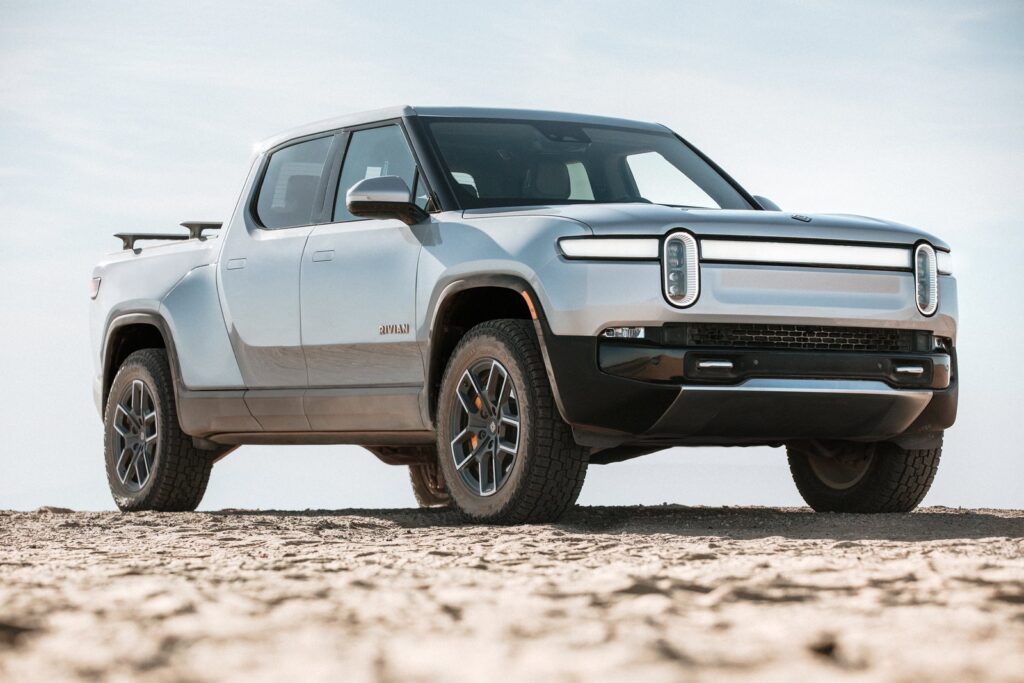
Rivian is recalling 98,828 vehicles because a notification can pop up over the backup camera while you are in reverse. The fix is a software update that arrives over the air, so nobody has to book a service appointment.

Which vehicles
- 2022 to 2027 R1S SUVs
- 2022 to 2026 R1T pickups
- 2027 R2
That is essentially Rivian’s entire production history in one recall.
What the defect is
While the vehicle is in reverse, a notification can appear over the rearview camera display and block part of the view.

That puts it out of compliance with the federal rear-visibility standard, which requires drivers to be able to see the area behind the vehicle when backing up. The rule exists because of children and pedestrians in blind zones.
No crashes have been tied to it in the reporting we reviewed. The recall is about the standard being violated, not about a known injury.
You can check whether a specific vehicle is affected by entering the VIN at nhtsa.gov/recalls.
Why over-the-air matters
This is the quiet part of the story and it is the more interesting one.
A traditional recall means a letter, a dealership appointment, and a service bay. Compliance rates are famously poor. Plenty of recalled cars are still on the road with the defect years later because the owner never went in.
A software recall pushed over the air fixes the car in the driveway overnight. For a defect that is genuinely a software problem, that is a real improvement in public safety, not a loophole.
It also means the count sounds alarming and the remedy is close to invisible. Ninety-eight thousand vehicles is a big number. The inconvenience is approximately zero.
The same day, Tesla opened a Semi plant
Tesla held an invite-only rollout event Thursday for its Semi factory in Sparks, Nevada.

- 1.7 million square feet.
- Capacity for up to 50,000 Semis a year.
- First truck off the high-volume line in late April 2026.
- Long Range, rated 500 miles, at $290,000. Standard Range, 325 miles, around $260,000.
The next-generation Roadster reveal is scheduled for October 1.
The market underneath both stories
The EV market is not having a good year, and these two stories sit inside that.
Tesla holds roughly 52% of the US EV market and the Model Y alone accounts for about 37% of new EV sales. That dominance comes alongside a 16% year-to-date sales decline, to 325,351 vehicles.
The broader market contracted around 30%. Ford, Hyundai and GM have all pulled back on electric offerings.
So Tesla’s share is rising because competitors are retreating faster than it is shrinking. That is a different thing from winning.
The BeezLoop Take
The Rivian recall is the kind of story that gets a scary headline and deserves a calm read. Ninety-eight thousand vehicles, a notification covering part of a camera view, no reported crashes, fixed by a software push while you sleep. That is a company catching a compliance problem and closing it with minimal cost to owners. It is close to the best-case version of a recall.
What is worth watching is the precedent, not the defect. As more of a car becomes software, more recalls become patches, and the regulatory framework was built for physical parts and dealer service bays. An over-the-air fix is better for owners and it also means a manufacturer can resolve a federal compliance failure without anyone ever walking into a building. That is efficient. It also makes it easier for problems to be quietly handled at scale, and the oversight model has not caught up.
The Tesla Semi numbers are the ones that should draw skepticism. A $290,000 truck, a plant sized for 50,000 units a year, and a vehicle first unveiled in 2017 that is only now reaching a high-volume line. Capacity is not demand. Freight operators buy on total cost per mile, not on specs, and nothing about an announcement event tells you how many of those 50,000 slots have orders behind them.
The market picture is the part nobody is saying plainly. Tesla’s share went up while its sales went down 16%, because the rest of the industry is retreating from EVs faster. A 52% share of a market contracting 30% is a smaller business than a 40% share was last year. Legacy automakers scaling back is not a Tesla victory, it is a signal about whether American consumers are buying these at the current prices and the current borrowing costs.
The question
If a recall can be fixed overnight with no owner involvement, should it still be called a recall? And who is buying 50,000 electric semis a year at $290,000 each?
Related: the US-China trade truce that governs a lot of what these companies pay for parts.
Sources: The Autowire · Yahoo Autos · NHTSA recall lookup