

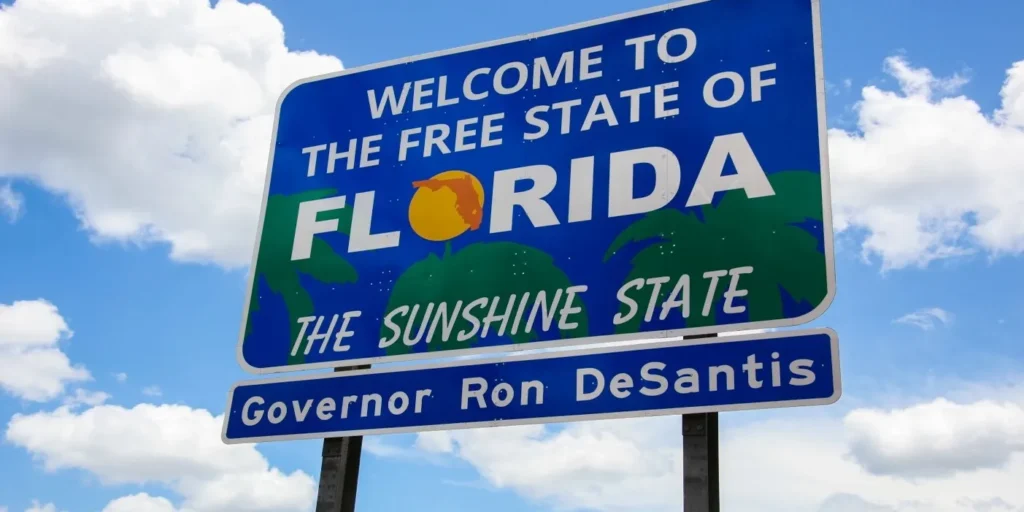
Starting October 1, saying you are in a gang counts as evidence that you are in a gang in Florida. So does posting the right words on the right account. That is the short version of a law Ron DeSantis signed on June 16.
What the law says
The bill is CS/HB 429, sponsored by Rep. Jessica Baker. It rewrites how the state decides who is a criminal gang member. It passed the House 100 to 7 and the Senate 29 to 9.
Under the new version, a person has to meet two or more of the listed criteria. Per the Senate’s own bill summary, those now include:

- Admitting gang membership in person or on an online platform or social media.
- Being identified or claimed by a gang as one of its members.
- Being identified as a gang member by a parent, guardian, or a spouse living with them.
- Being observed with known gang members two or more times. The old threshold was four.
- Authoring communications showing gang affiliation or taking responsibility for gang crimes.
- Using gang-related language on an online platform to further criminal gang activity.
How the state defines gang language
This is the definition that does the most work, so here it is as written:
Any verbal or written statement that signals gang affiliation, supports gang activity, or uses recognized gang codes, symbols, or terminology associated with criminal organizations.
CS/HB 429, effective October 1, 2026
That includes digital and electronic statements. A caption. A comment. An emoji, if a detective can testify it is a recognized symbol.
The statute attaches a limit to this one. The language has to be used in furtherance of criminal gang activity. Whether that limit holds in practice is the whole argument.
What this does not do
Worth being clear, because the law is getting described online as a ban.
Being in a gang is not itself a crime in Florida, and this bill does not change that. What the gang label does is add years. Florida’s gang statutes enhance sentences for crimes committed by someone classified as a member. The classification is the multiplier, not the offense.
So nobody gets arrested on October 1 for a post. Somebody arrested for something else gets a longer sentence because of one.
Who this lands on
Two groups, mostly.
The first is rappers. Drill and trap lyrics are full of the exact material this definition describes. Codes, sets, symbols, claims of affiliation. Prosecutors have used lyrics as evidence for years, and now the statute names the category directly.
The second is teenagers. A 16-year-old in Liberty City or Overtown who posts a set name to look hard, and who gets photographed twice at a corner with someone the state already has in its database, has met two criteria without committing a crime. The Keffe D case in Las Vegas showed what happens when somebody talks about affiliation in public and a prosecutor is listening years later.
Florida is also where enforcement politics have already turned on communities like Little Havana this year.
The BeezLoop Take
The self-admission piece is the least objectionable part of this. If a person states plainly that they belong to a criminal organization, treating that as one of two required data points is not unreasonable. Courts take admissions seriously in every other area of law.
The problem is everything around it. Dropping the observation threshold from four times to two is not a technical tweak. In a small neighborhood, two sightings is a Tuesday. It is a cousin, a barber shop, a bus stop. Combine one photograph pair with one caption a detective reads as a code, and the state has a gang member without alleging a single criminal act.
The language definition is the part that should worry people who are not in gangs at all. Recognized gang codes, symbols or terminology is not a list anybody can look up. It is whatever a testifying officer says it is. That standard has produced bad outcomes everywhere it has been tried, and Florida just wrote it into statute for social media, where context collapses and a 15-year-old posting song lyrics looks identical to someone giving an order.
Supporters have a real argument and it deserves stating. Gangs recruit and coordinate on these platforms now. A law written before Instagram existed does not reach how these organizations actually operate, and police pointing that out are not inventing a problem.
But the burden here falls on the state to show restraint on a standard it wrote without any. The bill passed 100 to 7 and 29 to 9. That is not a close call in either chamber, and it means almost nobody in Tallahassee pushed back on the vagueness. The people who will find out whether the furtherance limit means anything are teenagers with public defenders, after the fact, one at a time.
The question
Where is the line between a kid posting for clout and a member signaling affiliation, and who decides it? And if two sightings and one caption is enough, how many Floridians meet this definition today without knowing it?
Sources: Florida Senate bill summary, CS/HB 429 · Florida House staff analysis · News4Jax · Florida Politics