

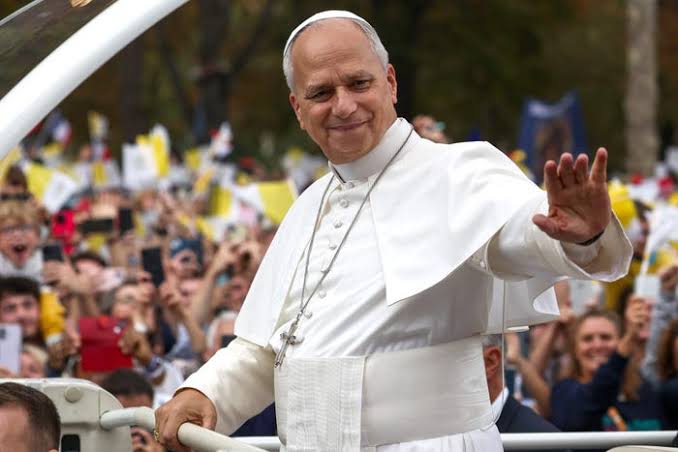
Pope Leo XIV landed in France on Friday and warned that people are at risk of losing their humanity inside what he called a paradise of machines.
What he said
If we are to avoid losing our humanity amid a paradise of machines invading and conditioning our daily lives, there is an urgent need for education in ethical discernment.
Pope Leo XIV, arriving in France, September 25
The phrase is doing precise work. A paradise of machines is not a warning about robots taking over. It is a warning about comfort. Systems that answer before you finish the question, that decide what you see, that remove the friction of choosing.

This is his signature issue
Not a passing comment. Leo has made artificial intelligence a defining theme from the start of his pontificate.
- His first encyclical, Magnifica Humanitas, is dedicated to the subject.
- It calls for robust regulation and for AI developers to work for the common good rather than profit.
- In a speech to the Pontifical Academy of Sciences on Thursday, he said AI can benefit humanity but has introduced new dangers to security and international peace.
- He urged global leaders to govern wisely.
An encyclical is the highest form of papal teaching document. Choosing AI for the first one is a statement about where he thinks the century is going.
Why this lands now
The timing is not coincidental, and the contrast is sharp.
This week, Google, OpenAI and Anthropic moved to set up their own voluntary safety body with no government oversight. Congress has written nothing; a preemption bill has been stalled since June. Virginia’s governor wrote to Congress asking it to act and created a state task force instead of waiting.
Into a vacuum where the industry is writing its own rules, the Pope is one of the few figures with a global audience and no equity stake.
The BeezLoop Take
The easy dismissal is that a pope has no standing on a technical subject. That dismissal is wrong, and not for religious reasons. The unresolved questions about AI are not engineering questions. Whether a system should make a decision about a person, what a human being is owed before an algorithm sorts them, what we lose by outsourcing judgment. Those are moral questions, and the Catholic Church has been arguing about moral questions longer than any institution currently in the conversation.
He is also, notably, one of the only major voices on this with nothing to sell. Every AI executive warning about existential risk is also raising money on the premise that their product is powerful enough to be dangerous. Every politician has a donor list. The Vatican has a lot of institutional interests but an equity position in Anthropic is not one of them.
The paradise framing is sharper than the doom framing and deserves the attention. Most warnings imagine machines that turn hostile. Leo is describing machines that are extremely accommodating, that make life frictionless, and that erode something in us precisely because they work so well. That is a better description of what is actually happening to people than any robot apocalypse, and it is harder to legislate against.
Where his argument is weakest is the remedy. Education in ethical discernment is a real answer and it is also the answer institutions reach for when they cannot compel anything. You cannot educate your way out of a system deployed at global scale by companies with more money than most governments. The encyclical calls for robust regulation, which is the serious half; the discernment language is the half that asks individuals to solve a structural problem.
And the Church should expect the obvious question back. An institution asking to be trusted as a moral authority over powerful actors who resist accountability has its own record on exactly that, and it is not a good one. That does not make him wrong here. It does mean the argument has to stand on its merits rather than on the office, and on the merits it mostly does.
The question
If the people building AI are also writing its safety rules, who is left to say no? And is a warning about losing our humanity useful if the proposed remedy is individual discernment against a trillion-dollar industry?
Sources: Washington Times · Irish News · Detroit News · PYMNTS