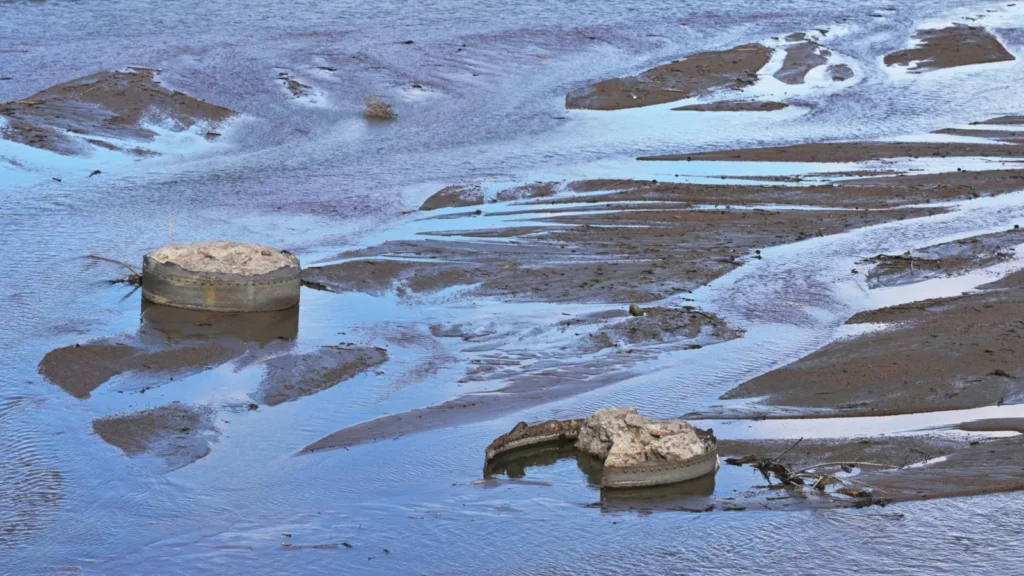
About 4.25 million gallons of raw sewage poured into the Arkansas River near Pueblo, Colorado after a patched pipe at a city wastewater plant failed, prompting a health advisory that stretches roughly 90 miles downstream. State officials are telling people to stay out of the water entirely until further notice.
What failed, and for how long
A patch on a concrete sewer pipe at the Pueblo treatment plant gave way, sending untreated sewage through a stormwater pipe and directly into the river. The discharge began Wednesday, August 26, and ran until it was discovered the following day. That detection gap is the reason the volume reached 4.25 million gallons: the sewage was flowing into the river for roughly a day before anyone knew it was happening.
How contaminated the water actually is
The testing numbers give a concrete sense of scale. Colorado’s safety standard for swim beach access is 235 colony-forming units of E. coli per 100 milliliters. Readings downstream near Nyberg Road came back above 2,419 CFU per 100 mL, which is more than ten times the threshold and also the upper limit of what the test reports, meaning actual levels could be higher. Upstream readings were normal, confirming the contamination came from the spill site rather than a broader problem with the river.

Who this affects and what they’re being told
The advisory from the Colorado Department of Public Health and Environment and Pueblo’s health department reaches as far east as Las Animas, and covers more than swimmers. People are told to avoid swimming, kayaking, tubing, and wading downstream of the discharge point, not to fish there, not to let pets or livestock drink from the river, and not to use the water for preparing food. That last set of instructions is aimed squarely at agricultural users along the lower Arkansas, where the river is a working irrigation and stock-water source rather than a recreation area, and where “avoid the water” carries real operational cost.
How long until it clears
Officials extended the advisory indefinitely rather than setting an end date, which reflects how this kind of contamination moves. The sewage travels downstream as a slug, so bacteria levels at any given point rise and fall as it passes, and dilution and sunlight gradually reduce them. That means the all-clear depends on repeated testing at multiple points rather than a fixed waiting period, and communities further east see their risk window later than Pueblo does.
Related from BeezLoop: Colorado Springs Fugitive Wanted for Attempted Murder Found Hiding Under an Air Mattress, Bear Euthanized After Breaking Into Colorado Home and Starting Kitchen Fire and 1 Killed, 5 Hurt After Truck Strikes Pedestrians at Fort Collins Bike Festival.