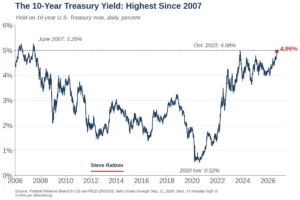
The bond market is flashing a warning most Americans never see coming until it shows up in their own bills. The yield on 30-year US government bonds hit its highest level since 2007 this week, as investors sold off bonds over worries about the federal government’s ballooning debt and the path of inflation. That matters well beyond Wall Street: the US now pays roughly $3 billion a day in interest on the national debt, which recently crossed $40 trillion, making interest payments the federal government’s second-largest expense after Social Security. And rising bond yields don’t stay contained to bonds. They ripple directly into the rates regular people pay on mortgages, credit cards, and car loans.
The 30-year fixed mortgage rate hit 6.67 percent last week, according to Freddie Mac, close to its highest level in a year. That’s not a coincidence. Mortgage rates track long-term bond yields closely, because lenders are competing for the same pool of investor money that’s currently demanding higher returns to hold government debt.
Why Investors Are Suddenly Nervous
Bond investors are effectively betting on two things at once: how much inflation will erode the value of the fixed payments they’re owed, and how likely the government is to keep spending more than it collects in tax revenue. Right now, both bets are pointing the same direction. The federal deficit keeps growing, tax cut extensions have gone through without matching spending cuts, and none of that inspires confidence in bondholders that today’s yields will be worth as much a decade from now. So they’re demanding more return upfront to compensate, which pushes yields, and therefore borrowing costs across the entire economy, higher.

What This Actually Means for Your Wallet
This isn’t an abstract Wall Street story. If you’re shopping for a mortgage, refinancing, financing a car, or carrying a credit card balance, this is the mechanism setting the rate you’ll pay, months before it shows up as a headline about “the economy.” And if the trend continues, rising borrowing costs eventually slow consumer spending, which is the point at which stock investors typically start worrying too, not just the bond market. Right now, that broader spillover hasn’t fully happened. Whether it does is likely to depend on whether Washington shows any real sign of narrowing the deficit gap, something neither party has demonstrated much appetite for regardless of who’s in office.
What do you think? Should the federal deficit be treated as an urgent problem given what it’s already doing to mortgage and loan rates, or is this level of concern overblown? Let us know your thoughts in the comments on BeezLoop.com!
Related from BeezLoop: US National Debt Passes $40 Trillion, Months Ahead of Projections, The 10-Year Treasury Hit 5.12%. Here's What That Does to Your Mortgage, Your Car Note and… and Lennar Cut Its Housing Target Twice This Year.