

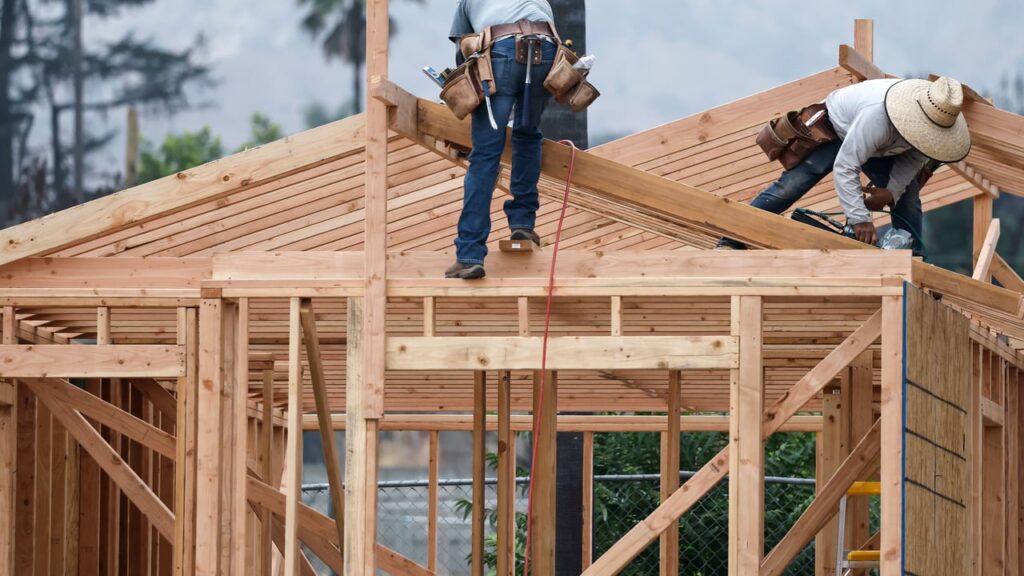
Lennar, the country’s second-largest homebuilder, cut its 2026 delivery target for the second time this year and reported quarterly profit down 52%, blaming mortgage rates and deteriorating conditions. It is the clearest read yet on what higher rates are doing outside of Washington.
The receipts
Third-quarter net earnings fell to $284 million, down 52% from a year earlier. Revenue came in at $8.05 billion, missing consensus of $8.33 billion and down 8.6% year over year. Adjusted earnings of $1.23 a share missed the $1.29 estimate and fell 38.5% from $2.00. New orders dropped 9%. Deliveries fell 3%.
The company now expects to deliver 80,000 to 81,000 homes this year, down from guidance of 82,000 to 83,000. That is the second cut to the same number in a single year.

Why a builder’s bad quarter is worth your attention
Homebuilder earnings are one of the few places where interest rate policy becomes visible quickly. Most economic data arrives with a lag and in aggregate. A builder reports what actually sold, at what price, to buyers who had to qualify for a loan at current rates. New orders falling 9% is a direct count of people who looked at a payment and walked away.
That is the same mechanism we described when the Fed raised its target range to 3.75% to 4%. Mortgage rates do not track the federal funds rate directly, they follow the 10-year Treasury, but the broader tightening and the inflation expectations behind it push in the same direction. A builder cutting guidance twice is that pressure showing up as an actual number.
Who is absorbing it
Not evenly distributed. An existing homeowner with a fixed-rate mortgage is insulated entirely and may even benefit from constrained supply supporting their home value. The people absorbing this are would-be first-time buyers priced out of qualifying, and construction workers whose hours depend on how many homes get built. Lennar delivering 2,000 fewer homes is also a smaller number of jobs on sites.
The BeezLoop Take
A single quarter from one builder is not an economy. But the direction here is consistent with what the rate path implies, and Lennar lowering the same target twice in one year is a company revising its own view of demand, not a one-off miss.
We would treat this as evidence that the affordability squeeze is real and biting at the entry level, where qualifying for a payment is the binding constraint.
Where we are not convinced: one builder’s results can reflect its own geography, product mix and land positions as much as the national market. Lennar is heavily exposed to Florida and Texas, where local conditions including insurance costs and inventory are doing their own work. We would want to see the other large builders report before treating this as a national verdict.
What happens next
Watch the other large builders reporting in the next few weeks, new and existing home sales, and whether builders lean harder on rate buydowns to move inventory. Those incentives are the tell: when a builder pays down a buyer’s rate, it is absorbing the cost of the Fed’s policy on its own margin rather than passing it to the buyer, and there is a limit to how long that holds.