

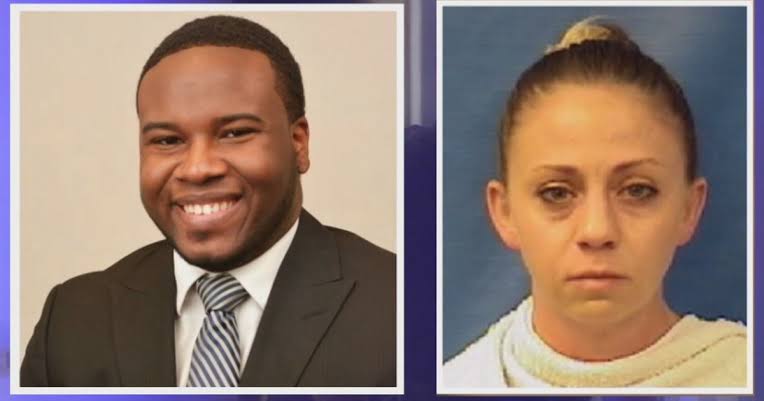
Former Dallas police officer Amber Guyger was granted parole Thursday, seven years after a jury convicted her of murdering Botham Jean, a 26-year-old accountant she shot inside his own apartment. The Texas Board of Pardons and Paroles approved her release on October 1. She was sentenced to 10 years. No release date has been set.
The board turned her down once before, in 2024, when she first became eligible. This time it said yes, two days after what would have been Jean’s 35th birthday.
Why did the parole board release Amber Guyger?
The board gave three reasons, according to its statement reported by NBC News. Guyger doesn’t have “a documented pattern of violent arrests” or convictions. She has kept up a “satisfactory institutional adjustment” in prison. And she completed programs “that should enhance chances to obtain and maintain full-time stable employment.”

That’s standard parole language. Texas lets people convicted of murder apply for parole after serving half their sentence, which is why Guyger, 38, first became eligible in 2024. She’s been held at the Patrick L. O’Daniel Unit, a women’s prison in Gatesville, west of Waco. The Texas Department of Criminal Justice will decide when she walks out and under what conditions.
What happened to Botham Jean?
On September 6, 2018, Guyger came home in uniform after a long shift. She had worked nearly 14 hours. She walked into the fourth-floor apartment directly above hers, believing it was her own, and shot Jean, who was sitting at home eating ice cream. She said she thought he was an intruder.
The jury didn’t accept that as a defense. In October 2019 it convicted her of murder. Prosecutors had asked for at least 28 years, the age Jean would have been that year. The jury gave her 10.
The evidence at trial painted an ugly picture of the minutes after the shooting. While Jean was dying, Guyger was texting her patrol partner, Martin Rivera. One message read “I need you. Hurry,” and another, sent while she was on the phone with 911, said she had messed up, using a profanity. In the sentencing phase, prosecutors showed racist texts she had sent before the shooting. In one, as a Martin Luther King Jr. Day parade passed, she wrote, “When MLK is dead … oh, wait.” Two days before she killed Jean, when a friend joked that a dog “may be racist,” she replied, “It’s ok, I’m the same.”
Dallas fired her before the trial. Today, the stretch of road outside Dallas police headquarters is named Botham Jean Boulevard.
What did Botham Jean’s family say about the parole?
Family attorney Lee Merritt said they were “deeply disappointed.” He said the family and community had stood up “again and again” to ask that she serve her full sentence.
A 10-year sentence was already a fraction of what was lost. Releasing Ms. Guyger after seven years makes that loss feel even smaller.
Lee Merritt, attorney for Botham Jean’s family
The family asked for privacy and thanked people for remembering Botham. The Dallas Police Department said it “understands this decision may bring renewed attention and emotion surrounding the tragic death of Botham Jean.”
The family is still fighting over money, too. In November 2024, a federal jury found Guyger violated Jean’s constitutional rights and awarded his family about $98.65 million. This spring, the family sued the City of Dallas to force it to pay the judgment, arguing that the city’s liability plan covers employees acting in the scope of their duties and that Dallas “has failed to satisfy all or any part of the judgment.”
The BeezLoop Take
Parole decisions are supposed to be about the person in front of the board, and by the board’s own checklist, Guyger fits. No prior violent record, good behavior, programs completed. Plenty of people convicted of serious crimes get out under the same rules, and that system isn’t wrong just because the case is famous.
But the board didn’t create this outcome. The jury did, in 2019, when it convicted a police officer of murder and then gave her 10 years. Parole after seven is what a 10-year sentence means in Texas. The real question was always why a jury that rejected her story still handed down a sentence near the bottom of what Texas allows for murder, and whether a civilian who walked into a stranger’s home and killed him would have gotten the same.
The texts matter here. A woman who joked about Martin Luther King’s death, and said she was “the same” as a dog a friend called racist, shot an unarmed Black man in his own living room, and the system treated it as a tragic mistake worth a decade. Her record in prison may be clean. That doesn’t change what the trial showed.
The open question now is Dallas. The family won a $98.65 million verdict almost two years ago, and this spring they had to sue the city because it hadn’t paid any of it. Guyger is getting out. Will the city that employed her ever pay what a jury said it owes?
Also on BeezLoop: Prosecutors say an off-duty sergeant punched a woman who was filming him, and an Oregon man is charged in a sixth death after the state let him out early.
Sources: Texas Tribune · NBC News · NBC DFW · CBS Texas · Dallas Morning News, Nov. 2024 civil verdict · Texas Board of Pardons and Paroles