Three different groups of people say TikTok is burying their posts. People criticizing Donald Trump. People posting about Jeffrey Epstein. And Andrew Tate, who is suing over it. Same platform, same year, three very different stories, and only one of them is actually documented.
Who owns it now
Everything here runs through one date.
A group of American investors closed a $14 billion deal in January to take over TikTok’s US operation, satisfying the 2024 divest-or-ban law. On January 22, 2026, a new entity called TikTok USDS Joint Venture LLC was formally established under Trump’s executive order approving the sale.

The ownership split:
- Larry Ellison’s Oracle, private equity firm Silver Lake, and Abu Dhabi’s MGX hold 45% between them as managing investors.
- ByteDance, the original Chinese parent, keeps 19.9%.
- Most of the rest sits with existing ByteDance investors.
Ellison is a Trump ally. That is the fact underneath every accusation that followed, and it is why complaints that would once have been written off as shadowban paranoia now get a governor’s attention.
Thread one: Epstein
This started within days of the handover.
In late January, US users reported they could not type the word Epstein in direct messages. Not that posts were down-ranked. That the word would not send.
TikTok said it has no rule against sharing the name in DMs and that it was investigating why some people could not.
Users also reported that searching the term triggered restrictions, and that posts were being removed or shadowbanned.
Thread two: Trump
The same pattern, aimed at a different subject.
California state Senator Scott Wiener said a video he posted about his own legislation, explaining how to sue ICE, sat at zero views.
Others reported the same on posts about Renee Good and Alex Pretti, the two people federal agents shot and killed in Minneapolis in January.
On Tuesday, Gavin Newsom’s office said it had collected those reports, independently confirmed instances of its own, and is now reviewing whether the conduct breaks California law.

Thread three: Andrew Tate
This is the one that does not fit the theory, and it is the most documented of the three.
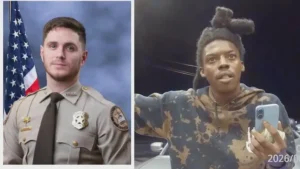
Tate was banned from TikTok, Instagram and Facebook in 2022. TikTok has said it keeps ramping up enforcement against videos of him expressing hateful ideologies, and it uses matching technology to catch reuploads of clips it has already ruled against.
In August 2025 the Tate brothers sued Meta and TikTok, seeking more than $50 million from each. They called the bans an unlawful and politically motivated campaign to suppress, silence and destroy them.
In April, a California federal judge threw out the Meta case without leave to amend, finding the brothers had not alleged facts that overcome a platform’s immunity as a publisher. No ruling on the TikTok suit has been reported.
Meanwhile the enforcement has never really worked. Fan accounts have reposted his material continuously for years. Tate is in federal detention in Miami fighting extradition to Britain on 59 charges.
What TikTok says
One explanation, used repeatedly: infrastructure.
The company described a major infrastructure problem set off by a power outage at a US data center, and said creators might temporarily see zero views or likes as a result. It denies censoring anything.
That is a genuine failure mode. It is also unfalsifiable from outside the building.
What researchers found
Two studies, pointing opposite directions, and both deserve to be on the table.
- In February, eight academics examined the ICE and Epstein censorship claims and found no evidence supporting them.
- In May, a study in Nature found TikTok’s algorithm favored pro-Republican content in three states during the 2024 campaign. NYU Abu Dhabi researchers ran 323 dummy accounts; Republican-trained accounts received about 11.5% more agreeing videos than Democrat-trained ones.
So the specific censorship claim has been checked and not confirmed, while measurable partisan skew in the recommendation system has been found. Those are not the same finding and neither cancels the other.
Why zero is the number that matters
If you want to judge this yourself, ignore slow growth and watch for none.
Algorithms suppress things constantly by simply not recommending them. That produces small numbers. A post that gets no views from anyone, including the account’s own followers, usually never entered distribution at all.
A data center outage does that. So does a filter. From the outside the two are identical, which is the entire problem.
The BeezLoop Take
Put the three threads next to each other and the simple version falls apart. If TikTok were straightforwardly protecting Trump and his allies, Andrew Tate would not have been banned for four years and would not be suing the company for it. A platform running a coordinated political favor does not also deplatform one of the loudest figures in that political orbit and win in court about it.
What the Tate case does show is which claim gets treated seriously. He alleged politically motivated suppression, took it to federal court, and a judge dismissed the Meta version without even letting him amend. That is the standard everyone else’s claim is eventually measured against, and right now the Trump and Epstein complaints are nowhere near it. They are screenshots and a governor’s press release.
Newsom is not a neutral referee here either. He is a Democrat with national ambitions picking a fight with a Trump-aligned company over the burial of anti-Trump posts. That does not make him wrong. It does mean his office saying it independently confirmed instances is not evidence until it publishes what it confirmed and how, and so far it has not.
TikTok’s position is weaker than its denial sounds. The Epstein DM problem is the detail it has never explained. A word that will not send in a private message is not a recommendation algorithm being subtle, and a power outage does not selectively break one proper noun. The company said it had no such rule and was investigating. Eight months later there has been no answer.
The deeper issue is that the deal made this permanent. An app that a hundred and seventy million Americans use for news now has a president’s ally among its managing investors and that president’s executive order in its incorporation papers. Every outage from here forward will be read as censorship, whether it is or not, and the company has no way left to prove a negative. That was foreseeable in January, and it was approved anyway.
The question
Can a platform owned by the president’s allies ever credibly investigate itself for protecting the president? And if a federal judge threw out Andrew Tate’s suppression lawsuit, what evidence would it take to win the one people are asking for now?
Related: the White House banning newsrooms from the Pentagon press corps, the ICE shooting of a DoorDash driver in Austin, and the Fox News poll showing 53% say enforcement has gone too far.
Sources: CBS News · Forbes on the Epstein DM blocking · NPR on the researchers who found no evidence · NBC News on the Tate lawsuits · Democracy Now on the ownership deal · UPI on the Nature study