

Virginia’s governor wrote to Congress this week asking it to set national rules for artificial intelligence. The request is notable mostly because of what it admits: right now, the rules are largely being written by the companies building the technology.

What Spanberger asked for
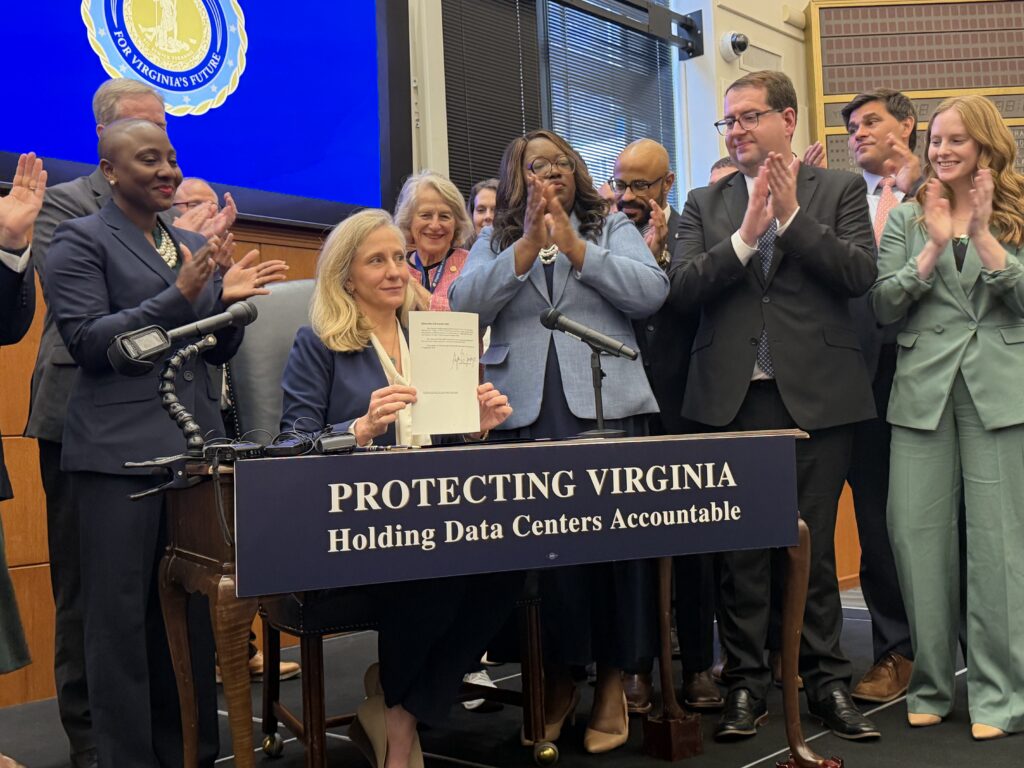
Gov. Abigail Spanberger sent a letter to congressional leaders calling for federal guardrails, warning that AI’s speed threatens jobs, privacy and public resources if oversight stays with the developers.
She also moved on her own. On September 18 she signed an executive order creating a state AI task force, and pledged to keep acting within Virginia’s authority.


That combination is the whole story in miniature. Ask Washington to act. Do not wait for it.
Why Congress has not
There is a bill and it is stuck.
A bipartisan preemption draft called the Great American AI Act has not moved since June. House Speaker Mike Johnson has been publicly skeptical that Congress should be leading on AI safety at all, which is not a promising sign for a statute that needs his floor time.
There is also recent history. Last year the Senate voted 99 to 1 to strip a provision from a spending and tax bill that would have discouraged states from regulating AI.
Ninety-nine to one is not a close vote. Whatever else the Senate disagrees on, it was nearly unanimous that states should not be blocked from acting.
What preemption actually means
Worth being plain, because the word does a lot of hiding.
Preemption is when a federal law overrides state laws on the same subject. Applied to AI, it would mean a single national standard replacing the patchwork of state rules.
Industry generally wants it. Complying with fifty different regimes is expensive, and one federal rule is cheaper than fifty state ones.
The catch is what the single standard says. A strong federal rule that preempts weak state rules raises the floor. A weak federal rule that preempts strong state rules lowers the ceiling. Both are called preemption, and the fight is entirely about which one you get.
What states are doing meanwhile
Not waiting.
- Colorado rewrote its AI Act rather than repealing it.
- California’s SB 53 is in its second public compliance dispute of the year.
- Virginia now has a task force by executive order.
Each of those is a state deciding its residents cannot wait for Congress. Each one also makes the industry’s patchwork complaint more accurate.
Why this reaches you
Not abstract. AI systems are already deciding things about people.
Whether your job application gets read. What your landlord charges. Whether an insurer flags your claim. What your kid sees. Whether a government benefits system thinks you are eligible.
The data centers that seven in ten Americans do not want near them are the physical side of this. The rules governing what runs inside them are the other half, and right now that half is mostly voluntary. The companies themselves are not settled on the question either: Musk is suing Altman while both agree AI should slow down.
The BeezLoop Take
Spanberger is right about the diagnosis and the letter will not fix it. A governor asking Congress to act is the weakest instrument available, and she plainly knows it, which is why the executive order came first and the letter second.
The 99-to-1 vote is the fact that should anchor this. The Senate was nearly unanimous that states must be allowed to regulate AI, and more than a year later the chamber that voted that way has produced no federal standard of its own. Blocking preemption and then writing nothing is the worst available outcome: no national floor, fifty separate regimes, and an industry that can truthfully say the rules are incoherent while benefiting from the incoherence.
The industry’s complaint is real and should not be dismissed as self-serving noise. A startup genuinely cannot afford counsel in fifty jurisdictions, and a patchwork favors exactly the largest companies, which can. But the companies pushing hardest for one national rule are also the ones best positioned to shape what it says, and a preemption statute written to their specifications would be worse than the patchwork it replaces.
What makes this urgent rather than merely unresolved is the sequencing. Technology deployed without rules does not wait politely for rules to arrive. It builds dependencies, business models and defaults, and every month those harden. By the time Congress acts, the question will not be what the rules should be. It will be which existing practices are too entrenched to unwind.
Johnson’s skepticism that Congress should lead deserves a straight answer. If not Congress, then who? The companies are already doing it, which is the situation Spanberger is writing to complain about.
The question
Is a weak national AI rule better than fifty stronger state ones, or worse? And if the Senate voted 99-1 that states must be free to act, why has the same Congress written nothing in the year since?
Sources: Virginia Mercury · WRIC · CASRAI on the preemption fight · WHSV