
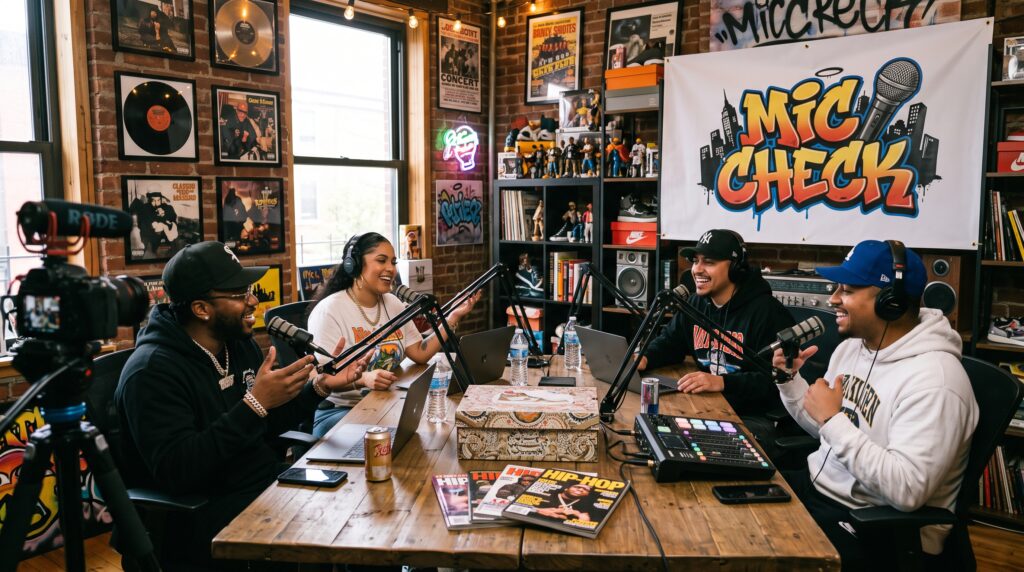
Turn on YouTube and you’ll find a hip-hop podcast for every day of the week. Former rappers, former managers, former hype men, all behind the same studio mics, all talking about other men’s business. It looks like the easiest way left to make money and stay relevant in rap. A lot of it is trash.
Not all of it. Some shows are doing real work. But the boom says something uncomfortable about where hip-hop is right now, and it’s worth saying plainly.
Why are there so many hip-hop podcasts?
Because the music business stopped paying the way it used to, and attention became the product. Complex’s 2026 hip-hop media ranking puts it bluntly: podcasters and streamers broadened their coverage “in response to hip-hop’s commercial slump and the lack of compelling narratives driving the genre.” It notes there hasn’t been a rap song in the Billboard top 10 since Drake’s “What Did I Miss?” last summer.

When the songs aren’t carrying the culture, the conversation about the culture becomes the business. A podcast costs little to start, YouTube pays for views, and clips travel. The fastest clips are the ones with someone getting dissed.
What’s wrong with a lot of them?
The formula is gossip. Who’s sleeping with whose ex. Who owes who money. Grown men breaking down other grown men’s relationships for an hour, then clipping the meanest 40 seconds. Some legends we grew up respecting now spend more time rewriting their own history and picking at younger artists than working on anything new.
NPR’s music team described the problem this fall: “In an ecosystem where all the players are banking on short attention spans, the audience gets reduced to eyeballs as podcasters and streamers play to the lowest common denominator.” The same piece noted that one of the biggest interviewers in the space has admitted to paying subjects for sit-downs, and that two of rap media’s best-known hosts recently traded shots over which of them matters more.
It’s worse when the beef is the content. Complex notes that one veteran host has used his show to go back and forth with his own former partners in public, beef “he seems to relish playing out in front of the massive audience he’s built.” Drama sells, so drama gets manufactured.
Is the newer generation hurting hip-hop?
This one’s more complicated. A lot of younger artists don’t seem to have studied the people who came before them, and you can hear it in music that’s built for a 15-second clip instead of a full album. Respect for the craft, the bars, the storytelling, the history, feels thinner than it did.
But the older generation doesn’t get off clean. When the people who built the culture spend their platforms mocking young artists instead of mentoring them, they’re part of the reason the kids aren’t listening. Respect has to run both ways.
Are any hip-hop podcasts worth your time?
Yes. Complex singles out shows that preserve history instead of strip-mining it: long, generous conversations with legends, honest interviews that let artists talk about their work, and the few journalists still doing real reporting. Shows like Drink Champs, at their best, have captured stories that would otherwise be lost. The difference is whether the host is curious about the music or just hungry for the clip.
The BeezLoop Take
Hip-hop has always had beef, gossip and big personalities. That’s not new, and some of the best moments in the culture came from friction. What’s new is that the talk has replaced the music as the main event, and a lot of grown men have decided their legacy is a YouTube thumbnail.
It hurts more when it’s people you grew up respecting. You remember them for the records. Now you know them for petty clips about someone else’s girlfriend. That’s a choice, and it’s costing them the respect they spent careers earning.
The fix isn’t fewer podcasts. It’s better ones: hosts who focus on their craft, who mentor instead of mock, and who make the music the story again. The open question is whether the audience will reward that, or keep clicking on the drama.
Also on BeezLoop: Drake lost the ‘Not Like Us’ case.
Also: Madonna won seven VMAs at 68 as Taylor Swift became the most-awarded artist in the show’s history.
Sources: NPR Music · Complex: Hip-Hop Media Power Ranking 2026 · BBC World Service