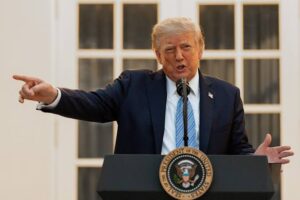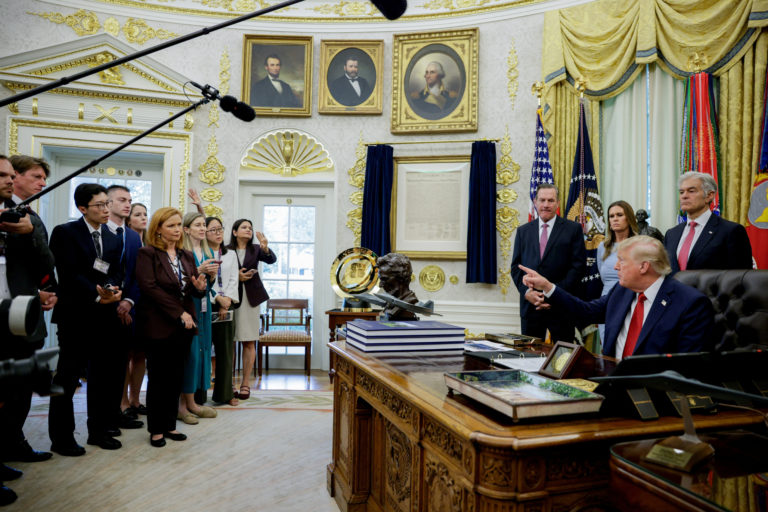
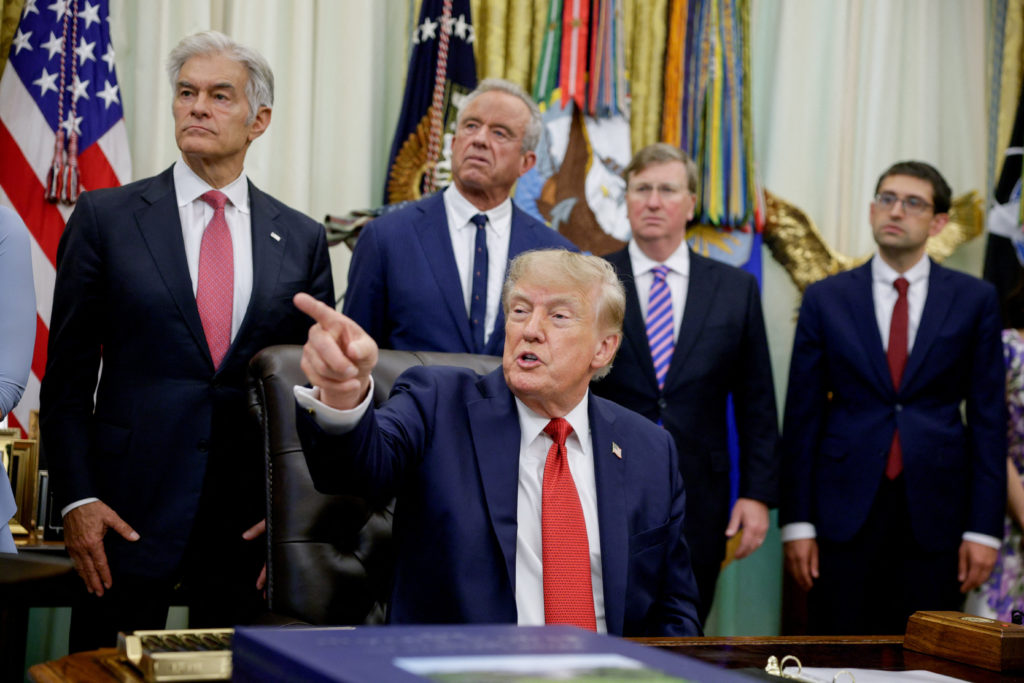
The ban Trump announced Friday stopped being a Truth Social post on Saturday morning. Reporters from all three outlets he named showed up for work at the White House and were turned away at the badge reader. CNN and MS NOW each had credentials physically confiscated.
MS NOW correspondent Akayla Gardner got through two gates before it went wrong. At the magnetometers her badge threw a red light and a beep. “The officer asked me to hand over my badge,” she said on air. “He said that it was disabled. I asked why I was not able to get inside. He said it was above him.”
Betsy Klein, CNN’s senior White House reporter, was stopped the same morning and said her badge had been deactivated too. Her credential was taken after she spent about a minute in the security kiosk. A Politico reporter was also denied entry, though that reporter hasn’t been named in any coverage so far.

One MS NOW photographer was blocked as well. A producer for the network got in.
We covered the announcement Friday, including the $8 million Politico claim Trump used to justify part of it, which describes federal agencies buying subscriptions rather than anyone funding a newsroom. What’s new is that somebody went and turned the badges off.
What a hard pass actually is
Worth explaining, because the word “ban” is doing a lot of work here.
A White House hard pass is a building credential. It gets a reporter through the gate and into the briefing room, the press workspace and open events on the grounds. It isn’t a press card, and losing it doesn’t stop anyone from reporting. It stops them from reporting from inside, which in practice means no shouted questions, no pool duty, and no being in the room when something happens.
The producer getting through while the correspondent and photographer didn’t is the tell. This was done name by name, off a list, not by switching off an outlet.
Trump says two more are coming
Asked Friday who might be next, he named The New York Times and The Washington Post, calling them fake news.
He stopped short of saying their reporters would lose access. “We’re probably not going to display the paper anymore in the White House, those papers,” he said. “But we haven’t taken the step of throwing them out.”
It’s worth noting the ban was announced on Truth Social, the same channel we track weekly, rather than through any formal process. No order was published. Nobody at the White House has explained the mechanism, and when asked, officials declined further comment and pointed back to Trump’s posts.
Where this has already been to court
The AP ran a version of this in 2025 after it refused to stop saying Gulf of Mexico. It sued and won at the district level, then lost the stay fight. The D.C. Circuit paused the order 2-1, with Judge Neomi Rao writing that the injunction “impinges on the President’s independence and control over his private workspaces.”
Judge Cornelia Pillard dissented, saying the majority couldn’t be squared with “any sensible understanding of the role of a free press in our constitutional democracy.”
So there’s live appellate language on the president’s side about spaces he controls. Anyone telling you this is obviously illegal is skipping that. First Amendment scholars quoted since Friday have said the opposite, that the move is unconstitutional, and both things can be true at once: a practice can be unconstitutional in principle and still survive the specific court that hears it.
Who is objecting
The White House Correspondents’ Association came out against it, and the detail worth noticing is who signed the statement. WHCA president Jacqui Heinrich is a Fox News reporter.
“The president said it plainly in the Oval Office, describing his own planned action as a ‘ban on the free press,’” Heinrich wrote. She added that the Constitution’s protection “does not depend on whether the president likes a news organization’s coverage, agrees with its reporting, or approves of the questions its journalists ask,” and that the WHCA “stands in defense of our colleagues at CNN, MSNOW and Politico who are being singled out for doing their jobs.”
We looked this week at how conservative outlets built a hero out of a juror, and the reverse applies here: a press corps closing ranks across outlets, with a Fox reporter leading it, is unusual enough to be worth marking.
CNN said it has “a right under the U.S. Constitution to do our reporting without hinderance or interference from the government and this ban is an illegal assault on this fundamental right.”
MS NOW said it will “take any and all steps necessary to defend our First Amendment rights and the essential role of independent journalism in our democracy,” and added a line aimed at the ownership question: “The White House belongs to the American people and the decisions made inside are funded by our tax dollars.”
Politico said it “will vigorously defend our First Amendment rights against any attempt to restrict them” and that the subsidy claim has been “thoroughly debunked.” All three have signaled they’re heading to court.
The loudest objections came from the right
This is the part that makes the story more than a partisan fight. Some of the sharpest criticism came from Fox News and from conservatives who have spent years attacking these same three outlets.
Jonathan Turley, the George Washington law professor Trump has repeatedly cited approvingly, called it an assault on press freedom while going out of his way to say he shares the criticism of the outlets involved.
Turley added that barring outlets “would raise serious constitutional questions and undermine the country’s long-standing position as a voice for the free press,” and made a practical point: “It is hard for the United States to advocate for press rights globally when it is banning disfavored outlets.”
Brit Hume, Fox News’ chief political analyst, said he agreed with Turley “100%%” and added a blunt prediction. If Trump “thinks this will lead to more favorable coverage, I think he’s dreaming.”
Ari Fleischer, who was George W. Bush’s press secretary and is now a Fox contributor, agreed the coverage is biased and said the remedy is wrong. “Open the pool and the briefing room to conservatives. Challenge liberal reporters. Argue and defeat them. Don’t ban them. Or one day they’ll ban us.”
Guy Benson, a Fox political analyst, was the most direct about the motive. “The WH media ban, even if you hate the targeted outlets, is a bad idea & bad precedent,” he wrote. “It’s the sort of thing he does when he doesn’t feel like things are going well politically. Beyond his hardcore loyalist base, it achieves nothing and is exhausting.”
Not everyone on the right objected on principle. Laura Loomer, a Trump loyalist, used the moment to complain that the White House has mishandled credentials for pro-Trump independent journalists while letting “hostile” reporters in. That’s a grievance about who gets access, not an argument against controlling it.
One more detail worth sitting with, reported by Mediaite: while Fox contributors were criticizing the ban on social media, the network’s primetime lineup didn’t cover it at all.
The BeezLoop Take
The legal question and the practical question are pulling in different directions, and most coverage is picking one. Legally, the D.C. Circuit has signaled a president has wide latitude over his own workspaces, and a hard pass has never been a constitutional entitlement. Practically, no specific story was cited, no correction was demanded, and no error was identified. The stated trigger is coverage the president dislikes.
The reaction is its own evidence. When Turley, Hume, Fleischer and Benson all say the same thing, the objection isn’t coming from people who are fond of CNN. It’s coming from people who think the tool is dangerous regardless of who it’s pointed at, which is Fleischer’s point exactly: one day they’ll ban us.
Our position: the absence of a specific complaint is the whole story. An administration that believed a newsroom got facts wrong has a fast, cheap remedy, which is to say what the facts are. Pulling badges instead tells you the objection is to the coverage existing, not to it being inaccurate. That’s worth naming even if a court eventually allows it.
Saturday also settled the question we had on Friday. This isn’t a threat or a single reporter losing a pass in a dispute. Three newsrooms were named on social media one afternoon and their people were physically stopped at the gate the next morning, with no published order and no stated process. The speed is the part to sit with.
Where we’d still hold back: scope is unclear. We don’t know how many passes were pulled at each outlet, whether this reaches the full press corps at those three or only the White House teams, or what happens to pool rotations. The Times and Post are being talked about but nothing has happened to them. And an administration that can do this in a morning can undo it in a morning, which is its own kind of leverage.
What happens next
Watch for a lawsuit, probably fast. CNN sued over the Jim Acosta revocation in 2018 and got the pass back within days on due-process grounds, which is a different argument from the First Amendment one and historically the quicker of the two. The AP case is the cautionary tale on the slower track.
Also watch the WHCA pool rotation, because that’s the mechanism that decides who travels with the president and who is in the room for small events. If the association keeps the three outlets in the rotation, the White House has to keep turning them away one by one, in public, every day.
Sources: NBC News · CNN · The Hill · Variety · WHCA statement · Al Jazeera on the legal question