

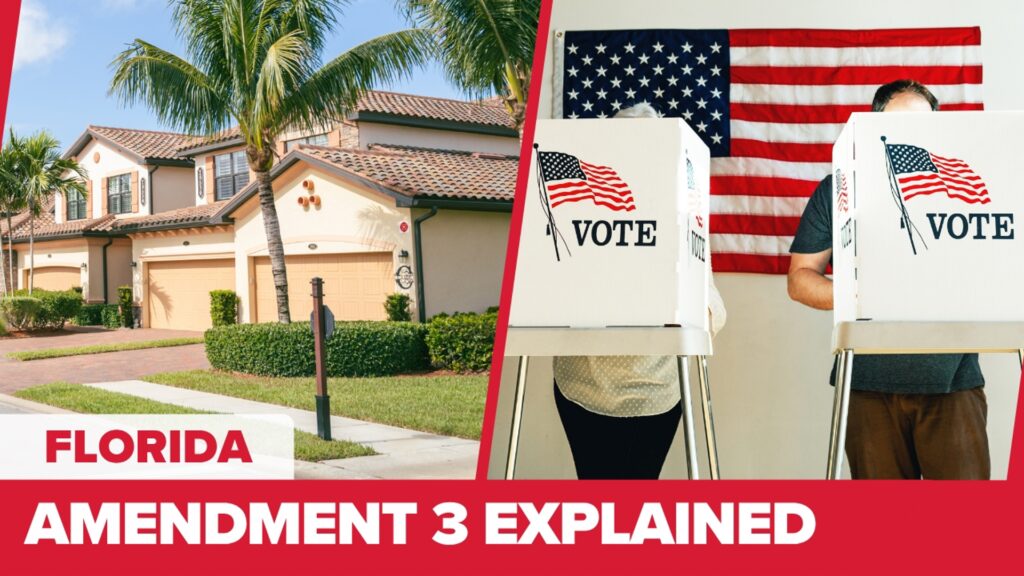
If you own your home in Florida, Amendment 3 on the Nov. 3 ballot could cut your property tax bill by a couple thousand dollars a year. If you rent, own a second home or run a business, it doesn’t give you a break, and local governments would have billions less to spend on police, fire and roads. Here’s what a yes or no vote actually means. It needs 60% to pass, and early voting is already underway.

What does Florida Amendment 3 do?
- Bigger homestead exemption: the amount of your home’s value shielded from non-school property taxes jumps from $51,411 today to $150,000 in 2027 and $250,000 in 2028, then rises with inflation.
- Still pay school taxes: the exemption doesn’t apply to school district taxes.
- Smaller cap for everyone else: yearly assessment increases on non-homestead property, like rentals and second homes, would be capped at 5% instead of 10%.
- Newer residents wait: people who weren’t permanent Florida residents by Dec. 31, 2026, would get a $50,000 exemption for their first five years.
- Spending limits: counties and cities would have to use property taxes for listed purposes like public safety, schools, infrastructure and natural resources.
You can read the official ballot language in the Florida Department of State’s amendment booklet. A judge found the first version of the ballot summary misleading, and it had to be rewritten.
How much would Amendment 3 save homeowners?
For a typical homesteaded home, about $1,035 in 2027 and $2,085 in 2028, according to Florida TaxWatch’s analysis, though it depends on your local tax rate. Homes assessed at or below $250,000 by 2028 would pay no county, city or special district property taxes at all, only school taxes. Here’s NBC 6’s example: on a home with a $300,000 taxable value, non-school taxes would apply only to $50,000.

What would Amendment 3 cost local governments?
A lot. The state’s revenue estimating conference projects local governments would lose about $4.9 billion in 2027, $8.7 billion in 2028 and $45.8 billion over five years, at current tax rates. Coral Springs alone estimates a hit of about $14.5 million in 2028 and $26.8 million in 2029, NBC 6 reported. The Florida Sheriffs Association warned the loss “could affect public safety funding.”

Who supports and opposes Amendment 3?
Yes: Miami-Dade Property Appraiser Tomás Regalado, Miami-Dade Sheriff Rosie Cordero-Stutz, Republican governor candidate Byron Donalds and the Florida Realtors. No: Democratic governor candidate David Jolly and Florida TaxWatch, a nonpartisan taxpayer research group that called it “not really tax cuts as much as tax shifts.” In an NBC 6/Telemundo 51 poll, 55% supported it, short of the 60% it needs.
The BeezLoop Take
Florida homeowners are getting crushed by property taxes and insurance, and a real tax cut would be welcome. But this one picks winners. Homeowners get a big break. Renters, who’ve watched rents soar, get nothing, and neither do small businesses. TaxWatch is right that when one group pays less, the cost moves somewhere, either onto everyone else or into cuts to police, fire and roads.
If you vote yes, go in knowing your county may raise its tax rate or cut services to make up $45 billion. If you vote no, you’re betting the Legislature comes back with a fairer fix. Neither is free.
The open question: if Amendment 3 passes, which local services get cut first, and will renters end up paying more anyway?
Also on BeezLoop: Florida will send more state school money to vouchers than public schools in Miami-Dade, and why electric and water bills keep climbing.
Sources: Florida Department of State amendment booklet · Florida TaxWatch · NBC 6 South Florida · NBC 6 South Florida (video)