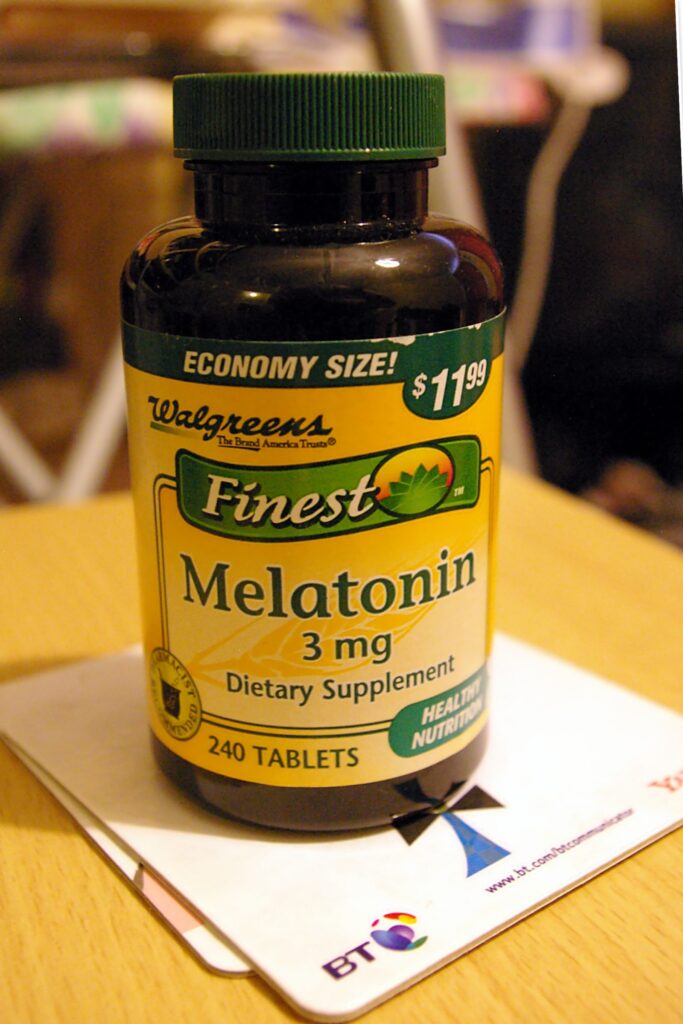
A large study found that people with chronic insomnia who took melatonin for a year or longer had roughly a 90% higher risk of developing heart failure over the following five years. That number is alarming on its face, and it is also the number most likely to be misread, so it’s worth walking through what the researchers actually measured.
What the study found
Researchers reviewed five years of electronic health records for more than 130,000 adults with chronic insomnia drawn from the TriNetX Global Research Network, comparing long-term melatonin users, defined as 12 months or more, against matched non-users. Over five years, 4.6% of the long-term melatonin users developed heart failure, compared with 2.7% of non-users. Chronic users were also roughly twice as likely to die during the study period and about 3.5 times more likely to be hospitalized for heart failure. The findings were presented at the American Heart Association’s Scientific Sessions as preliminary research.
What “90% higher risk” actually means here
This is the part worth slowing down on, because the headline figure and the practical figure are very different things. Going from 2.7% to 4.6% is a jump of about 1.9 percentage points in absolute terms. Expressed as a relative increase, that same gap is roughly 90%. Both are accurate. But “90% higher risk” describes the size of the difference between two groups, not your personal odds, and if you are a long-term melatonin user, the study’s own numbers say the large majority of people in that group, better than 95%, did not develop heart failure over five years.

The bigger caveat: this cannot show cause
The study is observational. It looked back at health records and found an association; it did not assign people to take melatonin or not, which is the only design that can establish cause and effect. That distinction matters a lot here for a specific reason: everyone in the study had chronic insomnia, and severe, persistent insomnia is itself linked to cardiovascular problems. People who take melatonin for more than a year are, almost by definition, people whose sleep problems did not resolve. It is genuinely difficult to separate the effect of the supplement from the effect of the underlying condition that led someone to keep taking it. Researchers have also raised the possibility that routine supplementation may mask symptoms that would otherwise prompt someone to get checked out.
What to actually do with this
Nothing in this study suggests occasional use, for jet lag or a few bad nights, carries this risk; the association was specific to continuous use of a year or more. The reasonable takeaway is narrower than “melatonin is dangerous.” If you have been taking it nightly for months as a standing solution to insomnia, that is worth raising with a doctor, both because of these findings and because year-plus insomnia warrants actual treatment rather than indefinite self-medication.
One thing the study doesn’t address but is worth knowing: in the U.S., melatonin is sold as a dietary supplement, not a drug, so it isn’t subject to the same FDA pre-market approval as medication. Independent testing has repeatedly found products whose actual melatonin content differs substantially from the label. Anyone taking it long-term is dosing with less precision than they probably assume.
Related from BeezLoop: Opinion: That '90% Higher Risk' Headline Is True, Lucas Fire Grows to Nearly 3,500 Acres Along Mendocino-Lake County Line, Forcing Evacuations and Two Teens Arrested in Separate School Shooting Threat Cases in Kentucky and Massachusetts.