

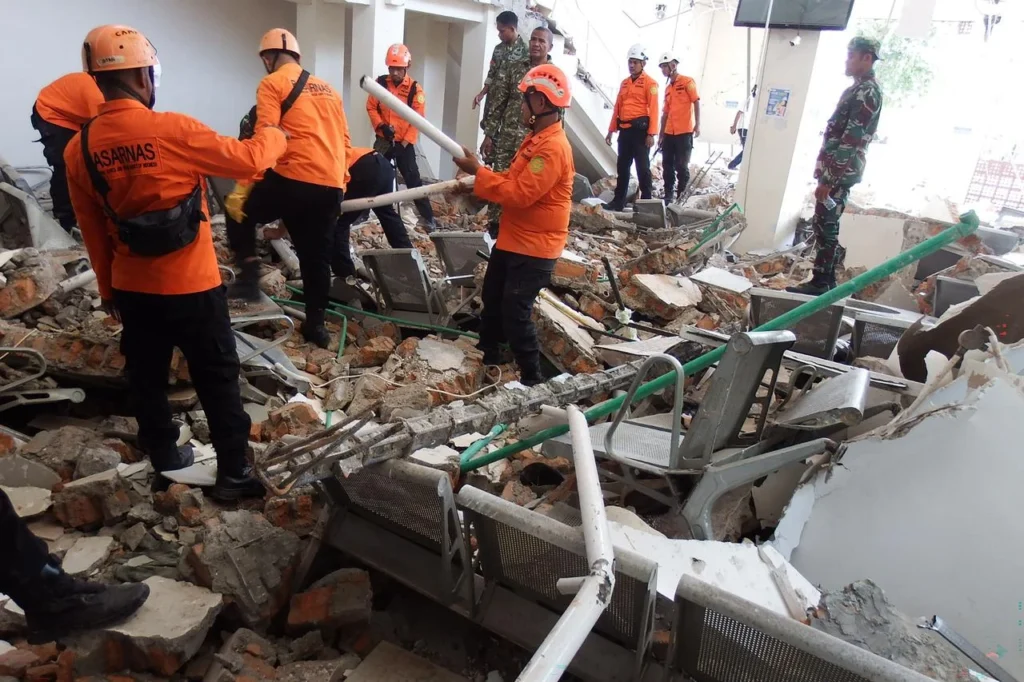
A 7.7 magnitude earthquake struck off the coast of Flores Island in Indonesia’s East Nusa Tenggara province early Saturday morning, with the death toll climbing to at least 51 as rescue crews continue pulling bodies from the rubble. The quake’s epicenter was about 68 kilometers north-northwest of the city of Ende, at a depth of roughly 10 kilometers, and was followed by more than 200 aftershocks, including a magnitude 6.9 tremor just hours later.
Local disaster officials say hundreds of homes have been destroyed or damaged across the province, along with schools, medical centers, and other public buildings, forcing roughly 5,000 displaced residents into temporary shelters. Rescue teams have struggled to reach Nagekeo, the region closest to the epicenter, after landslides blocked roads and knocked out communications.
Building on Borrowed Time
East Nusa Tenggara sits on one of the most seismically active stretches of the Pacific Ring of Fire, where a major earthquake isn’t a question of if but when. Much of the region’s housing, however, is built from unreinforced masonry and timber that was never engineered to withstand a quake of this size, which is a major reason the death toll and damage climbed as fast as they did. Retrofitting vulnerable homes with basic seismic reinforcement is neither exotic nor especially expensive by global aid standards, but it consistently loses out to higher-profile, higher-visibility initiatives when it comes to where international disaster funding actually gets spent.

The Long Recovery Ahead
With landslides still blocking roads to the hardest-hit areas and thousands sheltering in temporary camps, the immediate priority is search and rescue. But the disparity between the region’s earthquake risk and the durability of its housing stock is likely to resurface the next time the ground shakes here, because geologically, there will be a next time.
🔥 The Flores Island Earthquake:
What do you think? Should international disaster aid prioritize funding seismic retrofitting in high-risk regions over broader climate initiatives, or is that a false choice between two things aid organizations should be doing anyway? Let us know your thoughts in the comments on BeezLoop.com!
Update: Toll Climbs to 68 as Independence Day Aid Effort Continues
Indonesia’s National Disaster Management Agency now puts the death toll at 68, with 213 people injured and more than 12,800 displaced across Flores Island. Over 1,600 aftershocks have been recorded since the initial quake, and a provincial update found nearly 8,000 homes damaged.
The government has deployed more than 1,800 military and police personnel, along with 10 aircraft and several vessels, to distribute over 100 metric tons of emergency aid. Thousands of residents were still waiting for that aid to reach them as Indonesia marked its 81st Independence Day, with some of the hardest-hit villages remaining cut off by damaged roads.
Related from BeezLoop: Anak Krakatau Eruption Shuts Eight Indonesian Airports, Strands More Than 270,000 Travelers, Nepal Flood Toll Soars Past 683 Dead, Nearly 3,000 Missing and Borneo Wildfire Haze Forces Nearly 600 Malaysian Schools to Close.