
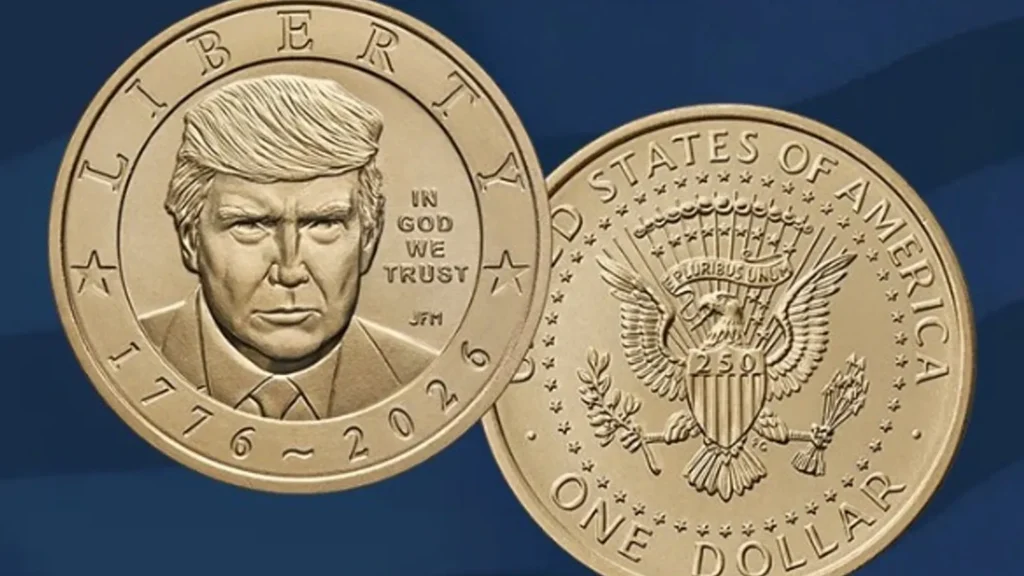
The US Mint started selling a new dollar coin on Tuesday with President Trump’s face on it, and for the first time in the country’s history, that face belongs to someone actually holding the office right now. Rolls of 25 coins went on sale for $61 and bags of 100 for $154.50, exclusively through usmint.gov starting at noon Eastern.
The coin is part of the Mint’s “Semiquincentennial President Donald J. Trump $1 Coin” program, tied to America’s 250th anniversary, according to the Mint’s own announcement. The obverse shows Trump in a suit, facing forward, ringed by “LIBERTY,” “IN GOD WE TRUST” and “1776~2026.” The reverse carries the Presidential Seal: an eagle holding an olive branch and arrows, a shield marked “250” for the anniversary, and a banner reading “E PLURIBUS UNUM.” Despite the gold-toned finish, the coin is mostly copper, with zinc, manganese and nickel mixed in — no actual gold.
A law built to keep this from happening
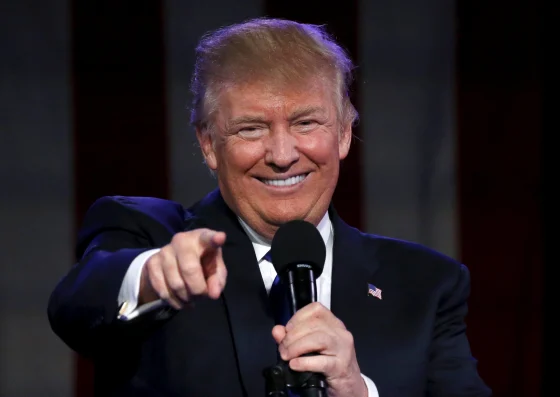
Putting a living president on money isn’t just unusual, it’s something federal law has specifically tried to prevent. An 1866 statute known as the Thayer Amendment bars the portrait of any living person from appearing on US currency and securities, a rule Congress adopted partly because George Washington himself had turned down the honor, worried that putting a leader’s face on money looked too much like something a king would do. That law was written with paper currency and securities in mind, and doesn’t spell out coins by name, which is the gap the Treasury Department is using to justify this release.

Treasury Secretary Scott Bessent has pointed to the Circulating Collectible Coin Redesign Act of 2020, a law Trump signed in his first term authorizing a run of anniversary-themed dollar coins through 2026, as the legal basis for the design. Bessent has described the coin as honoring “the enduring legacy of liberty” and “the strength of American values.” Trump, for his part, told Fox Business the whole thing is “very unusual, but I was honored by it,” calling it “very cute.”
Not everyone signed off
The rollout skipped some of the usual guardrails. The Citizens Coinage Advisory Committee, the body that normally reviews new coin designs, says it “declined to consider” this one. One committee member, Donald Scarinci, put it bluntly: “The concept that the secretary of the Treasury can create his own coin — it’s illegal.” A colleague on the committee, Kellen Hoard, raised the same question about whether the Mint could move forward at all without that review. The Commission of Fine Arts, which does weigh in on design, recommended a profile portrait and a different eagle image; neither suggestion made it onto the final coin.
In Congress, Senator Catherine Cortez Masto introduced a bill aimed at blocking any living or sitting president from appearing on US currency, and five other Democratic senators, along with independent Senator Angus King of Maine, asked Bessent directly to scrap the design before it went into production. None of that stopped Tuesday’s sale.
The one time this happened before
There is a partial precedent, and it did not go well. In 1926, the Mint issued a half dollar for the country’s 150th anniversary showing then-President Calvin Coolidge silhouetted behind a bust of George Washington. It was a commemorative coin, not one meant for everyday circulation, and the public mostly ignored it. Of the roughly one million coins struck, some 860,000 went unsold and were eventually melted down.
This time, the Mint is betting on a bigger audience. The rolls and bags sold Tuesday are a first batch, and whether the coin becomes a genuine curiosity item or the government’s next collectible flop, the sale itself has already done something no other president has managed while still in office: put his own face into circulation.
Related from BeezLoop: Trump Admits He's Building Monuments to Himself Because "Nobody Will Do It Once I'm Gone", Maria Bartiromo Suddenly Exits Fox News After 12 Years, With Reports Tying Her Departure to… and Trump Says Bombardier Jets Can No Longer Be Sold in the US Unless the Canadian Company….