

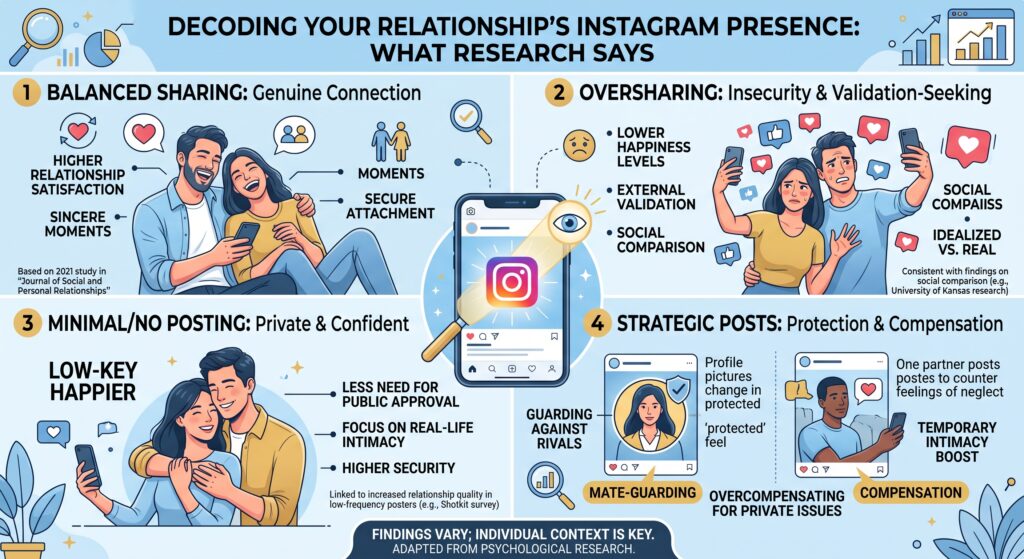
Researchers at Arizona State University’s Relationships & Technology Lab, led by Liesel Sharabi, set out to answer a question a lot of people quietly wonder about their own dating lives: does how visible a couple is on Instagram actually reveal something real about the relationship, or is it just performance? Their answer, published in the Journal of Social and Personal Relationships, is that it’s genuinely revealing, just not in the simple way most people assume.
The core finding: couples post about each other more, and more publicly, when they report higher relationship satisfaction, investment, and commitment. That part isn’t especially surprising. The more interesting finding is what happens on the other end. People who perceived themselves as having access to higher-quality alternative partners, meaning they believed better options were realistically available to them, tended to make their current relationship less visible on Instagram, posting less and tagging less, regardless of how happy they said they actually were.
Why the “Alternatives” Piece Matters More Than the Obvious Part
This is the part worth actually sitting with. It suggests that relationship visibility on social media isn’t a clean, direct readout of how happy someone is. It’s filtered through how secure someone feels about the relationship’s future, specifically whether they’re quietly keeping the door open. Someone can report reasonable satisfaction in a relationship and still be less publicly invested in it, if some part of them is tracking other options.

That reframes what a lot of people do instinctively when they scroll through a partner’s, or an ex’s, or their own feed looking for clues. A quiet Instagram presence around a relationship doesn’t necessarily mean something’s wrong in the way people assume. It might. It might also just mean two private people who aren’t performing their relationship for an audience at all, which the study doesn’t fully separate out from the alternatives-monitoring effect.
The Bigger Pattern This Fits Into
This finding sits inside a broader, messier body of research on social media and relationships that’s worth being honest about rather than flattening into a single takeaway. Other work has found that heavy reliance on social platforms specifically for relationship maintenance, using likes, comments, and posts as a stand-in for actual connection, tracks with lower relationship satisfaction over time, while couples who deliberately choose presence over scrolling report the opposite effect. Researchers describe part of the mechanism as digital emotional contagion, where the emotional tenor of what you’re consuming online bleeds into how you show up with your actual partner.
None of this adds up to a tidy rule like “post more” or “post less.” It adds up to something more useful: how a couple uses social media is a real signal, but it’s a signal about security and attention allocation more than it’s a scoreboard of who loves whom more, and reading it as the latter is usually where people go wrong.
What do you think? Do you actually read into how visible (or invisible) couples are on social media, or is that reading too much into a habit that doesn’t mean much? Let us know your thoughts in the comments on BeezLoop.com!
Related from BeezLoop: Americans Marry Less Than They Used To, "Dimagi Naxal Party" Instagram Account Goes Viral, Then Gets Suspended and Meta to Pay Up to $17.1 Billion in Landmark Child Safety Settlement.