
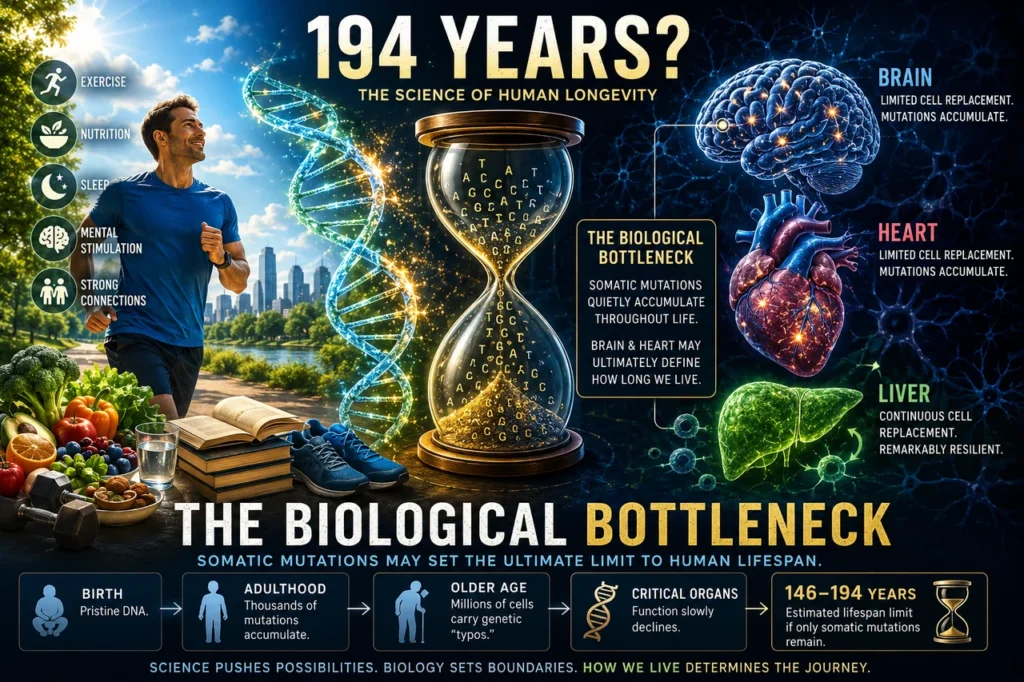
A new study out of the Skolkovo Institute of Science and Technology in Moscow put a number on something scientists have argued about for decades: the absolute ceiling on how long a human body could last, even in a world with no disease, no accidents, and perfect medical care. Their answer, published in the journal npj Aging, is somewhere between 146 and 194 years, with a median estimate around 156.
Before anyone starts planning for a second century of life, it’s worth being clear about what this study actually is. It’s not a prediction about what medicine will achieve. It’s a computational model, a thought experiment built to isolate one specific biological process and see where it alone would eventually stop the body from working.
What’s Actually Setting the Limit
The process in question is the slow buildup of somatic mutations, small errors in DNA that accumulate in your cells after birth, as opposed to the mutations you’re born with. Every time a cell divides, there’s a small chance of copying errors. Over decades, those errors pile up.

The researchers modeled four organ systems and found something that lines up with basic biology most people already sense intuitively: your liver and skin can shrug off a lot of this damage because they constantly replace their own cells, cycling out the damaged ones. Your brain and heart can’t do that in the same way. Once those tissues accumulate enough mutation damage, the model says, no amount of regeneration elsewhere can save you. That’s what actually draws the ceiling.
Why This Number Isn’t a Promise
It’s worth pushing back on the more breathless versions of this story circulating online. A model that isolates ONE variable and calculates its theoretical endpoint is a useful scientific exercise, but real human bodies don’t age from a single cause. Cardiovascular disease, cancer, infection, and dozens of other factors will end a life long before somatic mutation alone would. The current world record for a verified human lifespan is 122 years, and that gap between the record and the model’s 146-to-194-year range is exactly the space where every other cause of death still operates unchecked.
So what does a study like this actually buy us? Mostly, a clearer target. If researchers eventually find ways to slow the accumulation of somatic mutations in the brain and heart specifically, rather than chasing a vague, all-purpose “cure for aging,” this model gives them a more precise idea of what they’d be extending life toward, and which tissues matter most. It’s a map of a distant destination, not a vehicle to get there.
Can Humans Live 194 Years? What the Study Says
What do you think? Would a much longer lifespan actually be a good thing for society, or does it just delay problems we haven’t figured out how to solve at current lifespans? Let us know your thoughts in the comments on BeezLoop.com!
Related from BeezLoop: We Thought We Knew the World's Cats, A 30-Year Harvard Study Found the Exact Amount of Strength Training That Adds Years to Your… and The 300-Year-Old Sturgeon: What a Quiet Fish Tells Us About Our Scurrying, Screaming Lives.