
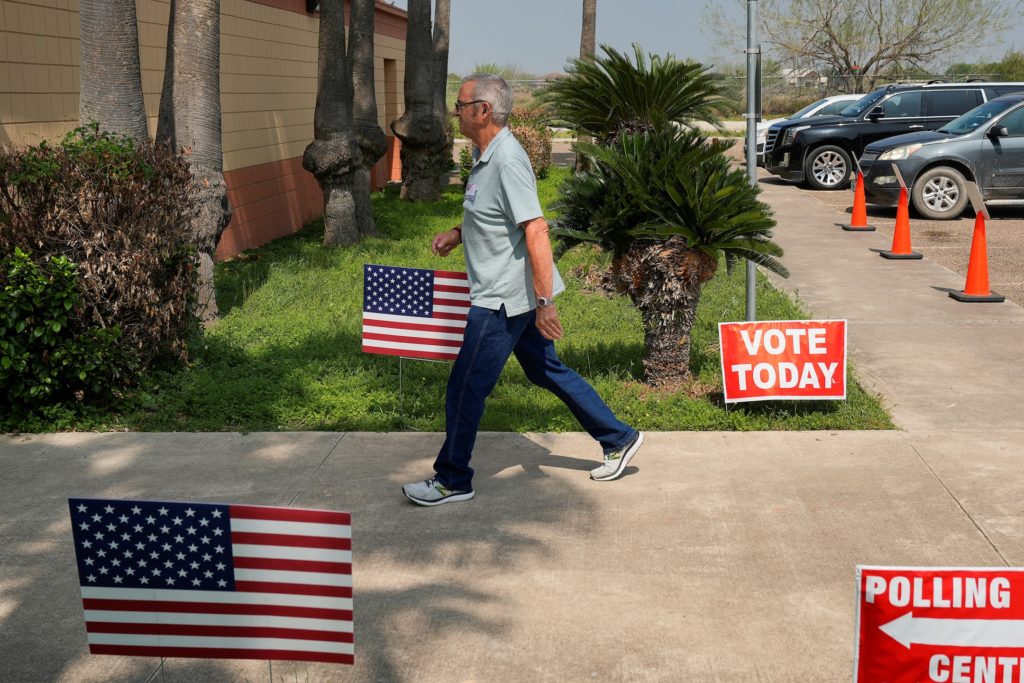
Tarrant County, Texas voted last month to close 92 polling places five weeks before a midterm election with a US Senate race on the ballot. It is not an outlier. Since the Supreme Court stopped requiring certain states to get federal approval before changing how people vote, counties have closed 1,688 of them.
What just happened in Texas
On September 1, 2026, the Tarrant County Commissioners Court voted 3-2 along party lines to cut Election Day polling places from 316 to 224.
- For: County Judge Tim O’Hare, Commissioners Matt Krause and Manny Ramirez, all Republicans.
- Against: Commissioners Alisa Simmons and Roderick Miles Jr., both Democrats.
- That is 92 closures, roughly 30%, in a county with about 1.3 million voters.
Officials say the plan drops low-turnout sites, keeps the rest about 1.5 miles apart and near bus stops, and saves money. Supporters cited locations that drew as few as 34 voters all day.

The NAACP and the ACLU of Texas wrote that the reductions cluster in majority-minority areas of Fort Worth and Arlington. The Arlington City Council passed a resolution asking the county to reconsider. Tarrant is the most closely divided large county in Texas, and the Senate race between Ken Paxton and James Talarico runs through it.
Tarrant County has not published a precinct-level demographic breakdown of which 92 sites closed.
The national number
The benchmark count is Democracy Diverted, from the Leadership Conference Education Fund, which pulled precinct-level polling place lists through public records requests rather than relying on what counties voluntarily report to the federal government.
- 1,688 polling places closed across 757 counties, 2012 to 2018, in jurisdictions once covered by Voting Rights Act preclearance.
- Nearly double the 868 the same researchers counted in 2016.
- About 1,200 of them closed between the 2014 and 2018 midterms.
One honest caveat. That report came out in 2019 and stops at 2018. It is still the most rigorous national count anyone has produced and there is no equally thorough update. A separate 2024 analysis found roughly one in five Election Day polling places nationally has closed over the past decade. Anyone quoting 1,688 as a present-tense figure is misusing it.
By state
- Texas: 750. More than the next two states combined. Texas is about 39% Latino and 12% Black.
- Arizona: 320 reductions, touching nearly every county.
- Georgia: 214. Nearly half of the state’s 159 counties closed at least one. Georgia is about 30% Black.
By county
- Maricopa County, Arizona (31% Latino): 171. The largest of any county in the country.
- Dallas County, Texas (41% Latino, 22% Black): 74.
- Travis County, Texas (34% Latino): 67.
- Harris County, Texas (42% Latino, 19% Black): 52.
A 2018 study found the pattern holds in aggregate: counties that are majority people of color lost an average of seven polling places. Predominantly white counties lost an average of two.
Arizona: what happens when the theory gets tested
Maricopa County is the clearest real-world test of the argument officials use to justify closures, and it is worth walking through because both sides cite it.
For the March 2016 presidential primary, County Recorder Helen Purcell cut Maricopa to 60 voting locations, down from about 200 in 2012. The reasoning was the standard case: bigger sites, better staffing, and for the first time any voter could use any location, so nobody would be stranded by precinct assignment.
- That worked out to about one site per 20,833 eligible voters.
- Other Arizona counties were running roughly one per 2,500.
- Waits hit five hours. Some people voted after midnight.
Purcell acknowledged she had underestimated Election Day turnout. Officials also argued the long lines hit minority and non-minority voters alike.
Georgia: seven of nine
In 2018 an elections consultant working with the office of then-Secretary of State Brian Kemp, who was at the same time running for governor, recommended that Randolph County close seven of its nine polling places. Randolph is majority Black, rural and low income.
The county scrapped the plan after national coverage. Reporting at the time found the same consultant had already persuaded ten other low-income counties with large Black populations to close sites. Those closures went ahead.
Separately, officials in Macon-Bibb County moved to close 14 of 40 precincts, reported at the time to be in majority-Black neighborhoods. Eight were shuttered.
The defense, stated fairly
Officials give reasons, and some are legitimate.
- Vote centers. Texas and Arizona counties let any voter cast a ballot anywhere in the county. Fewer, larger, better-equipped sites can in theory serve more people.
- The shift to early and mail voting. Election Day volume has fallen almost everywhere.
- Population decline in some rural counties.
- Budgets, aging buildings, and school safety rules that pushed polling out of schools.
None of that is invented, and an account that ignored it would not be worth reading.
What the evidence shows about the effect
- Relocating a polling place cuts in-person turnout by roughly 5.65 to 6.9 percentage points.
- A quarter-mile increase in distance is associated with up to 5% of affected voters dropping off.
- Absentee voting partly offsets the loss for white voters. It offsets less for voters of color.
- The Brennan Center found the white and non-white turnout gap widened in the decade after 2013, reversing decades of narrowing.
The BeezLoop Take
The vote center argument is the serious one and it deserves to be met rather than waved off. Replacing forty church basements with twenty-five properly staffed centers where anyone can vote is a real improvement, and advocacy groups quoting raw closure counts without that context are being imprecise.
Maricopa is what happens when that argument meets arithmetic. The county ran the experiment at full scale in 2016 and produced five-hour lines and ballots cast past midnight in a presidential primary. One site per 20,833 voters against one per 2,500 elsewhere in the same state is not an administrative judgment that went slightly wrong. The theory did not fail because vote centers are bad. It failed because the theory grants permission to close sites without imposing any discipline about how many, and the number gets picked by a budget rather than by turnout modeling.
The distribution is the part no efficiency argument explains. Seven closures on average in majority-minority counties against two in white ones is not a story about tight budgets, because budgets are tight everywhere. If cost and population were driving this, the burden would scatter. It did not scatter. It landed on Dallas, Travis, Harris and Maricopa, four of the largest and most diverse counties in the country, several of them growing.
What changed in 2013 is the thing to hold onto. Before then, a covered county had to show in advance that a closure would not make voting harder for minority voters. After, a voter has to sue afterward, which takes money, standing and years. The closures did not necessarily become more malicious. They became unreviewable, and 1,688 is what unreviewable looks like over five years. Randolph County proves the point from the other direction: it took national press to stop seven closures in a county of a few thousand, and the ten counties nobody covered lost theirs.
The fix is unglamorous and is not happening. Require any jurisdiction to publish turnout and demographic data for every site before it closes it. That is a records rule, not a federal takeover, and it would settle almost every one of these fights on facts. Tarrant County could end its own dispute this week by releasing the numbers for all 92. It has not, and that silence is doing more damage to its case than any accusation.
If closures are about cost and turnout, why do majority-minority counties lose three times as many as white ones?
If closures are about cost and turnout, why do majority-minority counties lose three times as many as white ones?
Why is no county in America required to publish the numbers before it shuts a polling place down?
Why is no county in America required to publish the numbers before it shuts a polling place down?
Related: the DOJ is sending over 1,000 monitors to polling places, the Supreme Court let a voter purge database keep running, and Florida announced 20 voter fraud arrests against nearly 11 million ballots.
Sources: Leadership Conference Education Fund, Democracy Diverted · NBC News on Tarrant County · NPR on the 2016 Arizona primary · NBC News on Randolph County · Voting Rights Lab · Political Science Research and Methods, 2025 · Brennan Center