

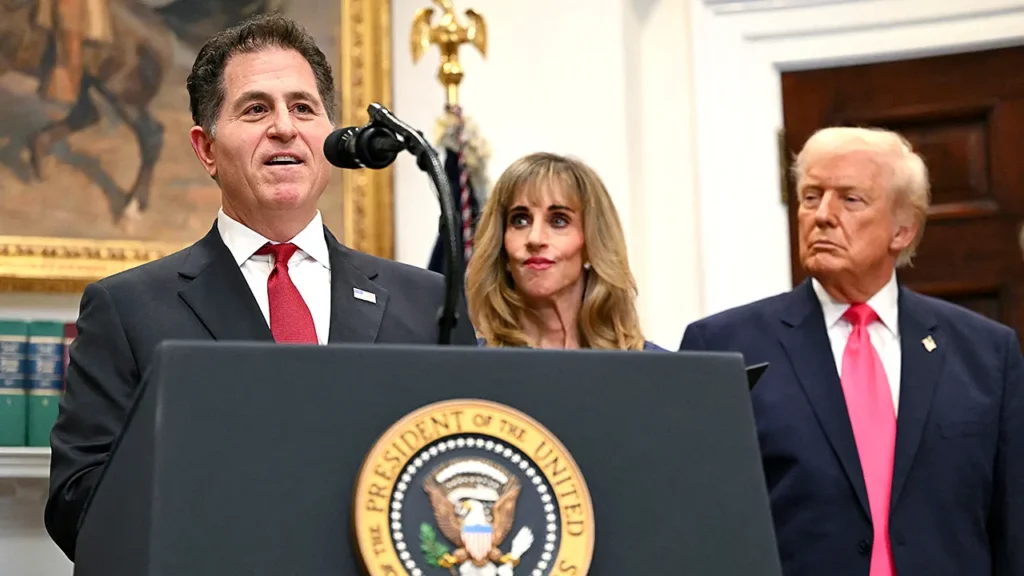
On Wednesday, two of the richest men in America went on national TV to explain what’s good for working families. In the Oval Office, Michael Dell stood next to President Trump to promote “Trump Accounts” for kids. That night on Fox News, Jeff Bezos told Bret Baier that “success is not villainy” and that politicians who blame landlords for housing costs probably “don’t have a solution.”
Nobody said success was evil. What working people have been asking for is simpler: play fair. Here’s what each of them actually said, and what they left out.

What are Trump Accounts, and what did Michael Dell say?
Trump Accounts are investment accounts for children, created by last year’s tax law. Kids born from 2025 through 2028 get a one-time $1,000 from the Treasury. Families can add up to $5,000 a year, and the money is invested in a stock index fund until the child turns 18. The administration says about 70 million children now have accounts ready to be claimed.

Michael and Susan Dell pledged $6.25 billion to put $250 into the accounts of up to 25 million kids born from 2016 through 2024 in lower- and middle-income areas. That’s real money, and the Dells deserve credit for giving it. At the White House, Dell said the accounts can teach kids about investing and how money compounds over time, according to STL.News.
Do Trump Accounts actually help working families?
Less than the sales pitch suggests. The government’s own website projects that a $1,000 seed could grow to $243,000 by age 55. When Morningstar ran the numbers for CNBC, factoring in real-world returns and families pulling money out, the average was closer to $38,000, and some accounts ended at zero.
Morningstar found outcomes “significantly better” for higher-income families, because they can keep contributing and don’t have to raid the account for bills. Stanford economists have warned that while the accounts are open to every child, the benefits will flow mostly to families who can put in thousands a year. A $250 gift helps. It doesn’t change who gets ahead.
What did Jeff Bezos say about socialism and housing?
Speaking at Blue Origin’s factory in Florida for Fox News’ 30th anniversary, Bezos admitted housing costs are a real problem. “You can’t pretend that there are no problems,” he said, according to Fox News. But he blamed government rules that limit building, pointed to Austin as a city where easier construction has brought prices down, and warned voters about politicians “picking villains and pointing fingers.”
He defended business success too: “There’s nothing wrong with making unbelievably good chicken that people love,” he said of Raising Cane’s. “And it doesn’t make him a bad person.”

The BeezLoop Take
Bezos is partly right about housing. Zoning rules that block new homes really do push prices up, and some cities that let builders build have seen rents ease. That point deserves a hearing even from people who can’t stand him.
But notice the move. Nobody serious argues that making great chicken is evil. People are angry about things that are specific and real: warehouse injury rates, union-busting, companies that pay so little their workers qualify for public aid, and billionaires who, as ProPublica found in leaked IRS data, often pay a smaller share of their wealth growth in taxes than ordinary workers pay on their wages. Calling all of that “picking villains” is a way to avoid answering it.
Dell’s moment had the same shape. A $250 deposit, announced next to the president a month before the midterms, is good PR and a modest gift. It isn’t a plan to close the gap between kids whose parents can invest $5,000 a year and kids whose parents can’t cover rent. Working people made Dell and Amazon what they are, as customers and employees. They’re not asking anyone to apologize for success. They’re asking for fair pay, fair taxes and a fair shot.
The open question for both men: if success isn’t villainy, will they back the policies that would let more people share in it?
Also on BeezLoop: Paramount and Warner Bros. Discovery are now one company, and mortgage rates jumped past 7%.
Sources: Fox News (Bezos interview) · Benzinga · CNBC / Morningstar analysis · STL.News (Dell remarks) · Fox Business · ProPublica (IRS files)