
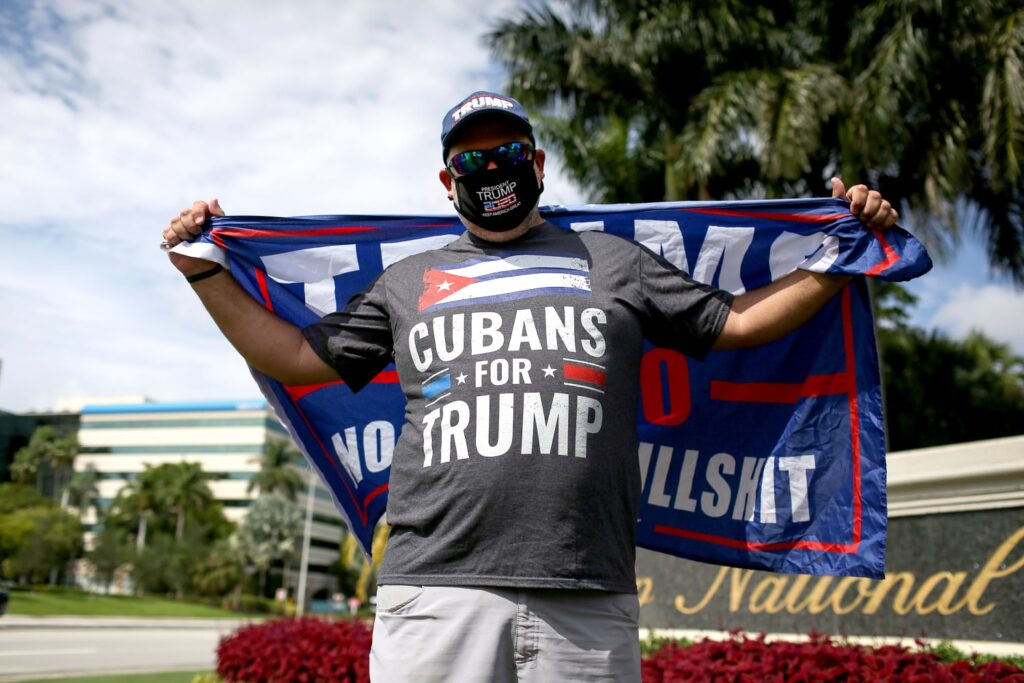
Two years ago, Cuban American voters in Miami gave Donald Trump the strongest support he’s ever had from them. Now Cubans are being deported in record numbers, some to countries they’ve never seen, and the backlash is reaching Miami’s own Republican members of Congress.
“I think there was a sense that, like, he’s not talking about us,” University of Miami historian Michael Bustamante told NPR. For a lot of families in Hialeah, Westchester and Little Havana, it turns out he was.
How strongly did Cuban Miami back Trump?
Very. Before the 2024 election, the FIU Cuba Poll found 68% of likely Cuban American voters in Miami-Dade planned to vote for Trump, the highest it had ever recorded for him (59% in 2020, 35% in 2016). Trump went on to carry Miami-Dade County, the first Republican presidential candidate to do it since 1988.

Part of the reason was a long-held sense that Cubans were different. Under the Cold War-era Cuban Adjustment Act of 1966, Cubans who reached the U.S. had a path to a green card that no other group had. Cuban Americans have also been more likely than any other Hispanic group to identify as white on the census, about 85% in 2004 census data analyzed by Pew Research Center, which researchers tie partly to who was able to leave Cuba in the early waves. Many saw Trump’s crackdown as aimed at someone else.
What’s happening to Cubans now?
The administration says many Cubans who arrived under President Biden got a different immigration document, known as an I-220A, rather than the parole Cubans traditionally used, and that this disqualifies them from the Cuban Adjustment Act. That interpretation is being challenged in court. In the meantime, NPR reports:
- The U.S. has sent nearly 6,000 Cubans to Mexico, where many have no legal status.
- Others have been deported to African countries. One Cuban man sent to the Central African Republic told NPR he’s gotten sick and is still in detention.
- Bustamante estimates about half a million Cubans are in limbo or at risk of deportation, roughly the same number the Freedom Tower once helped resettle.
- Some Cubans who’ve lived in the U.S. for 30 or 40 years, often elderly, are being deported to southern Mexico, “sort of stateless, effectively,” Bustamante said.
At Miami’s immigration court, Yusleidys Alvarez, now a permanent resident, stood in a line stretching blocks while her brother, who arrived under Biden, waited for his first hearing. She told NPR she’s afraid he’ll be sent to Mexico.
Do Cuban Trump voters regret it?
Some are angry, some aren’t, and NPR found both at Domino Park in Little Havana. A retiree named Roberto, who came from Cuba in the 1980s, said, “We Cubans used to have a lot of privileges,” and that “it really saddens me to see hardworking people doing things the right way and still being deported.” His friend Joaquin Mesa, in a GOP cap, said some Cubans are collateral damage in a necessary crackdown: “Some immigrants have come to the U.S. to scam and commit crimes,” and “everyone, including new Cuban arrivals, are paying for it.”
Polling suggests Roberto’s view is more common. A spring survey by Bendixen & Amandi and the Tarrance Group of 800 Cubans and Cuban Americans in South Florida found 68% disapproved of deporting Cubans who have no legal status and no criminal record. Only 28% approved.

Are Miami Republicans breaking with Trump?
Some are, a month before the midterms. Rep. Maria Elvira Salazar, a Miami Republican and staunch Trump supporter, released an ad aimed at the president: “It’s the same Hispanics who helped you get to the White House in 2024 feel betrayed today.” NPR reports her race has tightened. State Sen. Ileana Garcia, a co-founder of Latinas for Trump, has also denounced the deportation policy.
The BeezLoop Take
The families being split up didn’t do anything wrong by believing the promises made to Cubans for 60 years. Many came through the system the U.S. government set up for Cubans and are being punished because the rules changed under their feet. That deserves sympathy, not gloating.
But there’s a lesson in Bustamante’s line, “he’s not talking about us.” A lot of voters backed mass deportation believing it would land on other people: Mexicans, Central Americans, Haitians, Venezuelans. Protections that apply to one group and not others aren’t a principle. They’re a privilege, and privileges can be taken away by the same people who handed them out.
Salazar’s ad is a welcome break, but it comes after two years of supporting the policy that’s now hitting her district. The open question is November: will Cuban voters who feel betrayed actually change their votes, or just their talking points?
Also on BeezLoop: Only 27% of Latino voters approve of Trump in a new NBC/Telemundo poll.
Related: Salazar helped fund ICE. Now that it’s in Miami, she says it went too far.
Sources: NPR (Oct. 6) · NPR Weekend Edition (Oct. 3) · FIU Cuba Poll 2024 · The Hill (Bendixen & Amandi poll) · Pew Research Center · NPR (Central African Republic) · CBS Miami