
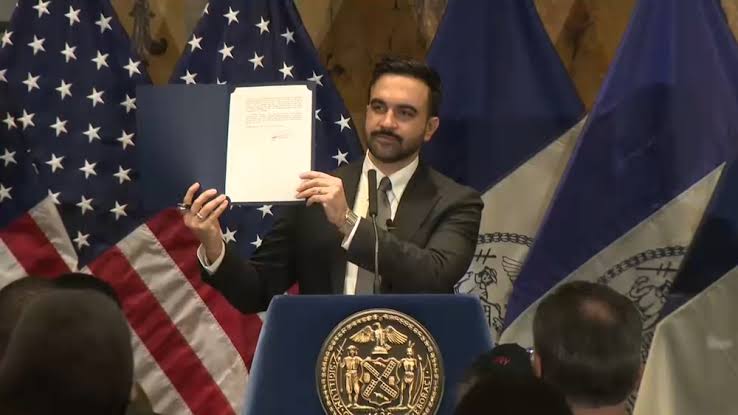
New York City Mayor Zohran Mamdani signed an executive order on Labor Day establishing the Mayor’s Office of Worker Power, a city agency intended to help private-sector employees organize unions and engage in collective bargaining. City Hall describes it as the first office of its kind created by any American city.
What the Office Does
The Office of Worker Power is meant to connect private-sector workers with organizing resources and education, give workers more input into city labor policy, and direct city agencies to proactively investigate workplace violations rather than wait for a complaint to be filed. Deputy Mayor for Economic Justice Julie Su, who previously served as acting U.S. Secretary of Labor, will coordinate the office. “It is not enough for government to simply wait until workers come forward,” Su said. She added that employers who have found it cheaper to violate labor law than comply with it should expect that “those days are over,” and said the city “will not hold back on the powers that we do have to make life better for working people.”
Tony Perlstein, a longtime union organizer most recently with the United Auto Workers, was named the office’s first executive director. Perlstein said he measures success in the office’s first year by whether it can “convene at scale large numbers of workers” and connect them with organizing resources. “There is a huge gap between what workers want and the reality,” he said. “I think it’s our role and our job to help bridge that gap.”

Where City Authority Actually Stops
Private-sector union organizing in the United States is governed by the National Labor Relations Act, a federal law that the Supreme Court has held preempts most state and local regulation of the organizing process itself. Under that preemption doctrine, cities cannot compel private employers to recognize a union, cannot regulate the tools either side uses in a labor dispute, and cannot condition city business, permits, or contracts on an employer settling a labor conflict, a limit the Supreme Court applied to a Los Angeles taxi franchise dispute in a 1986 ruling. Legal analysts who have examined Mamdani’s plans note that cities retain narrower tools: publicly supporting workers, enforcing local labor standards such as minimum wage and paid sick leave, protecting workers from retaliation for asserting those rights, and easing access to public space for organizing meetings and rallies.
Su has said the office is designed to work within those bounds. She said it will not run union organizing drives itself or single out specific employers or industries for organizing campaigns, and will instead support workers who already want to organize. The office’s stated jurisdiction is limited to the private sector, since city employees fall under New York’s separate public-sector labor law, the Taylor Law, which already sets out bargaining procedures for municipal unions.
Context
Union membership in the private sector has fallen for decades and stood at 5.9 percent nationally in 2025, according to the Bureau of Labor Statistics, far below the 32.9 percent rate among public-sector workers. Mamdani, a member of the Democratic Socialists of America, campaigned for mayor in 2025 on an agenda that included expanding labor protections and was backed by several of the city’s largest unions during that race. His administration has separately sued the New York City Council over a paraprofessional pay bill, arguing in that case that the council bypassed required collective bargaining, a dispute that involves public-sector rather than private-sector labor law.
Sources: amNewYork, “Mamdani puts City Hall behind worker organizing with new office” · Documented NY, “On Labor Day, Mamdani Announces City’s First Office to Organize Workers” · Common Dreams, “On Labor Day, Mamdani Announces First-of-Its-Kind Office of Worker Power in NYC” · OnLabor, “How Mamdani Can and Cannot Support Private Sector Union Organizing” · Washington Examiner, “Mamdani creates ‘Office of Worker Power’ to push unionization agenda”
Related from BeezLoop: Zohran Mamdani's Endorsed Candidates Sweep NYC Primaries, Rattling the Establishment, 'Moral Cowards': 77 Delegations Walked Out on Netanyahu and Netanyahu Made a Video About New York's Mayor.