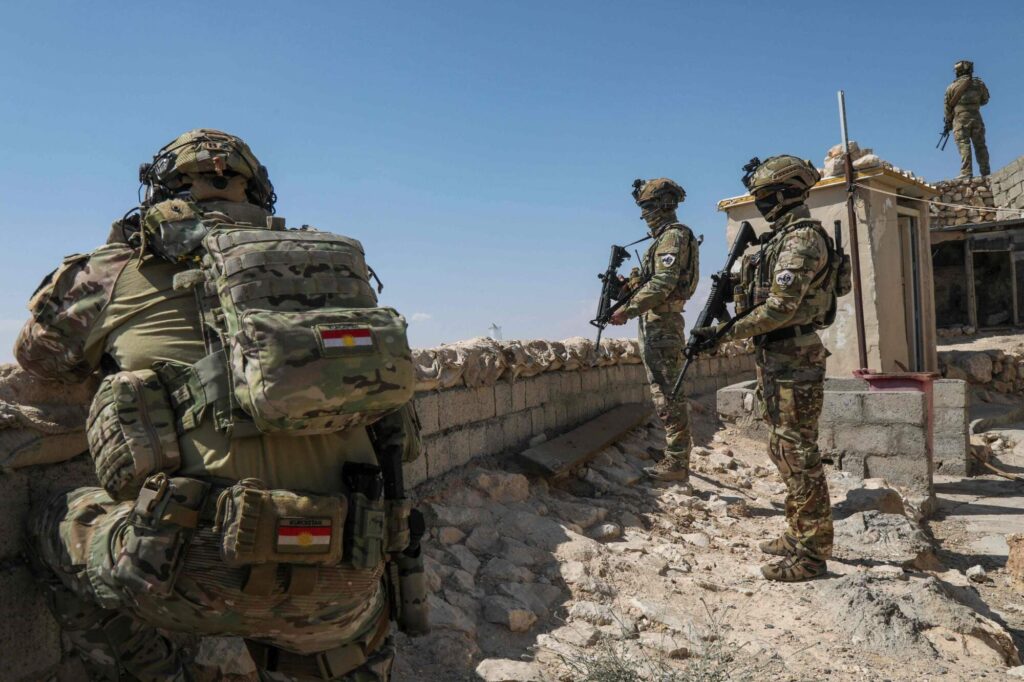
The United States finished pulling its forces out of Iraq on Wednesday, 23 years after the invasion. Iran’s Revolutionary Guard marked the occasion by telling Americans how to vote in November.

What exactly ended?
- Operation Inherent Resolve, the US-led anti-ISIS coalition mission, is over. The withdrawal completed Wednesday, September 30.
- The Pentagon says US forces will continue targeted training and intelligence support to Iraqi partners.
- The drawdown was agreed in 2024 under President Biden and carried out by the Trump administration.
So it is not a severing of the relationship. It is the end of a garrison, and the start of something closer to the arrangement the US has with most partners.
How did Iran respond?
A commander in the Islamic Resistance in Iraq, the umbrella for Iran-backed armed factions there, framed it in plain terms.

A historic victory for the Iraqi Islamic resistance groups and honorable Iraqis, and a crushing defeat for the American project.
Commander, Islamic Resistance in Iraq
Iran’s Revolutionary Guard went further and urged Americans to vote out Trump’s allies in Congress in the midterms.
That is worth reading twice. A branch of a foreign military that the United States is currently fighting issued voting instructions to the American electorate, five weeks out.
Why does this moment carry more risk than 2011?
Because the US is at war with Iran right now, and it was not then.
- The withdrawal happened in the seventh month of the US-Iran war.
- Iran-backed militias remain armed inside Iraq and have spent years attacking the American positions that just emptied.
- Analysts warn the Islamic State could use the space to regroup, though the Defense Intelligence Agency assessed in mid-2026 that ISIS in Iraq remains severely degraded.
- The Strait of Hormuz standoff is unresolved and is why the Federal Reserve raised rates on September 16.
The BeezLoop Take
The withdrawal was right and the celebration is earned by the wrong people, and both of those are uncomfortable to hold at once.
Iraq asked. A sovereign government set a date and the United States honored it, which is how this is supposed to work and is not how it always goes. Anyone arguing the US should have stayed over Baghdad’s objection is arguing for something other than a partnership. That the deal was struck by Biden and executed by Trump is the closest thing to bipartisan foreign policy continuity this decade has produced.
The Revolutionary Guard telling Americans how to vote is the part that should land hardest, and not because it will work. It will not; almost nobody will change a ballot because the IRGC suggested it. It matters because of what it reveals about the information environment, and because of the timing against the directive ordering Cyber Command to defend the midterms from foreign actors. The administration is tasking the military with stopping foreign election interference in the same week an adversary’s military openly attempts some. One of those is a cyber operation nobody sees. The other is a press release.
What we would resist is the framing already forming that any bad outcome in Iraq proves the withdrawal was wrong. That argument was used after 2011 to explain ISIS and it skipped eight years of decisions that produced a hollow Iraqi army. Iraq’s vulnerabilities in 2026 were built while American troops were there, not created the day they left.
The honest risk is narrower and real: leaving in the middle of a shooting war with the country whose proxies are inside the one you are leaving is a sequencing problem, and it was scheduled before the war started. Nobody chose this order. Everybody has to live with it.
What happens now?
Iraq moves to bilateral arrangements with the US, NATO and others: intelligence sharing, arms sales, training through the US Military Group-Iraq, and over-the-horizon support flown from Jordan and Gulf bases.
Whether that holds depends almost entirely on what the militias do next, and nobody is predicting that out loud.
Background: the last American troops leaving Iraq after 23 years.
Sources: NewsNation · Military Times · CBS News · Operation Inherent Resolve