
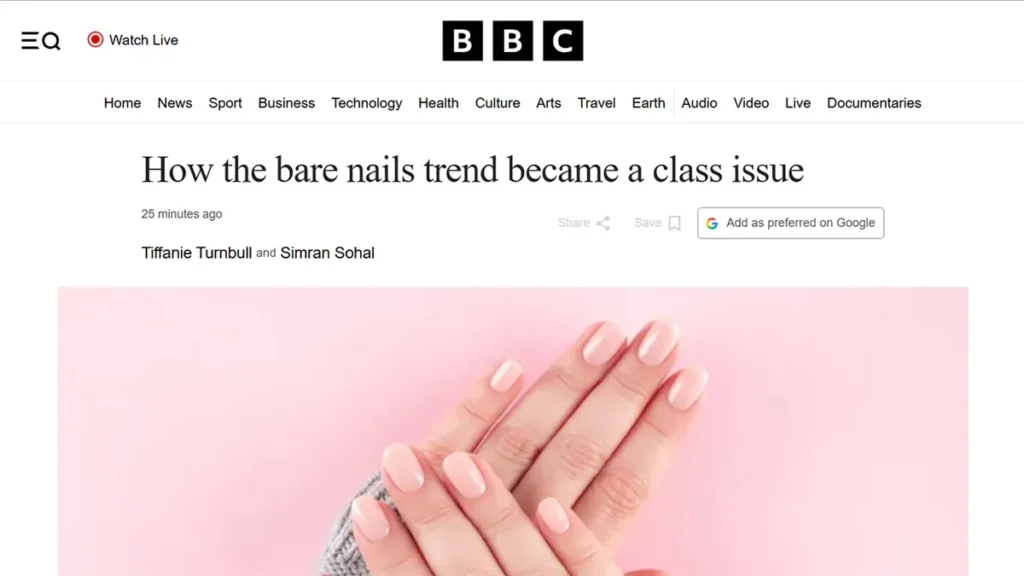
The BBC published a piece about unpainted fingernails becoming a status symbol. The internet decided it said bare nails make you a white supremacist. The BBC deleted it. Everybody involved handled this badly.
What happened
- The article was headlined How the bare nails trend became a class issue.
- It examined the shift toward clear, unpainted or minimally polished nails and what that signals socially.
- Reporting on the piece says it raised the argument that the trend could stigmatize Black, Latino and Asian communities, where elaborate nail art has deep cultural roots.
- Backlash built across social media and conservative outlets.
- The BBC first swapped the article for a notice saying it was under editorial review, then removed the notice too.
- The original URL now returns a 404.
We could not read the original. It is gone, and every description of it now available comes from outlets that were criticizing it. That is worth knowing before anyone forms a firm view about what it actually argued.
What it probably said, and what it was turned into
The claim circulating is that the BBC said bare nails are proof you are a white supremacist. That is a sentence no BBC style desk would publish, and no source quotes it as a direct quotation from the piece.

The underlying argument, that long decorative nails have been coded as low-class when worn by Black and Latina women and as high fashion when worn by white celebrities, is not exotic. It is an ordinary observation about beauty standards that has been made in fashion writing for years.
The BeezLoop Take
The BBC deserves the criticism it got, but not for the reason it is getting it. The failure was editorial judgment before publication and cowardice after it.
If the piece was defensible, the BBC should have defended it. If it overreached, the BBC should have corrected the overreach and left the rest up with a note. Deleting it entirely and then deleting the notice about deleting it is the worst of all options: it concedes the critics were right, destroys the evidence anyone would need to check whether they were, and teaches every writer in the building that an argument about race and class is not worth the trouble. A public broadcaster funded by the public does not get to quietly disappear its own work.
The pile-on deserves scrutiny too, and the honest version is that most of the people furious about this did not read it either. A headline about class became a claim about white supremacy somewhere in the third retelling, and that version is what several hundred thousand people are angry about. This is the standard mechanism now, and it works on every subject, in every direction.
The underlying idea was never the outrage it was flattened into. Nail art coded as ghetto on one woman and editorial on another is a real and documented double standard. You can think that argument is overstated, or badly made, or not worth a features slot. Treating it as self-evidently insane is its own kind of unseriousness.
The question
If the article was wrong, why not correct it in public? And how many people currently angry about this could quote a single line from the piece that no longer exists?
Related from BeezLoop: More Than Half of People Post Less Than They Used To, Nicki Minaj Is Telling Young People to Vote Republican and Twelve States and Hollywood Writers Just Stepped Aside.