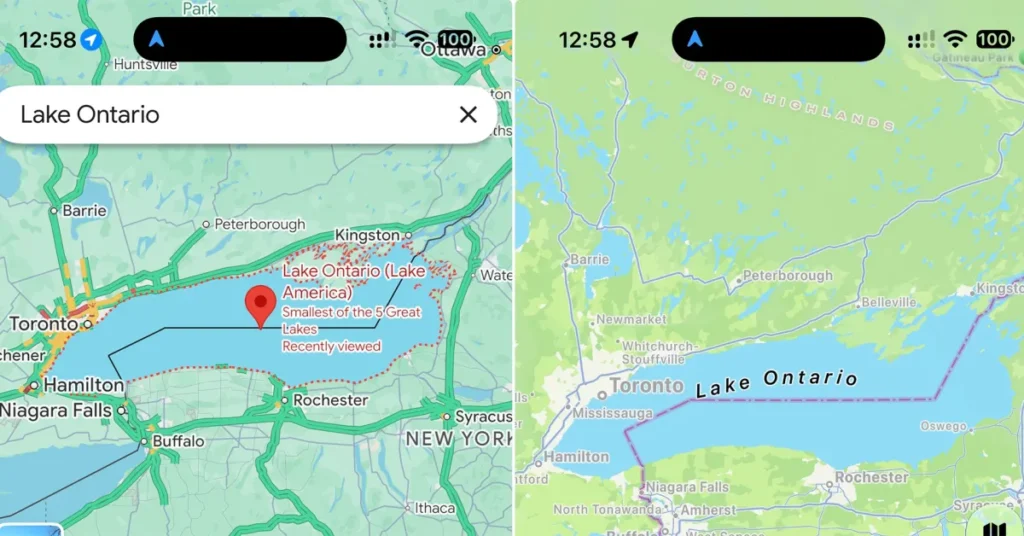
Apple Maps has renamed Lake Ontario “Lake America” for U.S. users, following Google Maps in complying with an executive order from President Trump. What you see depends entirely on where you are.
What changed, and for whom
Apple confirmed that U.S. users will see “Lake America,” while users in Canada continue to see Lake Ontario, and users elsewhere in the world see both names. Google made the same change for U.S. users days earlier. The split is deliberate: mapping companies serve names regionally, so the same body of water can carry different labels depending on the user’s location.
Why the companies say they had to
Both Apple and Google have pointed to the same mechanism: the name was changed in the U.S. Geographic Names Information System, the federal database of official place names, and their policy is to follow official government sources for the jurisdiction a user is in. That framing lets the companies present compliance as a procedural default rather than a political choice, and it is the same reasoning both applied when the Gulf of Mexico was renamed the Gulf of America.
The complication: Lake Ontario isn’t only American
This is where the Gulf precedent breaks down somewhat. Lake Ontario is shared between the United States and Canada, with a defined international boundary running through it, and its name has been standard in both countries and internationally for centuries. A U.S. database entry has no authority over the Canadian portion, which is why Canadian users continue to see the original name. The result is a border that now divides not just jurisdiction but nomenclature, on a lake both countries share.
Not everyone went along
MapQuest declined to make the change and was rewarded with the No. 1 spot on the App Store, a reminder that for a mapping product, “we kept the name you already know” turned out to be a competitive feature rather than a liability.