
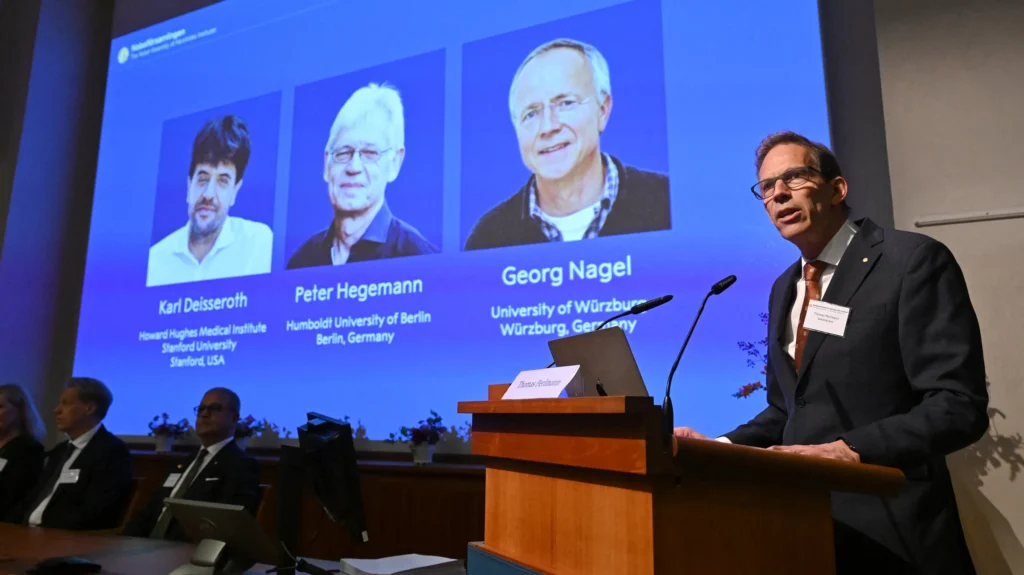
The 2026 Nobel Prize in Physiology or Medicine went Monday to three scientists who figured out how to turn brain cells on and off with light. Karl Deisseroth of Stanford University shares the prize with Peter Hegemann of Humboldt University of Berlin and Georg Nagel of the University of Würzburg in Germany.
The tool they built is called optogenetics. In two decades it’s become one of the main ways scientists study the brain, including what goes wrong in depression and Parkinson’s disease.

What is optogenetics, in plain English?
Your brain has billions of nerve cells, and they’re packed so tightly that it used to be almost impossible to tell which ones do what. Electrodes and drugs hit everything nearby. Optogenetics fixed that.

Nagel and Hegemann studied a light-sensitive protein in green algae, a tiny channel that opens when light hits it. Deisseroth’s lab at Stanford figured out how to put that protein into specific nerve cells in mammals, and how to run thin optical fibers into a living brain. Shine a pulse of blue light, and only those cells fire, within milliseconds. Later his team added proteins that shut cells off under yellow light.
That turned brain research from watching into testing. Scientists could switch on one circuit in a mouse and see whether its social behavior changed, or switch another off and see if a Parkinson’s-like tremor stopped. The Nobel committee’s chair, Per Svenningsson, said optogenetics “provides opportunities for mapping the brain in a way that we could once only dream of.”
Who is Karl Deisseroth?
He was born in Boston in 1971, earned his Ph.D. and M.D. at Stanford, and opened his lab there in 2004. He’s also still a practicing psychiatrist who treats patients with treatment-resistant depression and autism, which is rare for a scientist at his level. He’s written a book for general readers, Projections: A Story of Human Emotions.
The Nobel committee called at 12:27 a.m. Pacific time, and he missed it, according to Stanford Medicine. Seconds later his wife’s phone rang. “I found I had a hard time speaking,” he said. “I lost the ability to form words for about 30 seconds.” The only call he made afterward was to his mother.
Does optogenetics treat patients yet?
Not as a routine treatment. Most of the work is still in animals, because it requires adding a gene to specific cells and getting light to them. Stanford says it may eventually lead to gene-therapy treatments for neuropsychiatric disorders and help restore function after paralysis. Its bigger impact so far is indirect: it’s how researchers learn which brain circuits to target, which shapes the drugs and devices that do reach patients.
The BeezLoop Take
This prize is a reminder of where breakthroughs actually come from. The starting point was a protein that lets pond algae swim toward light. Nobody studying it was trying to cure depression. If you’d judged that research by its immediate payoff, you’d have cut it.
Deisseroth’s role is worth noticing too. He’s a doctor who still sees patients with the hardest cases of depression, and he built a tool to look at the circuits behind them. That mix of clinic and lab is rare, and this is what it can produce.
The open question is how long the jump from mice to medicine takes. Optogenetics has rewritten what scientists know about the brain in 20 years. When does it change what happens in a psychiatrist’s office?
Also on BeezLoop: The FDA held its first public hearing on psychedelic drugs as therapy, and New Zealand became the second country to approve MDMA-assisted therapy for PTSD.
Sources: NobelPrize.org · Stanford Medicine · HHMI · STAT · CBS Boston