

The U.S. added just 29,000 jobs in September, far below the 84,000 economists expected, and the unemployment rate rose to 4.2%, the Bureau of Labor Statistics reported Friday. The worst number for most families wasn’t either of those. Average hourly pay rose only 3% over the past year, the slowest since May 2021, and that’s no longer keeping up with prices.
Wall Street took the bad news as good news. Here’s what Friday’s report means for your paycheck, your job search and your borrowing costs this weekend.

How bad was the September jobs report?
Weak, with some cushions. The key numbers:

- Payrolls: +29,000, versus 84,000 expected.
- Revisions: August was cut to +133,000, and July flipped to a loss of 10,000. Together, 60,000 fewer jobs than first reported.
- Unemployment: 4.2%, up from 4.1%. Part of that came from 485,000 people joining the labor force to look for work, which is a healthier reason than layoffs.
- Pay: up 0.1% for the month and 3% for the year.
Health care added 17,000 jobs, construction 11,000 and manufacturing 9,000. Government lost 17,000, temp help lost 11,000 and information services lost 10,000, a sector where worries about AI are already showing up in hiring.
Are wages keeping up with inflation?
Barely, if at all. Pay is up 3% over the year. The Federal Reserve’s preferred inflation measure, excluding food and energy, is also running at 3%, and that leaves out the gas prices people actually pay.
Americans are frustrated by the lack of opportunities right now. Wage growth fell to a new 5-year low and is being wiped out entirely by inflation. That stings heading into the holidays.
Heather Long, chief economist, Navy Federal Credit Union
If you’ve felt like you’re working the same hours and falling behind, the data says you’re not imagining it.
What does the jobs report mean for mortgage rates and the Fed?
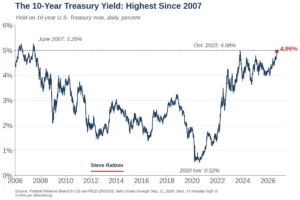
This is the part that helps some people right away. Two days ago, the 10-year Treasury yield hit its highest level since 2002 and mortgage rates jumped. After Friday’s report, Treasury yields fell and traders moved hard toward the Fed holding rates steady at its October 27-28 meeting. CME Group’s FedWatch tool put those odds at 82.8%.
For the Fed, this number should be the nail in the coffin for an October hike.
Thomas Simons, chief U.S. economist, Jefferies
Mortgage rates followed, a little. Zillow’s average 30-year fixed rate fell 4 basis points to 7.40% on Saturday, and the 15-year fell to 6.66%, Yahoo Finance reported. That’s still near three-year highs, but it’s moving the right way for buyers for the first time in weeks.
Don’t count on a straight line down, though. The Fed raised rates on September 16, and markets still expect another hike in December. Long said she doesn’t think one weak month will change that.
The BeezLoop Take
The headline number gets the attention, but the paycheck number is the story. A 3% raise that disappears into 3% inflation isn’t a raise. And it’s happening while gas is over $4 and mortgage rates are above 7%. That’s why consumer confidence is low even though unemployment is still historically modest.
There’s a fair case that this isn’t a collapse. More people looking for work pushed unemployment up, layoffs are still low, and the Atlanta Fed estimates the economy is growing at a strong pace this quarter. Economists call it a low-hire, low-fire economy. If you have a job, you’re probably keeping it. If you need one, it’s getting harder to find.
The ugly part is the Fed’s bind. It’s raising rates to fight inflation that’s coming mostly from oil, while hiring slows underneath it. Rate hikes don’t lower the price of crude. They just make everything you borrow for more expensive. A month of bad jobs data buys a pause, not a fix.
The next number to watch is September inflation. If prices stay hot while hiring stays cold, the Fed is choosing between two bad options, and you’ll feel either one.
Sources: Bureau of Labor Statistics, Employment Situation · CNBC · CNN · Yahoo Finance mortgage rates, Oct. 3