

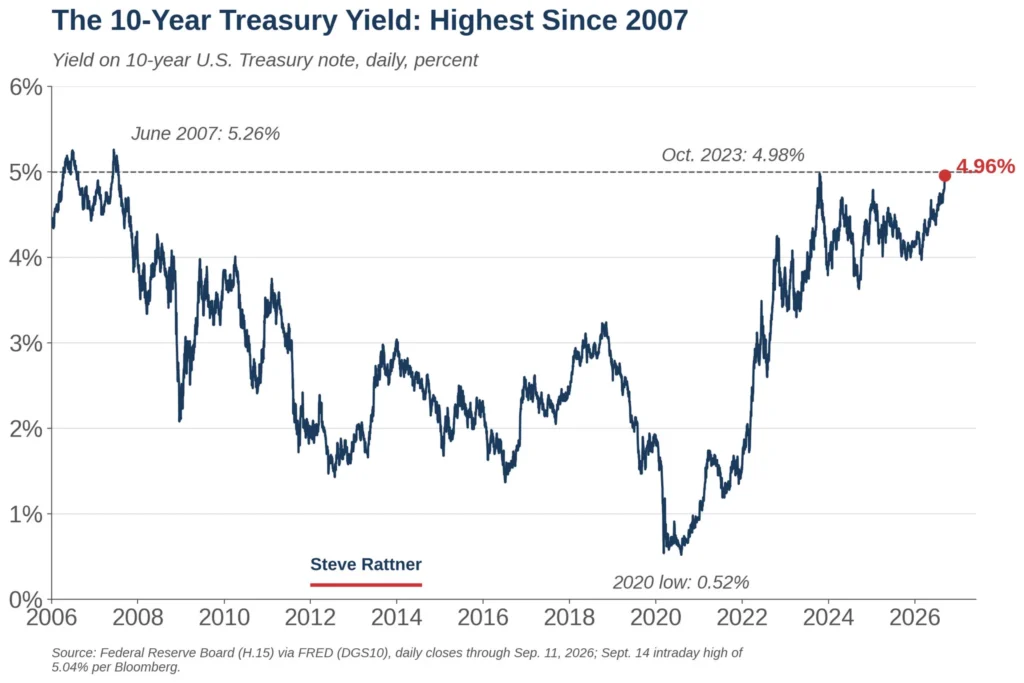
The yield on the 10-year Treasury note hit 5.33% on Thursday, its highest level since April 2002. The same morning, Freddie Mac said the average 30-year mortgage rate jumped to 7.28% from 7.03% a week ago. If you’re shopping for a house, refinancing, or carrying any debt with a variable rate, this is the number that matters this week.
Two days ago we said to watch the 10-year, not the Dow. This is why.
Why did the 10-year Treasury yield hit its highest level since 2002?
The 10-year rose as much as 4 basis points to 5.33% Thursday, according to LSEG data cited by CNBC, passing its 2007 peak before easing back later in the day. The 30-year Treasury touched 5.69%. Bloomberg pointed to a mix of pressures all pushing the same way:

- Oil. Crude prices tied to the confrontation with Iran keep feeding inflation.
- The Fed. The Federal Reserve raised rates on September 16, and traders expect at least one more hike.
- Borrowing. The federal government is issuing huge amounts of debt, and AI companies are competing for capital to build data centers.
- A strong economy. Growth hasn’t cracked, so investors don’t expect rates to fall soon.
NBC News reported the 10-year just had its biggest quarterly jump since 1994. Economist Diane Swonk summed up the latest inflation reading as “cooler on paper, hot underneath.”
How much more does a mortgage cost now?
Mortgage rates track the 10-year closely. Freddie Mac’s weekly survey, released Thursday, shows:
- 30-year fixed: 7.28%, up from 7.03% last week and 6.34% a year ago
- 15-year fixed: 6.60%, up from 6.42% last week and 5.55% a year ago
Daily rate trackers, which move faster than Freddie Mac’s weekly average, had the 30-year near 7.6% late Wednesday, the highest since late 2023, NBC reported.
Here’s what that does to a $400,000 30-year loan, principal and interest only:
- At a year-ago rate of 6.34%: about $2,486 a month
- At last week’s 7.03%: about $2,669 a month
- At this week’s 7.28%: about $2,737 a month
That’s $68 a month more than a week ago and $251 a month more than a year ago. Over the life of the loan, the year-over-year difference adds up to roughly $90,000. On a $300,000 loan, the monthly gap compared with a year ago is about $188.
What should you do if you’re buying or borrowing right now?
Nobody can tell you where rates go next, and anyone who says they can is guessing. A few things are true either way:
- If you have a rate lock, check when it expires. Extending it may cost less than relocking at today’s rates.
- If you’re house hunting, run your budget at today’s rate, not the one from your pre-approval letter.
- If you carry credit card or other variable-rate debt, another Fed hike would push those rates up too. Paying it down is a guaranteed return.
- If you have savings, high-yield accounts and Treasury bills are paying more than they have in years.
Sellers are feeling it too. NBC reported the number of unsold homes on the market recently hit its highest level in more than a decade.
The BeezLoop Take
The stock market has been telling a happy story while the bond market tells a worried one, and for regular people the bond market is the one that counts. A Dow above 51,000 doesn’t help you buy a house. A 10-year yield at a 24-year high makes it harder, and the people it hurts most are first-time buyers without equity from a previous home to soften the blow.
There’s a straight line from this week’s mortgage rate to policy choices in Washington. Oil is high because of the Iran standoff. Inflation is sticky partly because of oil and tariffs. The Fed is hiking to fight that inflation, and the government is borrowing heavily at the same time. Each of those is defended on its own terms, but buyers are paying for all of them at once.
To be fair, some of this is good news in disguise. Yields are rising partly because the economy is strong, and savers are finally earning real interest. But that trade favors people who already have money over people trying to build it.
The open question is how high mortgages can go before the housing market stops moving altogether. With unsold listings already at a decade high, we may be close to finding out.
Related: Gas prices are why MAGA support for Trump fell nine points.
Sources: Freddie Mac Primary Mortgage Market Survey · CNBC · NBC News · Bloomberg via Yahoo Finance