

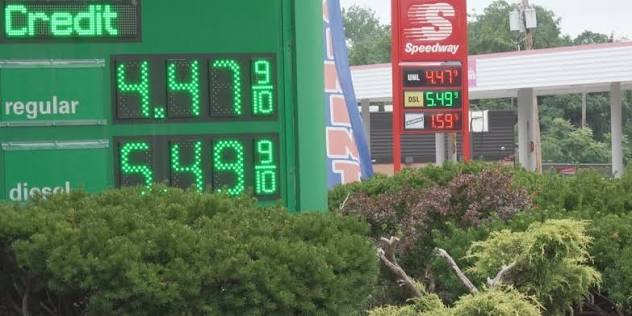
The national average for gasoline is above $4.10 a gallon. The White House has brought in refining executives to ask what can be done about it. The honest answer is that the thing pushing the price up is not sitting in that room.

What is the White House asking for?
Executives from at least ten companies were invited, including Chevron, Marathon Petroleum, Valero and Phillips 66, along with Interior Secretary Doug Burgum, Energy Secretary Chris Wright and National Energy Dominance Council director Jarrod Agen.
- Regulation changes.
- Faster permitting.
- Additional investment in existing capacity.
A White House official framed the goal as concrete, near-term steps to increase refining capacity rather than relying only on new refineries, which take years to build.

President Trump is laser-focused on ensuring his successful energy dominance agenda translates into the most cost savings possible at the pump for consumers.
White House spokeswoman Taylor Rogers
Is refining capacity actually the problem?
Partly, and less than the framing suggests.
Refining is a real bottleneck. The US has not built a major new refinery in decades, several have closed or converted, and when a large one goes offline for maintenance the regional effect on price is immediate. Permitting reform and debottlenecking existing plants are legitimate levers, and they are the only ones that work on a timescale shorter than a decade.
But the price of gasoline is mostly the price of crude, and the price of crude right now is being set by the standoff with Iran over the Strait of Hormuz. No amount of American refining capacity changes what a barrel costs when a fifth of the world’s seaborne oil moves through a strait somebody might close.
What would actually move the price this month?
Three things, in descending order of effect, and the administration controls one and a half of them.
- De-escalation with Iran. Crude falls, everything downstream falls with it.
- Releases from the Strategic Petroleum Reserve. Fast, limited, and finite.
- Refining and permitting changes. Real, and measured in quarters to years rather than weeks.
The meeting is about the third one.
The BeezLoop Take
Calling in the refiners is a reasonable thing to do and a poor substitute for the thing that would work. Permitting reform is genuinely useful and the US genuinely has a refining problem, so this is not theater. It is just aimed at the slowest lever available during the fastest-moving part of the problem.
The uncomfortable arithmetic is that this administration is simultaneously the main cause of the crude price and the party promising to fix the pump price. You cannot run a seven-month confrontation with Iran, watch Brent sit near $96, and then convene Valero to ask why gas is expensive. The refiners in that room know exactly what is driving it and so does everyone on the government side of the table.
It also collides with the Fed. The central bank raised rates on September 16 specifically because of oil-driven inflation, with most officials expecting another increase. That is the mechanism by which a Middle East standoff becomes your mortgage payment, and no refinery permit interrupts it.
We would give the energy-dominance framing one piece of credit, though. The argument that America should be able to refine what it pumps is correct, and the fact that it cannot is a bipartisan failure built over thirty years of nobody wanting a refinery near them. If this produces real permitting reform it will matter in 2029. It will not matter in November, and the people running it know that too.
Watch for an SPR release. It is the only tool on the list that works on a timeline that matters before the midterms, and it is the one nobody is discussing in public.
Related: MAGA support for Trump fell nine points since spring and the reason is on the gas station sign.
Sources: NewsNation · Yahoo Finance · Just the News · AAA fuel prices · U.S. Energy Information Administration