
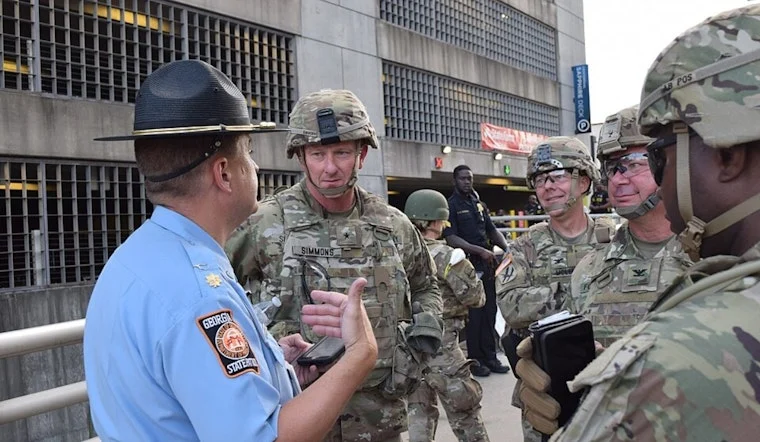
A Georgia National Guard member deployed to Washington, D.C., was arrested and charged with felony assault after allegedly drawing a handgun on a fellow Guard member during an argument over whether their haircuts met Army grooming regulations.
Zion Mitchell, 21, was charged with assault with a dangerous weapon and possession of a firearm while committing a crime of violence, both felonies, in connection with an August 25 incident. According to the arrest warrant, Mitchell and a female fellow guardsman were sitting together in a van during a break when they began arguing over whether their hairstyles complied with Army regulations. The woman told investigators she heard what she believed was Mitchell’s holster clicking open and thought he intended to draw his weapon on her.

Mitchell is a member of the roughly 531-person Georgia National Guard contingent deployed to Washington as part of the Trump administration’s task force aimed at reducing crime in the capital, the second-largest state contingent among the guard units currently stationed there. He was arrested earlier this month in connection with the incident.

The arrest comes as thousands of National Guard members from Washington and more than twenty states remain deployed in the district on an open-ended mission that has already cost well over a billion dollars and drawn scrutiny over troop conduct and rules of engagement. Guard leadership has not released additional comment on Mitchell’s case beyond confirming the charges.
The incident adds to a string of episodes involving Guard members on the D.C. mission that have prompted questions from lawmakers about oversight of the deployment, though officials have not indicated any change to the mission’s scope as a result of this case.
The haircut is not the story. The sidearm is.
Two people argued about grooming standards, which is unremarkable and happens in every military unit. What makes this an arrest rather than a reprimand is that one of them was armed, and the other reported hearing a holster click open. That is the actual issue, and it is a structural one rather than a story about two individuals: a domestic deployment puts service members in ordinary, boring proximity to each other for months, with loaded weapons, in a posture that is neither combat nor civilian policing.
Soldiers carry weapons on deployment because the mission is understood to be dangerous. A crime-reduction task force in a U.S. city produces long stretches of tedium punctuated by interpersonal friction, and the weapon is present for all of it. An argument that would end in eye-rolling anywhere else can escalate into a felony because of what is on the belt.
What is worth arguing about
This case lands amid an open-ended mission costing well over a billion dollars, with thousands of Guard members from more than twenty states, and a pattern of incidents that has already drawn congressional questions about oversight. The narrow question is what happened in that van. The broader one, which officials have not engaged, is whether the rules of engagement for a domestic policing deployment should look like the rules for a combat one, and whether anyone has seriously revisited that as the mission stretched on. Reasonable people disagree about the deployment itself; the arming posture is a separate question that has not gotten a separate answer.
Related from BeezLoop: Trump Admits He's Building Monuments to Himself Because "Nobody Will Do It Once I'm Gone" and Trump Threatens to Sue a Think Tank Over a Report He Doesn't Like.