

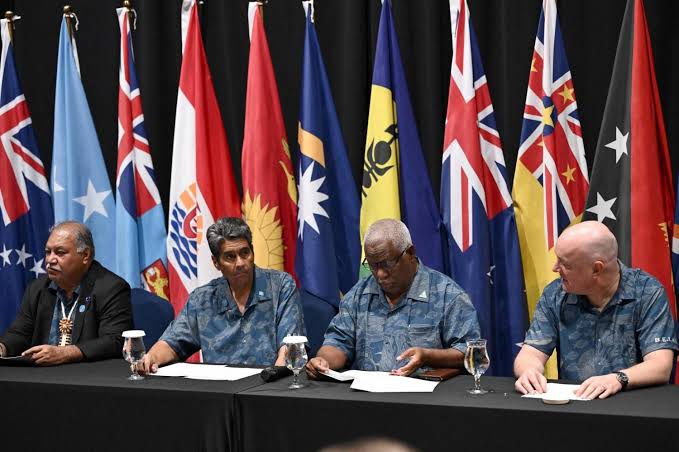
Leaders from across the Pacific used their annual summit this week to formally rebuke China over a July intercontinental ballistic missile test that splashed down in international waters near Tuvalu and Nauru, a region that still carries generational memories of nuclear testing by the United States, Britain, and France.
The joint statement came out of the 55th Pacific Islands Forum leaders’ meeting, hosted this year in Koror, Palau, and read by Palau President Surangel Whipps Jr. at a late-night news conference. Seventeen of the forum’s 18 members signed on; Nauru, the target country whose waters the missile actually landed near, was the lone holdout, a split that itself underscores how much pressure Beijing applied behind the scenes to keep the region from speaking with one voice.
What China actually did
China test-fired the missile, believed to be a DF-41-class intercontinental ballistic missile with a range exceeding 12,000 kilometers, giving only a handful of Pacific nations short advance notice before the launch. The missile landed in international waters near Tuvalu and Nauru, both small island states with no independent means of detecting or intercepting such a launch and limited recourse beyond diplomatic protest.
Beijing’s foreign ministry has dismissed the criticism, describing the test as “a routine arrangement of China’s annual military training” and insisting relevant countries were informed in advance. It went further this week, accusing Palau of “hijacking” the responses of other Pacific nations to manufacture a unified rebuke that Beijing suggests would not otherwise exist.
A small, specific ask
The forum’s actual demand is notably modest: at least 24 hours’ advance notice before any future intercontinental ballistic missile test. That is not a call to halt China’s military testing program, and it is not a demand with any enforcement mechanism behind it. It is a request for the bare minimum courtesy of a heads-up before a nuclear-capable weapon lands in or near a small nation’s waters, which makes Beijing’s pushback against even that ask look considerably worse than the original test itself. Pacific nations that lived through decades of foreign nuclear testing without much say in the matter are, understandably, not interested in being an afterthought a second time around.
Sources: ABC News Australia · Bloomberg · Hong Kong Free Press