

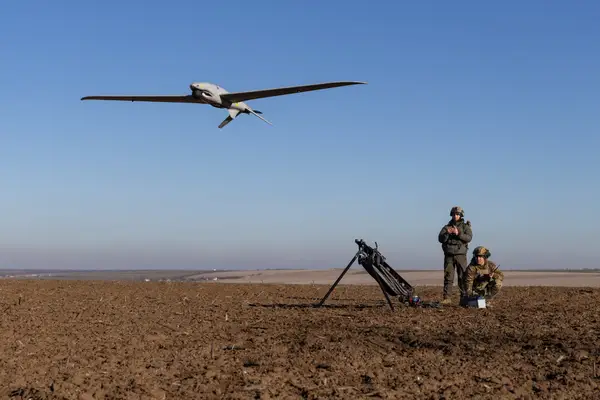
Ukraine launched one of its largest aerial assaults of the war on Sunday, sending hundreds of drones deep into Russian territory. Russia’s Ministry of Defense said it destroyed 822 drones overnight, while Moscow Mayor Sergei Sobyanin confirmed roughly 600 drones were detected heading toward the capital, with about a third of those brought down over the Moscow region itself. At least six people were killed across Russia, including an 83-year-old man killed when a drone hit a private home outside Moscow and five people killed in the Rostov region. A strike also sparked a large fire at a Wildberries warehouse outside Moscow, reportedly leaving several of the retailer’s largest logistics hubs out of operation. Russia responded with ballistic missile strikes on Kyiv and Kryvyi Rih.
The scale of the barrage, hundreds of drones launched in a single coordinated wave, is a reminder of how much cheaper it’s become to threaten a heavily defended capital than it is to defend one.
The Economics Behind the Swarm
Traditional air defense interceptors, like those used in Patriot or S-400 batteries, cost anywhere from $1 million to $4 million each and are built to knock down high-value targets like fighter jets and cruise missiles. A modern attack drone, by contrast, can be built for a few thousand dollars using off-the-shelf components. Launch enough of them at once , 600 toward a single city, as Sunday’s attack showed, and even a well-funded air defense network has to make hard choices about which threats are worth an expensive interceptor and which are allowed through.


A Shift That Isn’t Going Away
Sunday’s attack was described by Russian state media as the largest drone barrage of the year, and it’s part of a broader pattern: both sides have leaned more heavily on mass-produced drones as the war has ground on, because they’re cheap enough to launch in volumes that overwhelm defenses built for a different era of warfare. That dynamic isn’t unique to this war, and militaries well beyond Russia and Ukraine are watching closely as a case study in what happens when a defense grid built for a handful of expensive threats meets an attack built around hundreds of cheap ones.
What do you think? Does the sheer scale of Sunday’s drone barrage prove that traditional, expensive air defense systems can’t keep pace with low-cost drone warfare, or can better tracking and cheaper interceptors close the gap? Let us know your thoughts in the comments on BeezLoop.com!
Related from BeezLoop: Ukraine Hit Moscow With Over 1,000 Drones, Overnight Strikes Kill 19 Across Russia and Ukraine and Moscow Gas Lines Grow as Ukrainian Drones Keep Hitting Key Refinery.