
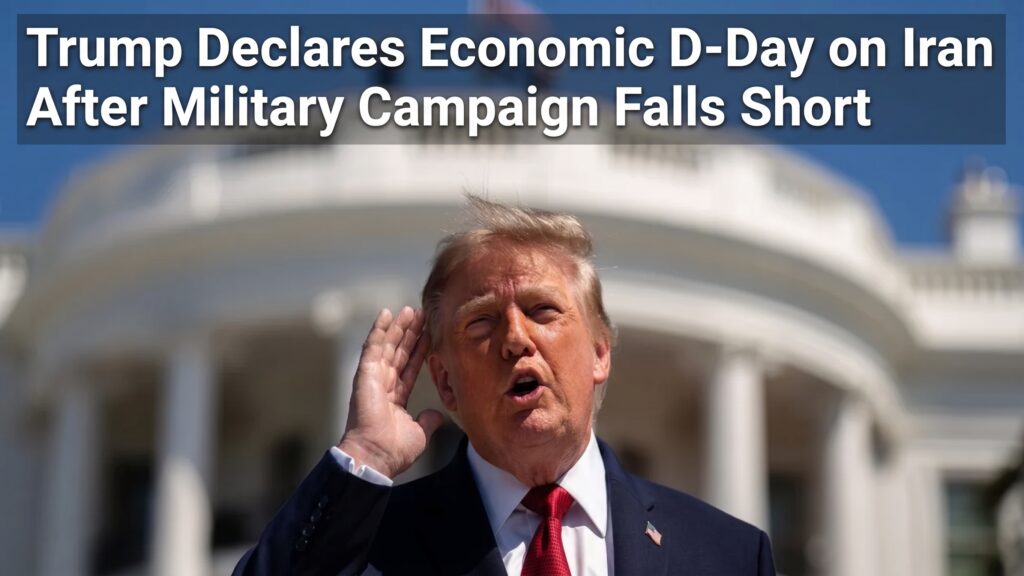
President Trump declared what he called “Economic D-Day” against Iran on Wednesday, threatening “tremendous economic consequences” for any country whose banks, airports, or businesses continue doing business with Tehran. In a Truth Social post, Trump called it “the most crushing economic operation” the US has ever launched against a country and wrote, “Oil smuggling, swap lines, cash transfers, exchange houses, ship registries, front companies. It all needs to stop NOW.” The announcement extends a pressure campaign the administration has run since April under the name Operation Economic Fury, and came a day after the United Arab Emirates, historically Iran’s largest source of imports, announced it was suspending all trade and financial dealings with Tehran following what it said were two ballistic missiles fired at its territory.
Why This Follows a Military Campaign That Didn’t Deliver
The US and Israel launched joint strikes against Iran on February 28, and the campaign ran 39 days before winding down without regime change or forcing Iranian capitulation. Trump repeatedly predicted at the outset that the war would end “pretty quickly.” It didn’t, and an August 17 deadline for a negotiated deal came and went with Trump instead threatening to bomb Oman. An analysis from the Center for Strategic and International Studies found US stockpiles of Patriot and THAAD interceptor missiles, the systems used to shoot down the kind of drones and ballistic missiles Iran has continued launching, have been cut roughly in half or more since the war began. Iran’s military capability has been degraded by months of strikes, but its drone and missile threat hasn’t been eliminated, and in some analyses its capacity to pressure the region through exactly those weapons has effectively increased since the war started.
What Sanctions Can and Can’t Do From Here
Turning to economic pressure after a military campaign fell short of its stated goals is a real strategic pivot, not necessarily a bluff, sanctions and export restrictions have historically been one of the more durable tools the US has against Iran. But an “unprecedented” sanctions regime that threatens penalties against any country still trading with a major oil-producing nation is also the kind of policy that tends to ripple back through global energy markets, and by extension, gas prices, well before it visibly changes Tehran’s calculus. The administration hasn’t detailed how it plans to shield ordinary consumers from that ripple effect, and that’s the part of “Economic D-Day” that will land on American households first, regardless of whether it ultimately works on Iran.
What do you think? Is aggressive economic pressure the right pivot after a military campaign that didn’t achieve its goals, or does threatening sanctions on any nation trading with a major oil exporter risk doing more damage to American consumers than to Iran? Let us know your thoughts in the comments on BeezLoop.com!
Related from BeezLoop: UAE Grants Starlink 10-Year License as Regional Rollout Raises Questions Over Iran's…, Bessent Unveils New Iran Sanctions Campaign and Iran Offered to Reopen Hormuz in Seven Days.