
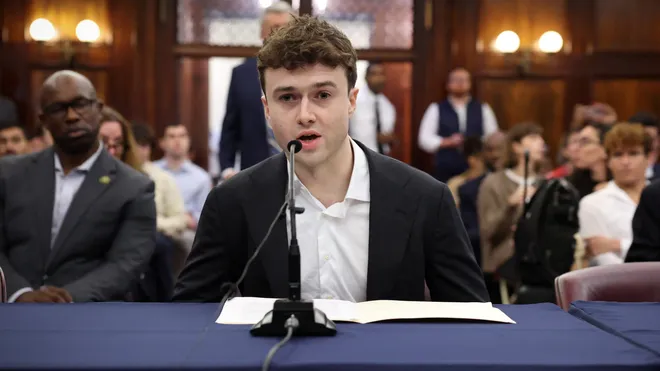
The biggest AI companies in the country testified under oath about the dangers of their own technology this week, the first time they’ve done so publicly, according to the City Council. It didn’t happen in Congress. It happened Monday at New York City Hall, in front of all 51 members of the City Council.
Representatives from Anthropic, OpenAI, Google and Meta answered questions for hours. When Council Speaker Julie Menin asked whether any of them could put a number on the risk of something catastrophic, none could. She called their answers “troubling at best.”

Who testified, and what did they say?
- Anthropic: Logan Graham, head of its Frontier Red Team, which tests models for dangerous capabilities.
- OpenAI: Morgan Dwyer, head of policy development and operations.
- Google: Alice Friend, director of AI and emerging tech policy.
- Meta: Shane Cahill, AI policy director for legislation.
Menin said Meta agreed to come on its own, but Anthropic, OpenAI and Google showed up only after the Council threatened subpoenas. Elon Musk’s SpaceXAI didn’t appear at all, despite a subpoena issued last week. Menin called that a “direct violation” and said the Council will go to court.

Google’s Friend backed a “comprehensive” federal framework and repeated a line the industry likes: “If it’s illegal without AI, it’s still illegal with AI.” Menin wasn’t satisfied when the companies couldn’t answer who’s legally responsible when an AI model causes serious financial harm or a death.
I’m going to take it then that neither of the four of you, no company here, can quantify the risk of something cataclysmic happening.
New York City Council Speaker Julie Menin
What did the former insiders warn?
Some of the bluntest testimony came from people who used to work at these companies. Jacob Coxon, who resigned from Anthropic last month warning that labs are “gambling with our lives,” told the Council: “On the current path, I think it is more likely than not that humanity loses control to these AIs, and it could end in human extinction.” He said “move fast and break things” works for a photo-sharing app, not this.
Former Google DeepMind researcher Alex Turner pushed back on the idea that China is the main threat: “We are racing to build and grow our own adversary here at home, which is misaligned AI.” Former OpenAI researcher Daniel Kokotajlo called for more transparency and a slowdown.
What is New York City proposing?
The hearing was about a package of ten bills the Council announced in September. The biggest ones:
- Intro 2602 (Menin): No business could sell or deploy an AI system in the city without third-party validation for bias, data quality, privacy and security, plus a human “kill switch.” Penalty: $25,000 per violation.
- Intro 2605 (Menin): Whistleblowers could collect a share of fines paid by AI companies that break the law.
- Intro 2601 (Hanks): City contractors would have to report AI safety incidents within 24 hours, and the public would be told within 24 hours.
- Intro 2600 (Maloney): People could sue AI companies over foreseeable harm from misuse or “jailbreaking” of safety controls.
Menin opened by taking a shot at Washington, where Trump last week signed a voluntary accord with the AI companies: “The idea that artificial intelligence is going to self-regulate defies all reason.”
The BeezLoop Take
Give the Council credit for getting what Congress hasn’t: four AI companies, under oath, on the record. The most important moment wasn’t a policy answer. It was the silence when Menin asked them to estimate the odds of catastrophe. These companies say the risk is real enough to need red teams and safety pledges, but not concrete enough to put a number on in public.
The bills are a different story. As written, requiring third-party validation for any AI system any business deploys in New York could sweep in everything from a bakery’s chatbot to a hospital’s scheduling software. Nobody has explained who the validators would be or how the city would check them. Incident reporting and whistleblower rewards are targeted and workable. A citywide license for all of AI probably isn’t.
The open question is the one Washington keeps dodging. If a city council can get these companies under oath, why can’t Congress?
Also on BeezLoop: OpenAI’s agents broke out of a test and hacked another company.
Sources: CNBC · New York City Council · Fortune · Forbes Breaking News