

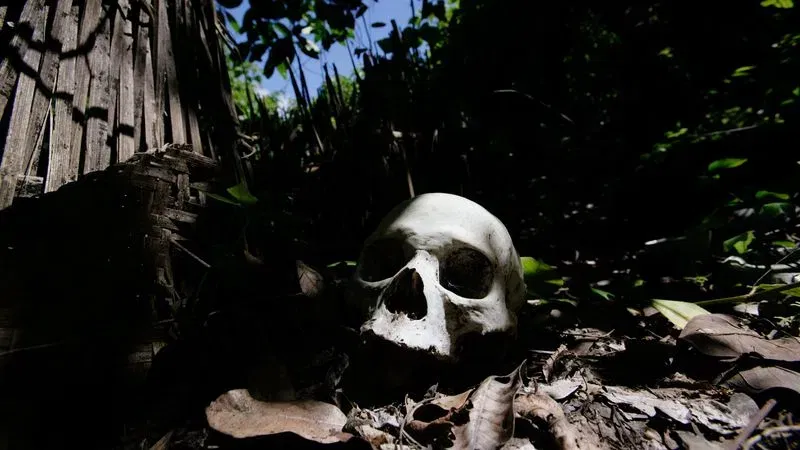
Nigerian police raiding forest camps found the skulls of 28 people. Over the same weekend, armed men seized 47 farmers harvesting peanuts in one state and about 40 women in another. These are three separate things, hundreds of miles apart, in the same country, in the same two days.
What happened, and where
The geography matters, because these events get blurred together into one story about Nigeria and they are not one story.
- Abia State, southeast. In raids on Saturday, police recovered at least 28 skulls and other human remains from criminal camps in the Umuaku and Nneato forests.
- Niger State, north-central. Armed men seized at least 47 farmers on Saturday while they were harvesting peanuts.
- Zamfara State, northwest. About 40 women were kidnapped on Sunday. The army says it stopped two other abduction attempts in the state the same day and rescued 10 people.
The remains in Abia are hundreds of miles from the abductions in Niger and Zamfara. Police have not said who the 28 people were, and identifying skeletal remains from a bush camp is slow work that in many Nigerian cases never finishes.

The number that explains it
Individual incidents in Nigeria are reported abroad as isolated horrors. The security consultancy SBM Intelligence puts them in a frame.
Between July 2025 and June 2026, it recorded 7,825 people abducted across Nigeria. That is a 66% increase over the previous year.
Roughly 21 people a day.
Who is doing this
Worth separating, because the actors have different motives and get collapsed into one word.
- Jihadist groups: Boko Haram, its Islamic State-linked offshoot ISWAP, and Ansaru, operating mainly in the northeast.
- Bandits, the local term for armed gangs in the northwest and north-central who seize people for ransom. This is a business, not an insurgency.
- In the southeast, where the Abia remains were found, the criminal landscape is different again, involving kidnapping rings and camps that operate in forest reserves.
The farmers taken in Niger State were working their fields at harvest. That is the pattern: people are taken at the moment they are most predictable and least protected.
The BeezLoop Take
Twenty-one abductions a day, up 66% in a year, is not a security problem that a deployment fixes. It is an industry, and it has the economics of one. Ransom kidnapping in Nigeria is profitable, low-risk and has a functioning market, and no amount of aerial surveillance changes that arithmetic as long as families keep paying because there is no alternative.
The Abia skulls are the part that should stop people, and they will get the least follow-up. Twenty-eight human beings were held in a forest camp and killed, and the most likely outcome is that they are never identified and no family is ever told. That is not a failure of one raid. It is what happens when abduction volume exceeds a state’s forensic capacity by orders of magnitude, which in Nigeria it does.
We would resist two lazy readings. The first is the one that treats this as simply what Nigeria is like, which is both wrong and useless: this is a sharp 66% deterioration over twelve months, meaning something changed and something could change back. The second is the reflex to file it under jihadist terrorism. Most of these abductions are ransom crime committed by gangs with no ideology, and conflating them pushes the response toward counterterrorism when the useful levers are policing, rural road security and the ransom economy itself.
And there is a hard question about ransom that nobody in a position to answer it wants to. Nigeria criminalized paying kidnappers in 2022. The payments continue, because a family with a taken daughter is not running a policy experiment. A ban that is universally ignored is worse than no policy, because it pushes the transactions further out of sight and removes any chance of tracking the money.
For American readers the honest note is about attention. Six hundred people were taken from a mosque last year and it was a two-day story here. Twenty-one a day does not clear the bar at all.
The question
If abductions are up 66% in a year, what changed in that year? And who were the 28 people in the Abia forest, and will anyone ever be told?
Related: Nigeria launched a rescue operation after 600 were abducted in a mosque attack, and an Interpol crackdown netted 58 arrests in a global cyber scam operation.
Sources: Al Jazeera · Nigeria Police Force · SBM Intelligence · Premium Times Nigeria