

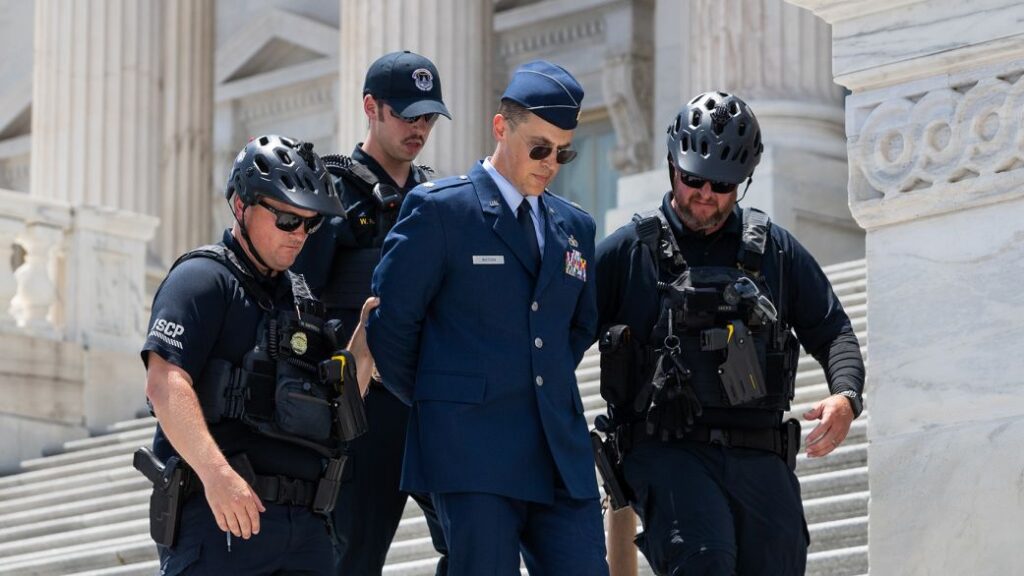
Air Force Maj. Jason Watson has been criminally charged under the Uniform Code of Military Justice after repeatedly calling for President Trump’s impeachment, including three rare violations of Article 88, the provision barring commissioned officers from making “contemptuous” public statements about the president. His attorney says he’s the first major in US military history to face an Article 88 charge.
Watson, a 17-year Air Force veteran, was first arrested by Capitol Police on July 1 after walking partway up the Capitol steps in uniform holding a sign reading “Impeach Convict Remove.” He was speaking at a news conference for Removal Coalition, a grassroots activist group, and argued Trump and Vice President JD Vance should be removed from office over alleged violations of the War Powers Act, the Appointments Clause, and the Fifth and Eighth Amendments.
What Article 88 Actually Prohibits
Article 88 of the Uniform Code of Military Justice bars commissioned officers from using contemptuous words against the president, vice president, Congress, and several other senior civilian officials, a rule meant to preserve civilian control of the military by keeping officers from publicly attacking elected leadership. It’s rarely charged in practice, which is part of why Watson’s attorney describes this case as unprecedented for an officer of his rank.

Why He Was Detained a Second Time
The initial civilian charges from the July 1 Capitol arrest were later dropped, but the Air Force moved separately to examine whether Watson’s public statements violated military rules. After Watson gave a CNN interview on August 17 repeating his criticism of Trump, he was ordered into pretrial confinement on August 18. He now faces three Article 88 violations, five Article 92 violations for allegedly disobeying orders, and two Article 133 violations for alleged conduct unbecoming an officer.
What Happens Next
A court-martial, if it proceeds, would need to weigh Watson’s free speech claims against the military’s argument that his uniformed, public criticism of the commander-in-chief crossed a line Article 88 exists specifically to enforce. Given how rarely this charge is used, especially against an officer of Watson’s rank, the case is likely to be watched closely as a test of how far a service member’s political speech protections extend once uniform and rank are involved.
Related from BeezLoop: Border Security Money Is Paying for Trump’s Ads, The Supreme Court Let the Voter Purge Database Run and Iran Offered to Reopen Hormuz in Seven Days.