
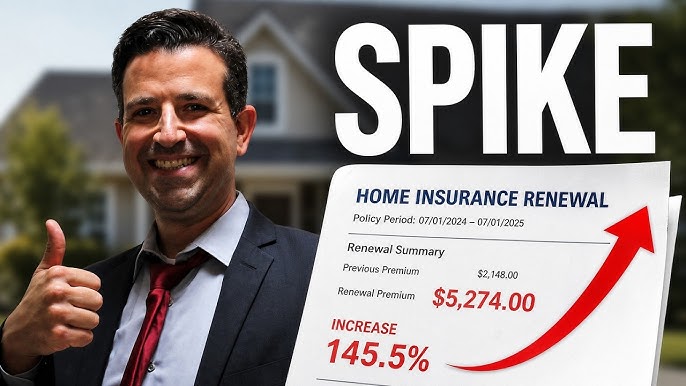
Home insurance premiums have climbed 46% since 2021, three times the pace of inflation. It’s not random. It’s insurers pricing in a risk most homeowners haven’t priced in yet themselves.
If your home insurance renewal came in higher than expected this year, you’re not imagining a pattern, and you’re not alone. The average U.S. home insurance cost has climbed roughly 46% since 2021, about three times faster than inflation over the same stretch, and is projected to hit around $3,057 in 2026. Premiums rose in 95% of U.S. ZIP codes between 2021 and 2024. This is not a coastal problem or a Florida problem. It’s a national one.
What’s actually driving this, beyond “everything costs more now”?
Climate-driven disasters, mostly, layered on top of a genuinely difficult reinsurance market. Hurricanes, wildfires, floods, tornadoes, and severe hail have been causing billions of dollars in residential property damage annually, and insurance companies, along with the reinsurance companies that backstop them, are pricing that risk into every policy, not just the ones in obviously high-risk zip codes. Higher rebuilding costs compound it further: materials and labor to rebuild a damaged home cost meaningfully more than they did five years ago, which raises the payout insurers expect to owe even before you factor in how much more often they’re paying out at all.

Is this actually affecting whether people can buy or sell homes?
Yes, in a very concrete way. Nearly half of recent home buyers and sellers report running into an insurance-related issue during their transaction, and 21% say the deal fell through specifically because of it. In the highest-risk states, this is even more severe. In Louisiana, an estimated 30% to 40% of mortgage loans fail specifically because of insurance costs that make the deal unworkable, not because of the buyer’s credit or the home’s price.
Home insurance premiums rose in 95% of U.S. ZIP codes between 2021 and 2024, making this a national affordability story, not just a coastal one.
, Industry insurance market analysis, 2026
So insurers are just raising prices wherever they want?
Not exactly, and this is the part that should actually worry people more than a higher bill. In the most disaster-exposed areas, insurers aren’t just raising prices, they’re leaving entirely, declining to write new policies or renew existing ones because the risk math no longer works for them at any price a homeowner could reasonably pay. That’s a different and more serious problem than an expensive bill. A high premium is annoying. No available insurance at all can make a home unmortgageable, since most lenders require coverage as a condition of the loan.
Does this actually threaten anything bigger than individual homeowners?
Economists studying the trend think so. Researchers have specifically flagged the collapsing availability of home insurance, and the mortgage lending built on top of it, as a genuine risk to broader financial stability, not just a personal budgeting headache. If insurance keeps becoming unavailable or unaffordable in a growing list of zip codes, home values in those areas eventually have to reflect that reality, whether or not local sellers are ready to accept a lower number.
Is there anything actually reversing this trend anywhere?
A few states are experimenting with policy responses, including proposals that would require fossil fuel companies to help cover climate-driven disaster costs rather than leaving the entire bill to homeowners and insurers, an idea gaining traction in states most exposed to the risk. Whether that kind of policy scales fast enough to change the trajectory nationally is an open question. For now, the more practical reality for most homeowners is that the bill is a signal worth taking seriously, not an inconvenience to just pay and ignore. It’s telling you, in dollars, exactly how exposed your specific home is to a risk that used to feel abstract and now shows up annually in the mail.
Quick Answers
Q. How much have home insurance premiums increased?
A. About 46% since 2021, roughly three times the pace of general inflation, with average costs projected to reach around $3,057 in 2026.
Q. Is the home insurance crisis only affecting coastal or high-risk states?
A. No. Premiums rose in 95% of U.S. ZIP codes between 2021 and 2024, making it a national issue, though high-risk states like Louisiana are seeing the most severe effects.
Q. Is home insurance actually causing real estate deals to fall through?
A. Yes. Nearly half of recent buyers and sellers reported insurance-related issues during a transaction, and 21% said the deal fell through because of it.