

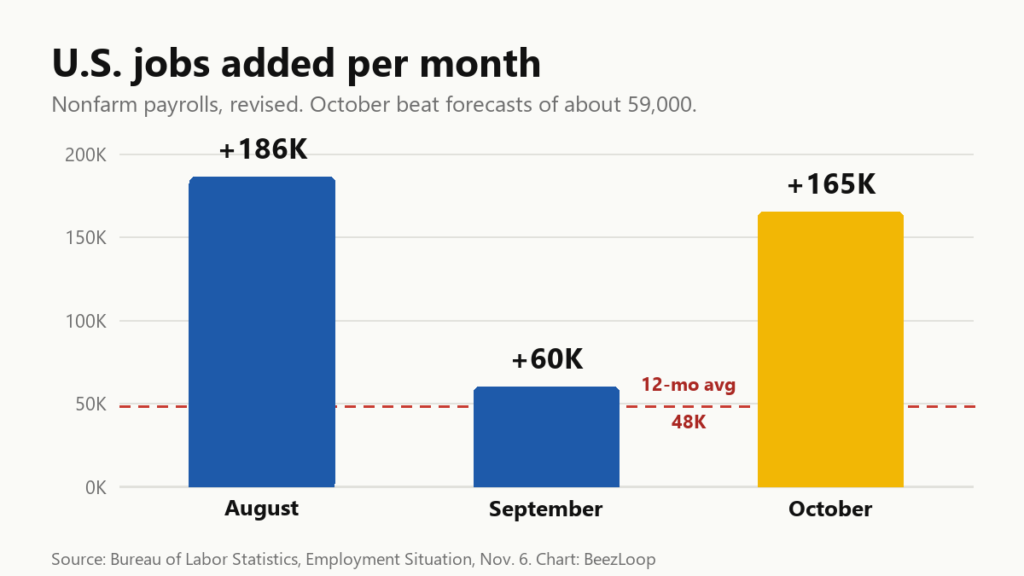
Employers added 165,000 jobs in October, almost three times what economists expected, and the unemployment rate dipped to 4.1% from 4.2%, the Bureau of Labor Statistics reported Friday. Wall Street had penciled in about 59,000. It’s the first big read on the economy since Tuesday’s midterms, and it’s a lot better than the mood voters took to the polls.
The government also revised its earlier numbers up. August now shows 186,000 jobs instead of 133,000, and September 60,000 instead of 29,000. Together that’s 84,000 more jobs than first reported. For context, the economy averaged just 48,000 a month over the prior year.
Where were the new jobs in October?
- Professional and business services: up 70,000, the biggest gain.
- Health care: up 42,000, led by hospitals and home health.
- Transportation and warehousing: up 25,000, mostly couriers and delivery.
- Manufacturing: up 19,000.
- Little change: construction, retail, restaurants and hotels, finance and government.
Pay rose too. Average hourly earnings climbed 14 cents to $38.00, up 3.1% from a year ago. “Today’s jobs report is a strong rebuttal to fears that the economy is heading into a meaningful slowdown,” Seema Shah of Principal Asset Management told CNBC. Heather Long of Navy Federal Credit Union noted that in 2025 the economy “added barely 10,000 jobs a month and basically all were in healthcare.”

Is it easier to find a job now?
For people already working, yes, it looks steadier. For people out of work a long time, not really. The number of long-term unemployed, people jobless for 27 weeks or more, was about 2 million, and CNBC noted it’s the most since December 2021. The average stretch of unemployment hit 27.1 weeks. And the number of people working part-time because they can’t get full-time hours jumped by 339,000 to 4.8 million. A broader jobless rate that counts those workers rose to 7.9%.
What does a strong jobs report mean for my wallet?
It could mean higher borrowing costs. The Federal Reserve is weighing whether to raise interest rates again in December because inflation is still above its 2% target, and traders put the odds of a hike at the Dec. 8-9 meeting at about 77% after the report, according to CME’s FedWatch tool. A hike would push up credit card and auto loan rates and could keep mortgage rates from falling. Stocks, which had their worst week since June in mid-October and sold off hard again Thursday, could swing on that.
Wages rising 3.1% a year is good news, but only if prices rise more slowly. With gas prices up because of the Iran war, a lot of families won’t feel that raise. It’s the same squeeze voters described on Tuesday, when Democrats took both chambers of Congress.
The BeezLoop Take
This is a genuinely good report, and it deserves to be called one. Hiring picked up, the earlier months were better than we thought, and wages are beating last year’s pace.
But a strong headline doesn’t mean everyone’s fine. Two million people have been looking for work for more than six months, and part-time workers who want more hours jumped. If the Fed answers this report with another rate hike, the people who feel it first will be the ones carrying credit card debt.
The open question: does the Fed raise rates in December on the back of this report, and will the next one show the same strength?
Sources: Bureau of Labor Statistics · CNBC · Bloomberg Television (video)